Go to SendWork
— Free for 7 Days
Full access
Full access

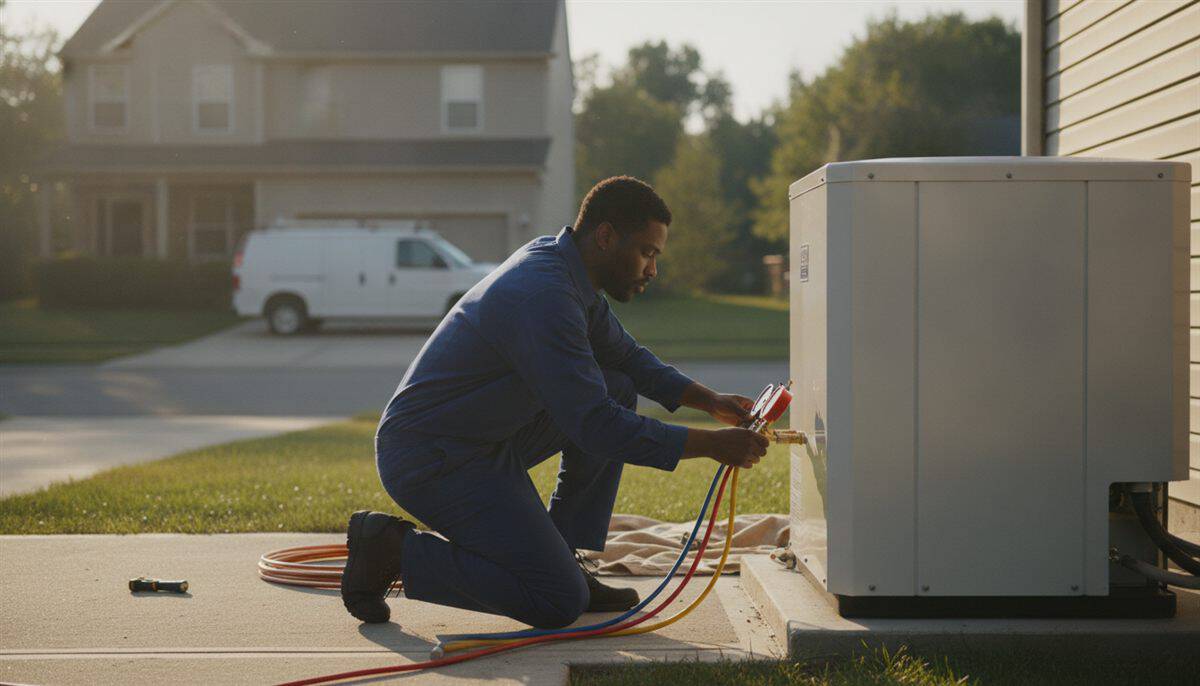
To start an HVAC business you need a 608 card, the right license and insurance. See state fees, the 2026 R-410A rule and pricing.
To start an HVAC business in the US, you need three things before your first paid call: EPA Section 608 certification, a contractor license wherever your state or city requires one, and the insurance or bond your state sets. In the four states covered below, the license usually takes two to four years of documented experience. A relevant degree or military training can shorten that in some states. If you are not there yet, that experience is your real timeline. After that come the business registration, an EIN, a supply-house account and prices built on your own costs.
One rule also changed this year. Since July 27, 2026, EPA lets you install residential and light-commercial R-410A systems with no end date, provided their specified components were made or imported before 2025.

There is no federal contractor license. Each state sets its own rules, and the differences can move your start date by years. Here is what four states ask for, from their own licensing pages as of October 1, 2026.
| State and license | Experience to qualify | State fees | Insurance or bond |
|---|---|---|---|
| Texas (TDLR, air conditioning and refrigeration contractor) | 48 months in the past 72 under a licensed ACR contractor, or 36 months in the past 48 plus 12 months holding a technician certification | $115; the license runs one year | General liability. Class A: $300,000 per occurrence, $600,000 aggregate, $300,000 products and completed operations. Class B: $100,000 / $200,000 / $100,000 |
| California (CSLB, C-20 HVAC) | Four years at journey level or above within the last ten | $450 application, $200 initial license (sole owner), $450 renewal every two years | $25,000 contractor bond; workers’ comp even with no employees |
| Florida (DBPR, air conditioning contractor) | Four years, including at least one year as a foreman, or set combinations of college credit and experience | Check with the board | $100,000 public liability and $25,000 property damage |
| North Carolina (Heating Group 1, 2 or 3) | Two years (4,000 hours) of full-time on-site work; up to half can be academic or technical training | Check with the board | Check with the board |
Sources: TDLR, CSLB, Florida Statutes 489.111 and rule 61G4-15.003, and the North Carolina licensing board.
The insurance figures are the minimums for the license itself. Once you hire, the SBA notes that you must also carry workers’ comp, unemployment insurance and sometimes disability insurance.
The license class also limits the jobs you can bid. A Texas Class B covers cooling systems of 25 tons and under and heating up to 1.5 million BTU per hour, while Class A has no size limit. Florida’s Class B stops at 25 tons of cooling and 500,000 BTU of heating per system. A Florida certified license works statewide; a registered one works only where you hold it. North Carolina’s Heating Group 3 covers ducted comfort systems of 15 tons or less, and all single-family homes regardless of size. In California, refrigeration below 50°F needs a separate C-38 license.
If you are still working for someone else, start collecting proof of your hours now. Texas wants your experience on an Experience Verification Form, filled in by the person who supervised you. TDLR is explicit that you must not complete it yourself. A former supervisor is far easier to reach while you still share a shop.
Some states have no statewide HVAC contractor license and leave it to cities or counties. Start with the License Finder on the Department of Labor’s CareerOneStop site, then confirm with your state board and the local building department that issues permits. Our overview of contractor license requirements by state explains how the tiers work.
Section 608 is the one federal credential, and it applies in every state. EPA requires certification for anyone who maintains, services, repairs or disposes of equipment that could release refrigerant. There are four types: Type I for small appliances, Type II for high-pressure systems, Type III for low-pressure systems, and Universal. You test through an EPA-approved certifying organization, and some offer remote testing. The credential never expires, and the exam is cheap: ACCA charges $32.95 per exam plus shipping through a registered proctor.
The certificate matters to the business as well as the technician. Under EPA’s sales restriction, only 608-certified technicians can buy refrigerant for stationary systems. A company can buy if it shows the wholesaler written evidence that it employs a certified tech. Have that card ready when you open your supply-house account.
It shapes your first hire, too. Apprentices are exempt only while a certified technician closely and continually supervises them. So an uncertified helper should not be sent alone to work on a refrigerant circuit.
New residential and light-commercial air conditioners and heat pumps made or imported since January 1, 2025, must use a refrigerant with a global warming potential (GWP) below 700. The common choices are R-454B (GWP 465) and R-32 (GWP 675). R-410A, at GWP 2,088, is over the limit, and that limit has not changed.
The installation deadline has. Under the earlier rules, systems built from pre-2025 components could be installed only until January 1, 2026. EPA’s reconsideration final rule (91 FR 31284), published May 26, 2026 and effective July 27, 2026, removed that date. A residential or light-commercial AC or heat pump system can now be installed with no end date, as long as all of its specified components were made in or imported into the US before January 1, 2025. So on a replacement call, the question is no longer the calendar but the equipment: ask your supplier when each component was made or imported before you quote it.
Take a hypothetical call: a homeowner’s R-410A condensing unit fails in August, and the quote you write has three honest options. You can replace just the condensing unit, which EPA still allows as a repair of the existing system. You can install a complete system from pre-2025 R-410A stock, if every specified component qualifies. Or you can install a new system on R-454B or R-32. What you cannot do is charge the old R-410A system with R-454B. EPA notes that its rules and industry standards prohibit mildly flammable refrigerants in systems not designed for them. Our guide to installing R-410A equipment you already own covers the paperwork that shows a system qualifies.
For a new shop, A2L refrigerants are now the default. EPA’s rule cites distributor data showing A2L equipment at about 90% of the market by the end of the 2025 cooling season. It also records that R-454B in service cylinders was hard to find in some regions. Check that your recovery machine, leak detector and cylinders are rated for A2L refrigerants, and ask your supplier about R-454B stock before you book installs.
Trading under any name other than your own usually means a DBA. The SBA says most states require you to register one. A sole proprietor working under their legal name does not need to register a business name. LLCs and corporations register with the state.
The IRS issues an EIN online for free, in minutes. You need one if you have employees or operate as a corporation or partnership. The SBA notes that it is used to open a business bank account and apply for licenses. It is worth getting on day one.
On structure, an LLC is a legal form that protects your personal assets in most cases. S corporation status is a tax election made on Form 2553. Our breakdown of LLC vs S-corp for US contractors shows where the difference starts to matter. Bring your accountant into that decision before you set up how you pay yourself.
No official source publishes a reliable total. The fixed fees are on record, and they are small. In Texas, a solo Class B start pays $115 for the license and from $32.95 per 608 exam plus shipping through ACCA. The EIN is free. With one exam, that is about $148 before shipping, the state licensing exam, insurance and tools. In California, the state fees alone are $650 ($450 to apply, $200 for the license), before the bond and workers’ comp premiums. CSLB requires every C-20 contractor to carry workers’ comp “whether or not they have employees”. Get that quote before you price a solo start.
The real money is in the truck, the tools and the premiums. Get written quotes for each one rather than relying on a published average:
Price from your own costs, not from a competitor’s door hanger. Here is the method as a hypothetical worked example, with assumed inputs.
Say you want to replace a wage near the BLS median for HVAC technicians: $29.33 an hour in May 2025. You are paid for 40 hours a week but bill 25 of them. Your overhead for the truck, fuel, insurance, phone, software and marketing is $3,000 a month.
HomeAdvisor’s consumer cost guide lists diagnostic service calls at $75 to $180. That is a range your customer may have seen, not market data. An $89 diagnostic that takes one billable hour clears this break-even by $14.36. Now suppose a slow month cuts your billable time to 20 hours a week. The same wage and overhead then need $93.30 an hour ($58.66 plus $34.64), and that $89 call loses money before you have paid yourself any profit.
The Bureau of Labor Statistics’ Occupational Outlook Handbook (updated August 27, 2026) projects 11% growth in HVAC jobs from 2025 to 2035, and about 40,600 openings a year. It points to commercial construction, including data centers, and residential building as the drivers. The median wage of $61,010 a year is the employee paycheck you would give up, not owner profit. The projected demand is there. Whether going out on your own beats that paycheck depends on your billable hours and break-even price.
One demand driver has gone. The federal 25C credit, up to $2,000 a year for a qualifying heat pump, covered improvements made through December 31, 2025. Don’t build a 2026 sales pitch around it. Our article on the heat pump tax credit ending covers what to change in your quotes.
Commercial work is a different business, run on maintenance agreements rather than one-off service calls. Our guide to building a commercial HVAC business shows how those accounts are won and kept.
Updated October 2026: rewritten with official licensing figures for four states, the July 2026 EPA refrigerant rule, startup fees and a pricing method. The unverified Colorado example was removed.
WHEN 25 HOURS BECOMES 20
In a new HVAC shop, the week’s schedule sets your margin as surely as your price list does.
The worked example showed an $89 call covering its costs at 25 billable hours a week and losing money at 20. SendWork puts every booked job in one schedule you can check from your phone, so a thin week shows up while there is still time to fill it.