Go to SendWork
— Free for 7 Days
Full access
Full access

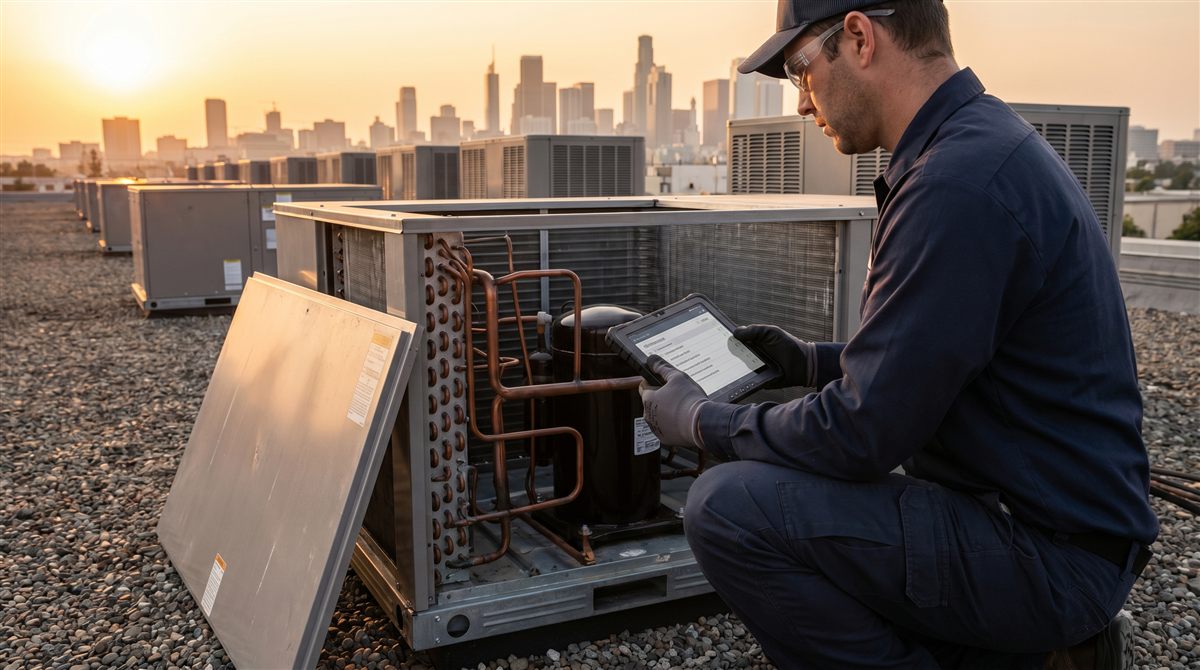
A field-tested HVAC preventive maintenance checklist for commercial operators: what to inspect, document, and flag on every round, by unit type.
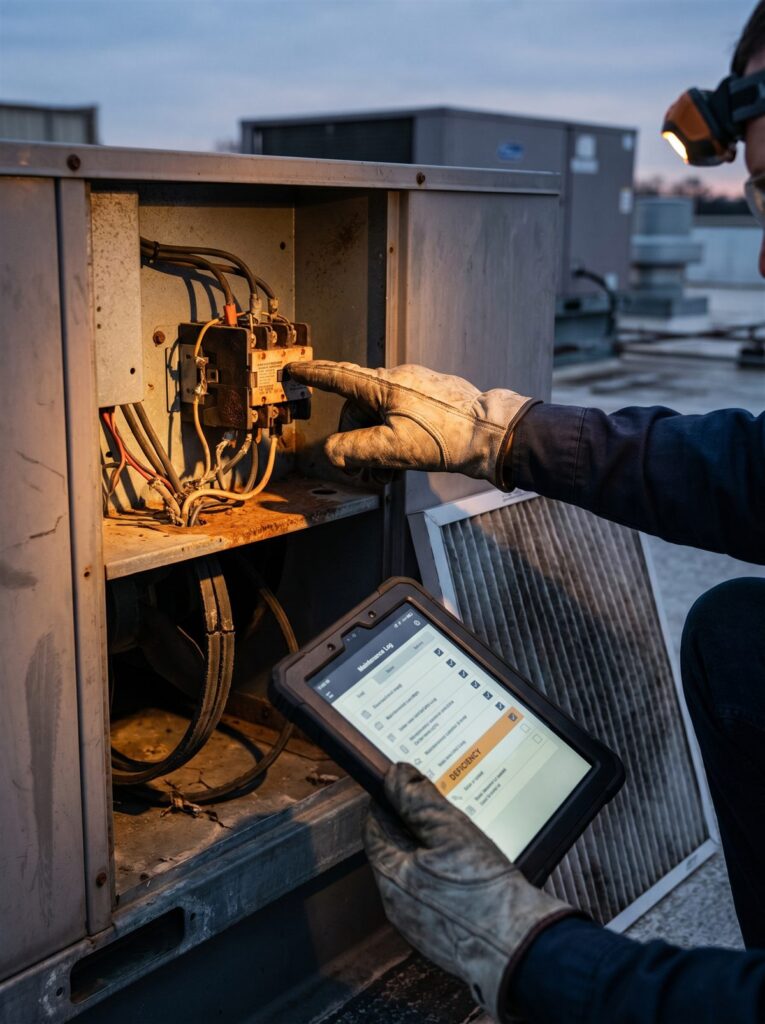
Walk a commercial roof with two different crews and you will see two different businesses. One crew opens a rooftop unit, glances at the filter, spins the fan by hand, and moves on. The other crew runs the same unit against a written HVAC preventive maintenance checklist, photographs a pitted contactor, logs the belt tension, and grades the finding before climbing down. Both invoiced the same visit. Only one built a defensible record.
That gap is the whole game in commercial planned preventive maintenance. A building owner does not pay you to “check the units” — they pay you to keep climate infrastructure running and to prove the work happened. So when a compressor fails in August and the facility director asks what your last round found, an unstructured crew has a vague memory and a paper scrap. A structured crew has a timestamped deficiency log with photos. By the second missed renewal, most operators understand which approach keeps the contract.
Commercial systems are not residential systems at a larger size. A single portfolio might span rooftop packaged units (RTUs), split systems, variable refrigerant flow (VRF) arrays, air handlers, chillers, and cooling towers — and each asset class carries its own failure modes and its own inspection logic. Therefore a generic list applied to every unit is worse than useless, because it trains technicians to tick boxes that do not match the equipment in front of them.
The remedy is to anchor the round to unit type. Industry practice was codified in ASHRAE/ACCA Standard 180, which ties maintenance tasks and frequencies to equipment class rather than to habit or guesswork. In practice, that means your checklist should branch: an RTU round and a chiller round share the same documentation discipline but almost nothing else mechanically. Our view is that this branching is the single biggest quality difference between a crew that looks busy and a crew that is actually protecting assets.
The table below is a working baseline, not a replacement for manufacturer intervals. Adjust frequency for runtime hours, climate, filtration load, and the scope written into the contract.
| Unit type | Core inspection points | Common deficiencies to flag |
|---|---|---|
| Rooftop packaged unit (RTU) | Filters, belts and bearings, economizer dampers, compressor amp draw, condenser coil, drain pan | Restricted filters, glazed belts, seized economizer, high head pressure |
| Split system | Refrigerant charge indicators, coil condition, blower assembly, line-set insulation, controls | Oil staining at fittings, dirty evaporator coil, failed capacitor |
| VRF array | Outdoor unit fans, refrigerant circuit pressures, zone balancing, control communication | Communication faults, uneven zone performance, fan motor noise |
| Air handler (AHU) | Filter bank, coil cleanliness, condensate management, fan alignment, actuator response | Bypass air, microbial growth on coils, stuck actuators |
| Chiller | Refrigerant and oil levels, approach temperatures, tube condition, starter and controls | Rising approach temps, low oil pressure, fouled tubes |
| Cooling tower | Fill media, drift eliminators, basin, water chemistry, fan and gearbox | Scale and biofilm, drift carryover, vibration, low biocide residual |
Regardless of unit type, a core set of steps belongs in every commercial HVAC preventive maintenance round. These are the items that turn a service visit into an asset record, and they are the items auditors and building owners actually ask about.
Severity grading is where most documentation falls apart. A finding without a class forces someone in the office to guess how urgent it is, and guessing is how a failing compressor gets buried under a clogged filter note. Consequently, strong operators standardize the scale and train every technician to apply it the same way.
| Severity | Meaning | Expected response |
|---|---|---|
| Critical | Active failure or safety risk | Immediate action or owner notification |
| Major | Will cause failure if left | Scheduled corrective visit |
| Minor | Degraded but stable | Address at next round |
| Monitor | Trending, not yet actionable | Track readings over time |
FRIGALTO — Climate Systems. Managed Uptime.
For operators running commercial HVAC maintenance portfolios — structured inspections, refrigerant compliance, and uptime reporting across every unit.
A checklist is not paperwork for its own sake; it is the difference between selling visits and selling uptime. The operators who win multi-year portfolio contracts are rarely the cheapest. Instead, they are the ones who can hand a facility director a clean trend line and a graded deficiency history without scrambling. That record is built one disciplined round at a time, and it compounds: a year of structured data turns the next renewal conversation from a negotiation into a formality.
If you are tightening your process this season, start with two changes. First, branch the checklist by unit type so technicians stop applying RTU logic to a chiller. Second, make severity grading mandatory before anyone leaves the site. Those two habits alone will lift the quality of your documentation against recognized standards like ASHRAE/ACCA Standard 180 and make every later report easier to defend. For more commercial HVAC operator coverage, see our ongoing HVAC maintenance resources.
The best contractors aren’t just skilled. They’re organized.
One system for scheduling rounds, capturing job records, and invoicing the moment work closes — so your maintenance data and your back office stay in sync without the late-night catch-up.