Go to SendWork
— Free for 7 Days
Full access
Full access

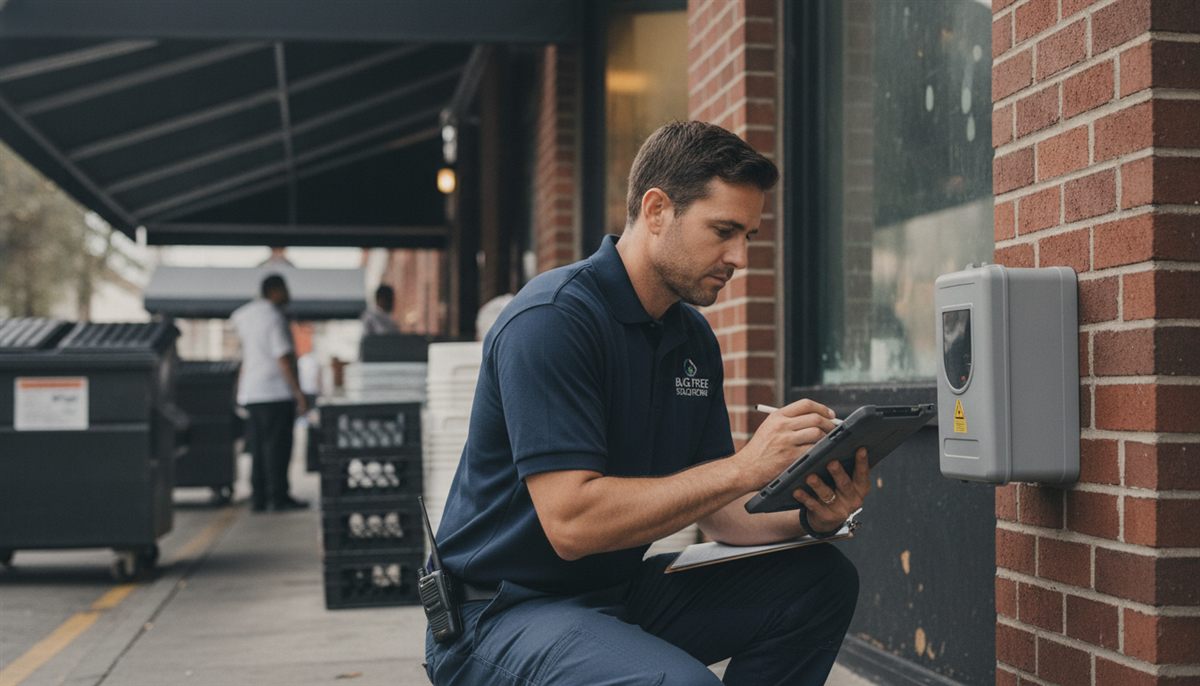
Commercial clients aren't just buying pest control — they're buying proof. Here's the pest control documentation auditors expect, and how stronger operators capture it.
Walk into any commercial account that has just fired its pest control vendor, and you will usually find the same story. The technician showed up, the bugs mostly went away, and nobody can produce a single record of what was applied, where, or when. Then a health inspector asks for the logbook, the account manager has nothing to hand over, and the contract is suddenly up for grabs. In commercial work, pest control documentation is no longer back-office busywork — it is the thing that wins accounts and the thing that loses them.
This is a real shift in how the better accounts buy. A restaurant group, a warehouse, or a healthcare facility is not just paying you to kill pests; they are paying you to prove, on demand, that the site is under control. Consequently, the operator who shows up with clean, organized records is competing on a completely different level than the one who shows up with a clipboard and a memory.
So the consequence lands fast. If your records cannot survive an audit, your contract probably cannot either.
Commercial buyers live under their own regulators. A food-service operator answers to health inspectors, an audit scheme, and often a corporate compliance team. Therefore, when they choose a pest control partner, they are really choosing whether their next inspection goes smoothly or turns into a scramble. Strong records make you part of the solution; weak records make you part of the risk.
There is also a trust dimension that pays off over years. When an account manager can pull up a clear history of every visit, every device check, and every treatment, they stop worrying about you. As a result, you become the vendor they renew without shopping around, because switching would mean starting that paper trail over from zero with someone unproven.
Documentation also protects you when something goes wrong. If a pest issue flares up and a client claims you missed it, your records are the difference between a defensible service history and a he-said-she-said you will probably lose.
Good pest control documentation is not about volume. Instead, it is about capturing the right things consistently, in a form someone else can read months later. Most commercial schemes and inspectors look for the same core records, summarized below.
| Record type | What it captures | Why it matters |
|---|---|---|
| Service report | Date, technician, areas serviced, findings | Proves the visit happened and what was done |
| Device/station map | Location and ID of every trap and station | Shows full-site coverage, not spot checks |
| Monitoring log | Activity found at each device over time | Reveals trends before they become infestations |
| Product records | Material used, amount, location, label info | Required for safety and regulatory review |
| Corrective actions | Recommendations and follow-up status | Demonstrates the issue was actually closed out |
| Safety data sheets | SDS for every product on site | First thing many inspectors ask to see |
Here is the field reality. An inspector rarely watches you work — they read your paperwork. If the device map is current, the monitoring log shows a clear trend, and every product is backed by an SDS, the inspection is short and your client looks good. If any of that is missing, the inspector digs deeper, and your client remembers exactly whose records came up short.
PESVARO — Precision Protection. Documented Proof.
For pest management professionals who need documented proof — inspection records, treatment protocols, and compliance reporting that hold up to audit.
The operators who win commercial accounts treat documentation as part of the service visit, not as paperwork they catch up on later. They capture findings on site, in the moment, while standing at the device. Because the record is created where the work happens, it is accurate, it is complete, and it is never reconstructed from memory three days later in a truck.
Consider a mid-sized firm that moved from paper service tickets to capturing everything digitally at each stop — device readings, photos, and corrective notes logged before leaving the site. When a major food-service client went through a surprise audit, the firm produced a full twelve-month history in minutes. They kept the account, and they used that audit performance to win two more locations in the same group. The pest work was ordinary. The documentation was the differentiator.
A system only helps if technicians actually use it under time pressure. Keep it simple enough to complete on site, standardize it across every account, and make the records easy to retrieve when a client calls. The checklist below covers the essentials.
If you want to move upmarket into commercial accounts, your pest control documentation has to be ready before the audit, not assembled during it. Start by standardizing one clean service report and a current device map for every commercial site. Then make capturing records on site a non-negotiable part of every visit, the same way safety gear is.
The payoff is real: better records mean smoother audits, stickier contracts, and a defensible history when something is disputed. For broader operator guidance in this trade, our pest control resources are a useful next stop, and the EPA’s guidance on integrated pest management principles is a solid, neutral reference for the standards commercial clients increasingly expect.
One system for jobs, history, and the paperwork that wins audits.
SendWork’s AI assistant keeps every visit, note, and client record in one place — so when an account asks for a year of service history, it is already there.