Go to SendWork
— Free for 7 Days
Full access
Full access

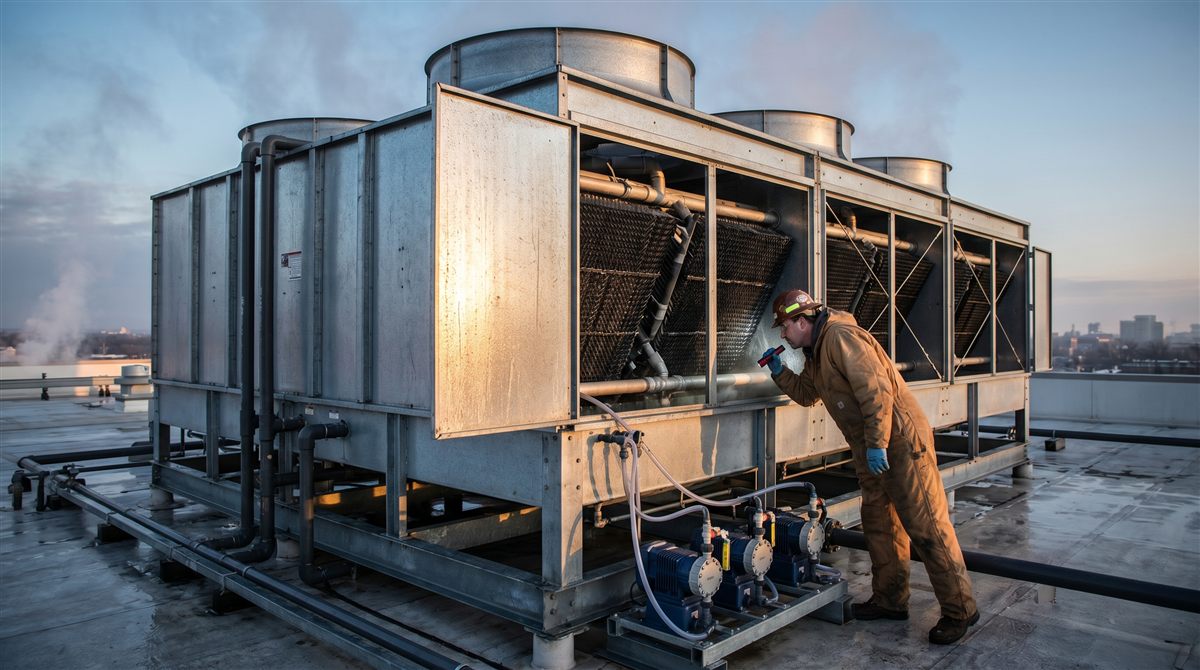
Cooling tower maintenance done right: water chemistry, fill media, drift eliminators, and the Legionella water management plan that protects tenants.
Of every water system in a commercial building, the cooling tower is the one most capable of putting someone in the hospital. Warm recirculating water, nutrient-rich biofilm on the fill media, and a fan that turns contaminated droplets into a breathable aerosol — that combination makes a neglected tower the textbook amplifier for Legionella. So cooling tower maintenance is not just an efficiency exercise; it is a public-health responsibility with real legal weight behind it.
For operators, the consequence is direct. A tower that is poorly maintained does not just waste energy and scale up its tubes — it exposes the building owner, and by extension your company, to outbreak liability, mandatory shutdowns, and litigation that has ended businesses. By the time a health department is involved, the question is no longer “is the water clean?” but “can you prove it has been managed?” That distinction is where strong operators separate themselves.
A cooling tower rejects heat by evaporating water, and everything that makes it effective at that job also makes it hospitable to bacteria and prone to scale, corrosion, and fouling. Therefore good maintenance works on several fronts at once: water chemistry, mechanical condition, and documentation. Neglect any one and the others suffer.
Water chemistry is the front line. Biocide programs, scale and corrosion inhibitors, and controlled blowdown keep the water within a range that resists both bacterial growth and mineral buildup. Mechanically, the fill media, drift eliminators, basin, and fan assembly all degrade over time, and each failure mode has a consequence: clogged fill reduces heat rejection, failed drift eliminators let aerosols escape, a fouled basin becomes a bacterial reservoir. Meanwhile, the documentation layer ties it together, because a water management program is only credible if the records show it was actually followed.
The table below is a working baseline. Tighten the frequencies for towers in warm climates, high-occupancy buildings, or facilities subject to stricter local rules.
| Frequency | Tasks |
|---|---|
| Weekly | Water chemistry check (pH, conductivity, biocide residual), visual inspection for biofilm and debris, confirm dosing equipment operation |
| Monthly | Inspect fill media and drift eliminators, check fan and motor operation, review treatment logs, verify bleed/blowdown |
| Quarterly | Microbiological testing as defined in the water management plan, basin cleaning as indicated, belt and bearing service |
| Annual / shoulder season | Full drain and disinfection, deep clean of basin and fill, gearbox service, structural and electrical inspection |
Recognized practice for building water systems is set out in ASHRAE Standard 188, which calls for a written water management program built around identifying hazards, setting control limits, monitoring, and defining what happens when a reading goes out of range. In practice, that document is what an inspector, an insurer, or a litigator will ask for first. A strong program names the control points, states the action thresholds, and — critically — specifies who does what when a result exceeds the limit, before that result ever lands.
Consequently, the maintenance round and the program are not separate things. Every chemistry reading, every basin cleaning, and every microbiological test result should feed the program record, so the building’s defense is built continuously rather than assembled in a panic after a positive sample.
Regardless of the deeper seasonal work, certain steps belong in every cooling tower maintenance visit. They are quick, and they are exactly the items that prevent a slow drift into a dangerous condition.
Here is the field reality that should worry any operator. A tower runs all summer with a dosing pump that quietly failed in June. The water chemistry looks fine on the controller readout, but no one verified the pump, biocide residual fell to nothing, and biofilm took hold across the fill. A routine quarterly test comes back positive, the health department gets involved, and now the building faces a remediation order and a very uncomfortable question about why the logs show “dosing OK” for three months. The chemistry was assumed. It was never confirmed.
Worth noting, too, is how uneven the rules have become from one jurisdiction to the next. Several states and cities now require cooling tower registration, routine testing, and reporting that go beyond the baseline standard, and an insurer may layer its own conditions on top of that. Consequently, an operator working across municipal lines cannot assume one program satisfies every building; the prudent move is to build to the strictest requirement you face and document to that level everywhere, so a tower never falls short simply because it sat on the wrong side of a county line.
Treat the cooling tower as the highest-risk asset in your portfolio, because it is. First, make sure every tower you service sits under a written water management program with named control limits and a documented response plan. Then build your round so chemistry is confirmed, not assumed, and so the dosing equipment is verified rather than trusted. Finally, keep the records continuous, because the difference between a defensible position and a catastrophic one is almost always documentation.
For authoritative guidance, the CDC’s Legionella resources and ASHRAE Standard 188 are the references most water management programs are built on, and for more commercial HVAC maintenance coverage, see our HVAC maintenance resources. Relevant website for operators specializing in this work: frigalto.com.
When someone asks for proof, “we did it” isn’t an answer.
SendWork keeps every visit, reading, and invoice attached to the job and the client — so the service history behind your water management records is always retrievable, not scattered across trucks and texts.