Go to SendWork
— Free for 7 Days
Full access
Full access

The job ended at 5:40. The invoice went out at 10:20 that night, from a laptop at the kitchen table, buried in a chain of three other quotes you owed people. The check arrived eighteen days later — two days after you had already paid for next week’s parts on your personal card. That gap between finishing the work and getting paid is where a profitable week quietly turns into a cash-flow problem, and fixing it is what a real plumbing invoicing system is for.
Most operators treat invoicing as the chore that happens after the real work. In a healthy business it is part of the job, not the cleanup afterward. The plumbers who never sweat payroll are not necessarily charging more — they have closed the gap between the handshake and the deposit. Here is how to build plumbing invoicing that gets you paid in days, not weeks, without spending your evenings on paperwork.
A slow invoice is not just an annoyance; it is an interest-free loan you are handing the customer without meaning to. Every day a bill sits unsent or unpaid is a day you are financing the customer’s repair out of your own pocket. On residential service work, thirty-five days from job completion to payment is a warning sign, not a baseline. Stretch that across forty jobs a month and you are carrying thousands of dollars of other people’s repairs on your personal credit.
The damage compounds quietly. When cash is always a few weeks behind the work, you cannot stock parts ahead, you hesitate to hire, and you take jobs you should decline just to keep money moving. Consequently, slow payment does not only cost interest — it shrinks the decisions you are free to make. Faster plumbing invoicing widens them back out.
The number to watch: days-to-payment
Track the average days between job completion and money in the account. As a rough read for residential service work:
The fix is not working harder at night. It is moving the invoice to the moment of completion, while you are still on site and the work is fresh in everyone’s mind. A tight loop looks like five steps, and most of them take seconds once the system is set up.
The difference between this loop and the kitchen-table version is not effort — it is timing. An invoice handed over at the moment of a satisfied handshake gets paid far faster than one that lands in an inbox three nights later, after the relief of the fixed leak has worn off.
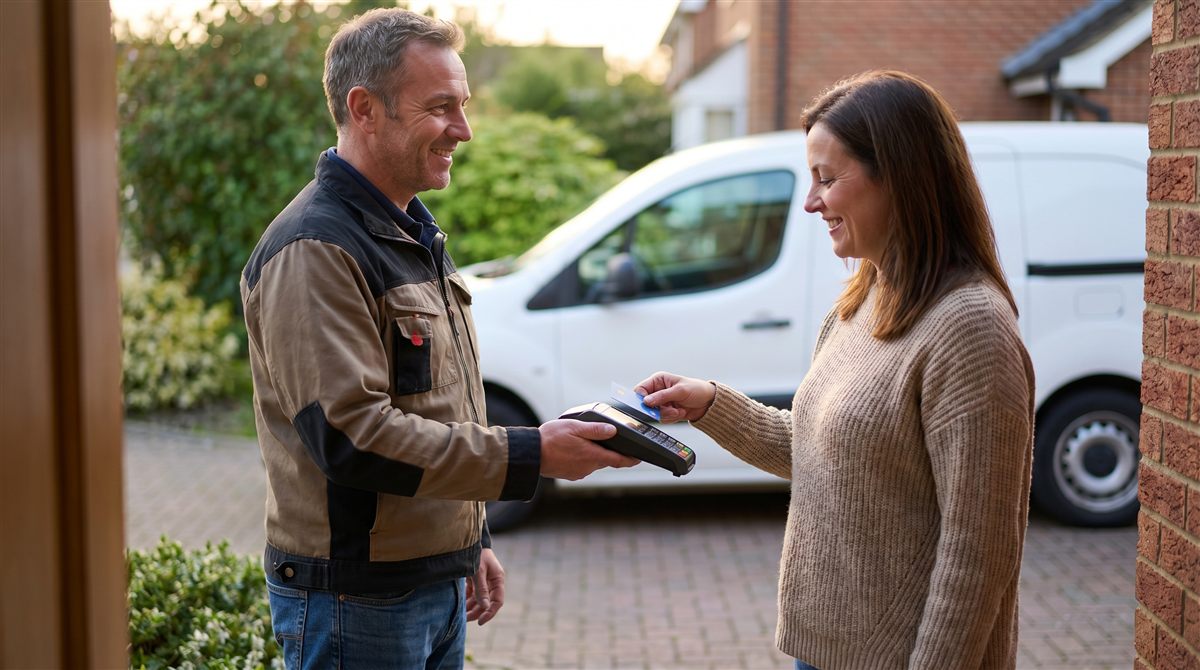
The single biggest lever in plumbing invoicing is removing the delay between the bill and the payment method. “Do you take a check?” is a polite way of saying “you will wait.” A card on file, a saved payment method on a maintenance customer, or a one-tap pay link closes that gap on the spot. You are not being pushy by asking for payment when the work is done — you are running a business, and the customer expected to pay anyway.
Even with a tight loop, a few invoices will go unpaid — a commercial client on net-30, a homeowner who meant to pay and forgot. The mistake is letting those sit out of discomfort. A polite, automatic reminder a few days after the due date does most of the work, and it does not feel like nagging because it is the system writing, not you. For the rare account that ignores three reminders, a brief phone call referencing the signed estimate and the dated invoice usually settles it, because the documentation leaves no room for dispute. The operators who get burned are not the ones who chase too hard; they are the ones who never followed up at all and then wrote the balance off months later. Plumbing invoicing is not finished when the bill goes out — it is finished when the money lands.
Systems beat willpower. If invoicing depends on you remembering to do it at night, it will always slip; if it is built into closing out the job, it happens whether you feel like it or not. The goal is to make the fast path the lazy path — the easiest thing to do is also the thing that gets you paid. When the invoice is a thirty-second step on site instead of an hour-long chore at home, the whole cash cycle tightens on its own.
Getting paid quickly is one piece of running a business that compounds instead of just staying busy. For the full picture, see the guide to building a plumbing business that is profitable, not just busy, and for the market context behind your pricing and payment terms, the regional plumbing market insights are a useful reference point.
Close the gap between the work and the deposit
The invoice should leave before you leave the job site.
Quote-to-invoice in one flow, from your phone, with payment and automatic reminders — so the money moves the day the job closes, not three nights later.
External reference: SCORE — free small-business mentoring and cash-flow resources for U.S. service businesses.