Go to SendWork
— Free for 7 Days
Full access
Full access

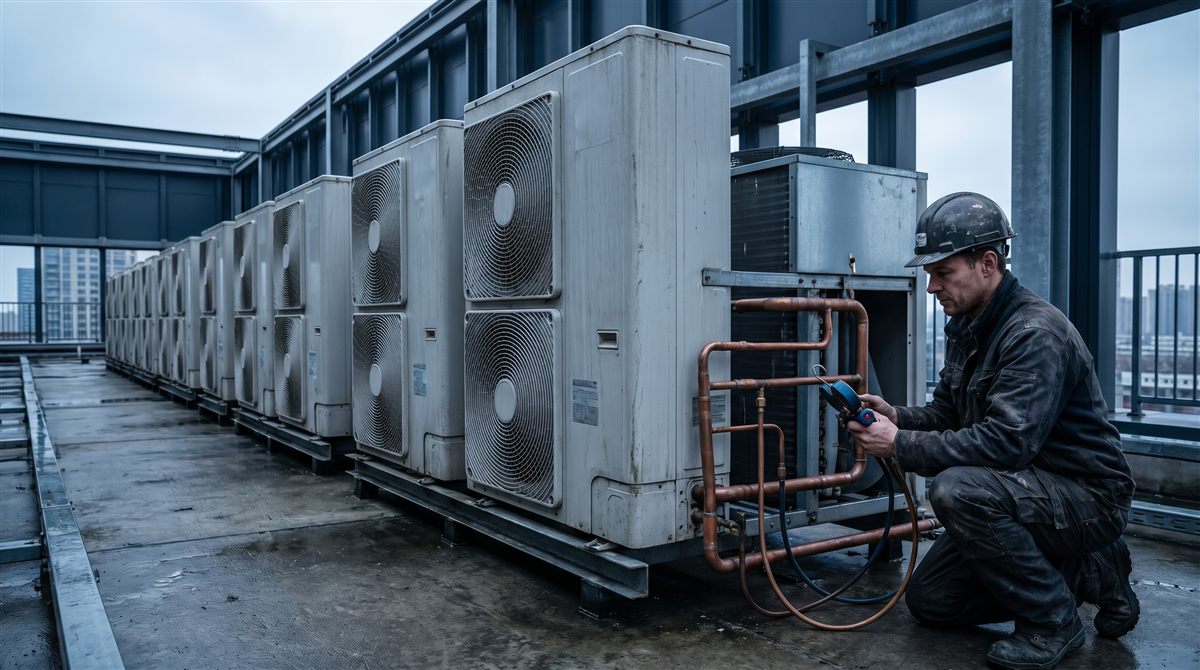
VRF system maintenance for commercial buildings: how to inspect the refrigerant circuit, controls, and zone balancing as one connected network.
A tenant on the fourth floor says their zone never gets cold enough. The crew swaps a thermostat, the complaint comes back, and three visits later someone finally checks the refrigerant circuit and the controls and finds the real culprit. That sequence is the most expensive way to run a building, and it is exactly what weak VRF system maintenance produces: chasing symptoms across zones instead of inspecting the system as one connected network.
Variable refrigerant flow systems reward operators who understand that distinction and punish those who treat them like a row of independent splits. Because a single outdoor array can feed dozens of indoor units through one refrigerant network, a small fault — a drifting charge, a failing sensor, a communication dropout — can surface as a comfort complaint two floors away. Get the maintenance logic wrong and you burn margin on repeat truck rolls; get it right and you hold uptime across the whole building with fewer visits.
The defining feature of VRF is shared refrigerant flow controlled electronically across many zones. As a result, the system behaves as an integrated whole, and that changes what a maintenance round has to accomplish. On a packaged rooftop unit you inspect a self-contained machine; on a VRF array you are inspecting a network where the outdoor units, the refrigerant circuit, the indoor heads, and the controls all depend on one another.
Consequently, three things matter more than they do on conventional equipment. First, refrigerant charge accuracy, because VRF systems are sensitive to even modest deviations and a slightly low charge can quietly degrade performance long before it throws a fault. Second, communication integrity between controllers and units, since a dropped signal can strand a zone. Third, zone balancing, because uneven demand across the building stresses the system in ways a single-zone unit never experiences. Our view is that operators who build their VRF round around those three pillars cut callbacks dramatically.
The table below organizes a commercial VRF round by subsystem. Treat it as a baseline and tighten frequencies for high-runtime buildings, dusty environments, or systems carrying critical loads.
| Subsystem | Inspection focus | Suggested frequency |
|---|---|---|
| Outdoor unit array | Fan motors, coil cleanliness, debris clearance, sound and vibration, electrical connections | Quarterly |
| Refrigerant circuit | Operating pressures, subcooling/superheat, charge verification, leak check at joints | Quarterly to semi-annual |
| Indoor units / zones | Filters, coil condition, condensate drainage, airflow, sensor accuracy | Quarterly |
| Controls & communication | Controller firmware, network/communication integrity, schedules, fault history review | Semi-annual |
| Branch controllers / distribution | Valve operation, connection integrity, insulation condition | Annual |
Beyond the subsystem table, a disciplined technician follows a consistent sequence so that nothing on the network gets skipped. The following checklist keeps the round repeatable across different buildings and crews.
FRIGALTO — Climate Systems. Managed Uptime.
For operators running commercial HVAC maintenance portfolios — structured inspections, refrigerant compliance, and uptime reporting across every unit.
Picture that fourth-floor zone again. The reading shows the indoor unit is fine, but the refrigerant subcooling is off and a branch controller has logged intermittent communication faults. In other words, the comfort complaint was a downstream symptom of two upstream issues. A technician who only reacts to the thermostat fixes nothing; a technician running a structured VRF round catches the charge deviation and the comms fault in a single visit. That is the entire economic argument for proper VRF system maintenance — one informed round beats three reactive ones.
The price of skipping structured rounds rarely shows up as a single dramatic failure. Instead, it accumulates. A charge that drifts five percent low does not trip an alarm; it simply raises energy use and shortens compressor life while the building owner pays for both. Likewise, a branch controller with intermittent communication faults may only strand a zone during peak demand, which is precisely when a tenant complaint becomes a lease conversation. Over twelve months, those small, invisible deviations add up to higher run costs, premature component wear, and a string of reactive truck rolls that erode the margin on the contract.
Therefore the economic case for disciplined VRF maintenance is not really about the equipment at all — it is about predictability. When you trend charge, communication health, and zone balance across the year, problems surface as line items on a report you can act on during a scheduled visit, rather than as emergencies you absorb at the worst possible moment.
VRF is a network, so maintain it like one. The operators who keep these systems healthy do not wait for complaints; instead, they run scheduled rounds that verify the refrigerant circuit, confirm communication, and check zone balance before tenants notice anything. Meanwhile, they capture readings consistently enough that a slow charge loss shows up as a trend rather than a surprise failure in peak season.
If you manage VRF across a portfolio, standardize the round so every technician inspects the network the same way and logs the same readings. For broader technical context, recognized commercial maintenance practice is documented by ASHRAE, and for more VRF and commercial HVAC coverage, see our HVAC maintenance resources.
A full calendar next week starts with the round you log today.
SendWork keeps recurring rounds, job records, and invoicing in one place — so scheduled maintenance actually gets scheduled, and nothing slips between visits.