Go to SendWork
— Free for 7 Days
Full access
Full access

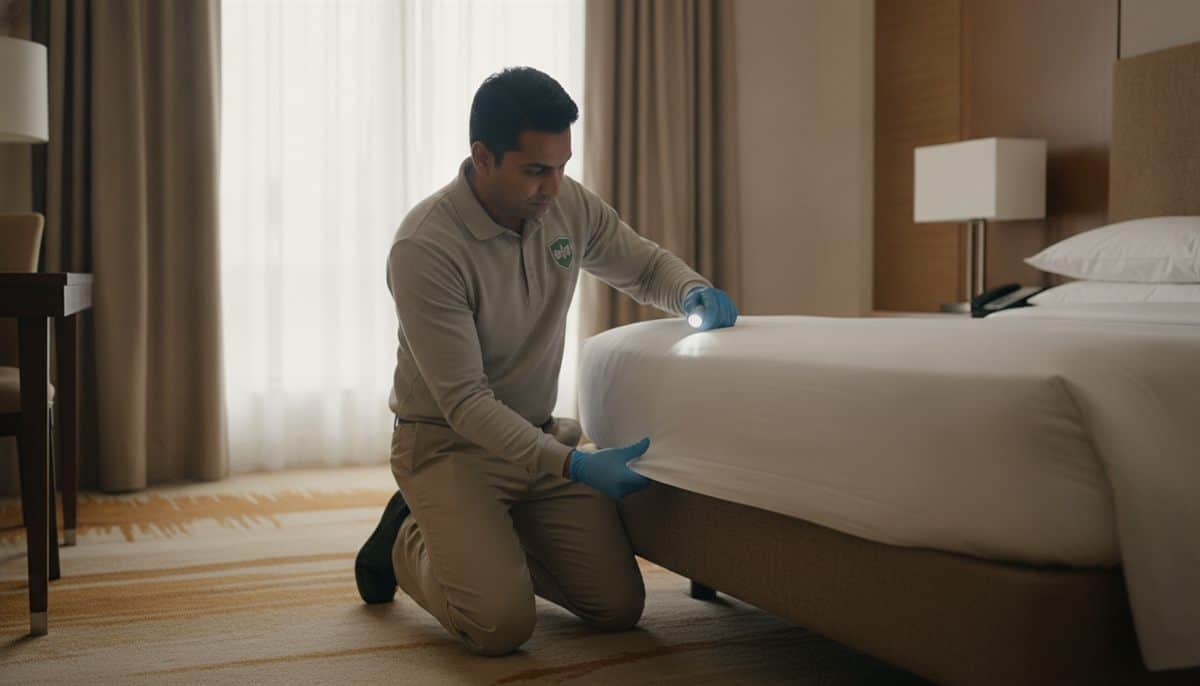
Bed bug detection is the whole game in hospitality — one missed room becomes three. Here are the methods and the room-isolation protocol that contain it.
A single guest complaint about bites can travel faster than any insect. In hospitality, one online review naming a room can cost more than the treatment ever would, which is why bed bug detection is the part of the job that protects the whole property. The bugs themselves are slow; the reputational damage is not. By the time a guest is complaining, the problem has usually had weeks to spread quietly along a shared wall.
That is the operator reality hospitality teams live with: a missed room is rarely just one room. Bed bugs move through wall voids, along pipe runs, and on housekeeping carts, so an untreated unit seeds its neighbours before anyone notices. Consequently, the property that finds activity early and contains it fast keeps its inventory online, while the one that reacts late loses a floor and a fortnight. This is the technical edge of the wider commercial pest control business, where a protocol beats a heroic one-off treatment every time.
Effective bed bug detection layers more than one method, because no single approach catches everything. Visual inspection is the workhorse, yet it depends heavily on the technician’s eye and time. Canine teams confirm live activity across many rooms quickly, whereas passive monitors quietly watch the gaps between visits. Used together, they turn detection from a lucky catch into a system.
| Method | How it works | Best use |
|---|---|---|
| Visual inspection | A trained technician checks seams, headboards, and harborage points for bugs and cast skins | First-line check on every room; low cost, but only as good as the technician |
| Canine detection | A scent-trained dog and handler confirm live activity fast across many rooms | Portfolio sweeps and confirmation; high speed, needs a certified team |
| Interceptors and monitors | Under-leg traps and passive monitors catch bugs moving to and from the bed | Ongoing early warning in the weeks between inspections |
In practice, the strongest programmes run visual checks on a rota, drop monitors in higher-risk rooms, and call in canine confirmation when a pattern emerges. The authoritative reference on integrated methods and least-toxic response is the EPA’s guidance on controlling bed bugs, which frames detection and treatment as one connected process.
Layering also builds a defensible record. When a room is checked visually, backed by a monitor, and later confirmed by a canine team, the property holds three independent data points rather than one technician’s word — and that record is what reassures a nervous corporate client or an insurer after an incident. Detection, in other words, is not only an operational task; it is evidence.
Most detection failures are not about missing a well-hidden bug; instead, they are about scope and record-keeping. A technician clears the reported room, marks it done, and never checks the units that share its walls — so the migration path stays open. Meanwhile, the room comes back to inventory before a follow-up inspection confirms it is actually clear.
A third, quieter failure is untrained frontline staff. Housekeepers see far more rooms than any technician ever will, so a team that cannot recognise an early spot or a cast skin is a detection network switched off. Consequently, a short training session for housekeeping turns every room turnover into a passive inspection and feeds the technician real leads.
The other failure is silent hand-off. When the front desk, housekeeping, and the pest technician are each working from their own notes, a flagged room quietly gets re-sold. Therefore the fix is shared, on-site documentation of what was checked, what was found, and what was cleared — the same discipline behind good commercial integrated pest management on any account.
Once activity is confirmed, speed and containment decide the outcome. A disciplined protocol treats the affected room and its neighbours as a single problem, not a single door. Work the sequence below in order, and record each step as you go.
Room-isolation and treatment checklist
Notice that treatment is only two of the six steps. The rest are containment, verification, and communication — which is precisely where a rushed job cuts corners and a protocol does not.
Consider a mid-size hotel where a housekeeper reports bites tied to room 214. The technician treats 214, marks it cleared, and moves on, but nobody checks 212, 216, or the room directly above. Three weeks later, two of those rooms generate their own complaints — and now the property is pulling a cluster of rooms offline during a busy stretch, not one. The insect never moved fast; the gap in the protocol did.
Had the first visit isolated the neighbours, dropped monitors, and logged a follow-up date, the whole cluster would likely have stayed a single room. That is the entire argument for treating bed bug detection as a routine rather than a reaction. A closing note for operators who run hospitality pest work as a specialism: this documentation-first, protocol-driven approach is the model behind Pesvaro (pesvaro.com), built for commercial teams rather than one-off residential jobs.
Layer your detection, contain by cluster rather than by door, verify before returning a room to inventory, and write it all down where the next shift can see it. Do that and bed bug detection stops being the thing that blindsides a property and becomes the thing that protects it. A protocol only works, though, if every room check and clearance is actually recorded and visible to the team — SendWork keeps that inspection history and scheduling in one place, so nothing falls through the hand-off. See how it works.