Go to SendWork
— Free for 7 Days
Full access
Full access


A commercial pest control business runs on IPM programs and audit-ready records. See the playbook that wins accounts and keeps them.
The call came in on a Monday, and it cost a commercial pest control business a restaurant group it had serviced for four years. Eleven locations, monthly visits, not a single missed appointment. The reason the operator lost the account was not price, and it was not a pest sighting. A district manager had a surprise audit scheduled and asked for twelve months of service records across all eleven sites. What came back was a shrug and a promise to “pull them together.” A competitor had already emailed the same manager a sample audit package — device maps, trend charts, corrective-action logs — for one of the buildings. By Friday the contract had moved.
A commercial pest control business survives on three things that spray-and-go operators never build: structured prevention programmes, audit-ready documentation, and species-specific expertise the account actually needs. The operator above had the routes and the relationships. However, he did not have the system — and in commercial work, the system is what gets renewed. Lose the system and you lose the account, no matter how clean the site looks on the day.
That is the consequence this playbook is built around: commercial accounts are not won by killing bugs. They are won by proving control. What follows is the business layer that sits above the fieldwork. That means how to package it, what it earns, who actually signs it, and what documentation has to stand behind it.
Reactive callouts feel like a healthy business. The phone rings, someone spotted a mouse, you roll a truck, you invoice. Yet a commercial pest control business that lives on callouts carries three structural problems it cannot out-hustle.
First, the revenue is unpredictable. A quiet winter empties the schedule; a warm, wet spring floods it. You staff for the surge and then absorb the lull. Second, the client has no reason to stay loyal, because whoever responds fastest wins the next callout. And there is always someone hungrier this month. Third, and least visible: reactive work builds nothing you can sell. After five years of callouts you have a stack of invoices. After five years of prevention programmes you have an asset. That asset is a contracted revenue base and a documented service history a buyer, a lender, or an auditor can actually value.
Picture the Monday after a long weekend. Three callouts stack up before nine — a bakery with a fly problem, a warehouse with droppings on a pallet, a café that failed a spot check. You clear all three by evening, bill well, and feel productive. None of those visits, though, produced a record anyone will trust in six months. None gave those sites a reason to keep you past the crisis. By the next quiet week the phone is silent again. That treadmill is exactly what a prevention programme is designed to end. Facility and food-safety managers already know reactive control is the expensive version. Consequently, when you sell only callouts, you are selling the version of yourself they trust least.
Moving from callouts to programmes is the single biggest shift available to a commercial operator. It is a packaging problem more than a technical one. In integrated pest management (IPM), the service you sell is not the treatment. It is the monitoring, the thresholds, the documentation, and the promise that the site stays under control between visits. The framing of ongoing management versus one-off control is worth reading in our look at pest control versus pest management. Still, the structure matters here, because the structure is what the buyer compares.
In practice, the programme rests on a device network. That means bait stations, insect monitors, and traps placed and numbered against a site map. You then check them on a fixed rota that runs the same commercial integrated pest management round no matter which technician shows up. That map is not paperwork for its own sake. Rather, it is the thing that turns a scatter of visits into a defensible system. Every device has a location, a history, and an activity trend. The sum of them is the story you tell an auditor. Most commercial programmes then settle into one of three shapes:
| Programme tier | What’s included | Who it fits |
|---|---|---|
| Monitoring-only | Scheduled inspection rounds, device network checks, condition reports; interventions quoted separately | Cost-sensitive sites; your entry point into a facility |
| Programme + intervention | Monitoring plus routine treatment and callbacks within scope; specialist work quoted | Facility managers who want a predictable monthly figure |
| Full IPM coverage | Monitoring, intervention, documentation, and priority response within defined limits | Audit-driven sites — food processing, healthcare, hospitality |
The tier labels matter less than the discipline behind them: defined scope, defined visit frequency, defined exclusions. Vague programmes breed disputes, and disputes are where renewals quietly die.
Run the numbers on a single mid-size account — say, a monthly IPM programme across one distribution warehouse. The programme fee is rarely the whole story. In practice, a structured commercial pest control business earns from one contract in four layers. First comes the recurring fee, then the legitimate remedial work the inspections surface. Third are the exclusion and proofing projects you are first in line to quote because you know the building. Fourth is the referral pull of a facility manager who runs more than one site.
Walk one account through those layers. The warehouse signs a monthly programme — layer one. Within the first quarter, the inspection rounds surface a loading-dock gap letting rodents in, so you quote and complete an exclusion job — layer two. Six months later the site passes its audit, partly on the strength of your records. Then the facility manager, who also runs two cold-storage units across town, asks you to quote both — layers three and four. The monthly fee was the smallest number in that whole sequence.
That fee can look modest beside emergency callout rates. Nevertheless, it arrives every month, it needs no marketing spend, and it compounds — the second year of an account costs almost nothing to hold. Operators who track it closely tend to find a contracted site generates well beyond the bare programme fee once genuine remedial work and proofing are counted. The word genuine earns its place there: inflate findings once, and you lose the account along with the manager’s entire portfolio. There is a quieter effect too. Recurring programmes smooth cash flow enough to keep technicians employed through the slow season. That means you stop re-hiring and re-training every spring.
Most programme pitches miss because they aim at the wrong fear. A homeowner buys the absence of bugs. A commercial buyer buys defensibility. The person signing your programme almost always answers to someone above them: a corporate compliance lead, a third-party auditor, a board. What they need from you is not a cheaper monthly visit. It is the ability to show, on demand, that the premises are being managed by professionals.
That reshapes the pitch in three concrete ways. First, lead with reporting, not treatment: put a sample trend report and a device map on the table before you name a price. Second, quote per premises and per device network, not per visit, because that is how facility managers already budget. The full mechanics are in our guide to pricing commercial pest control contracts. Third, write the renewal into the proposal itself — an annual programme review where you walk the manager through the year’s activity trends. In effect, you are booking your own renewal meeting twelve months ahead.
Once a programme is running, manage it against figures instead of impressions. Five are enough:
The five numbers to run the programme book against
None of these demand software you do not already have. Instead, they demand a decision: the programme book, not the busiest week of the season, is the scoreboard.
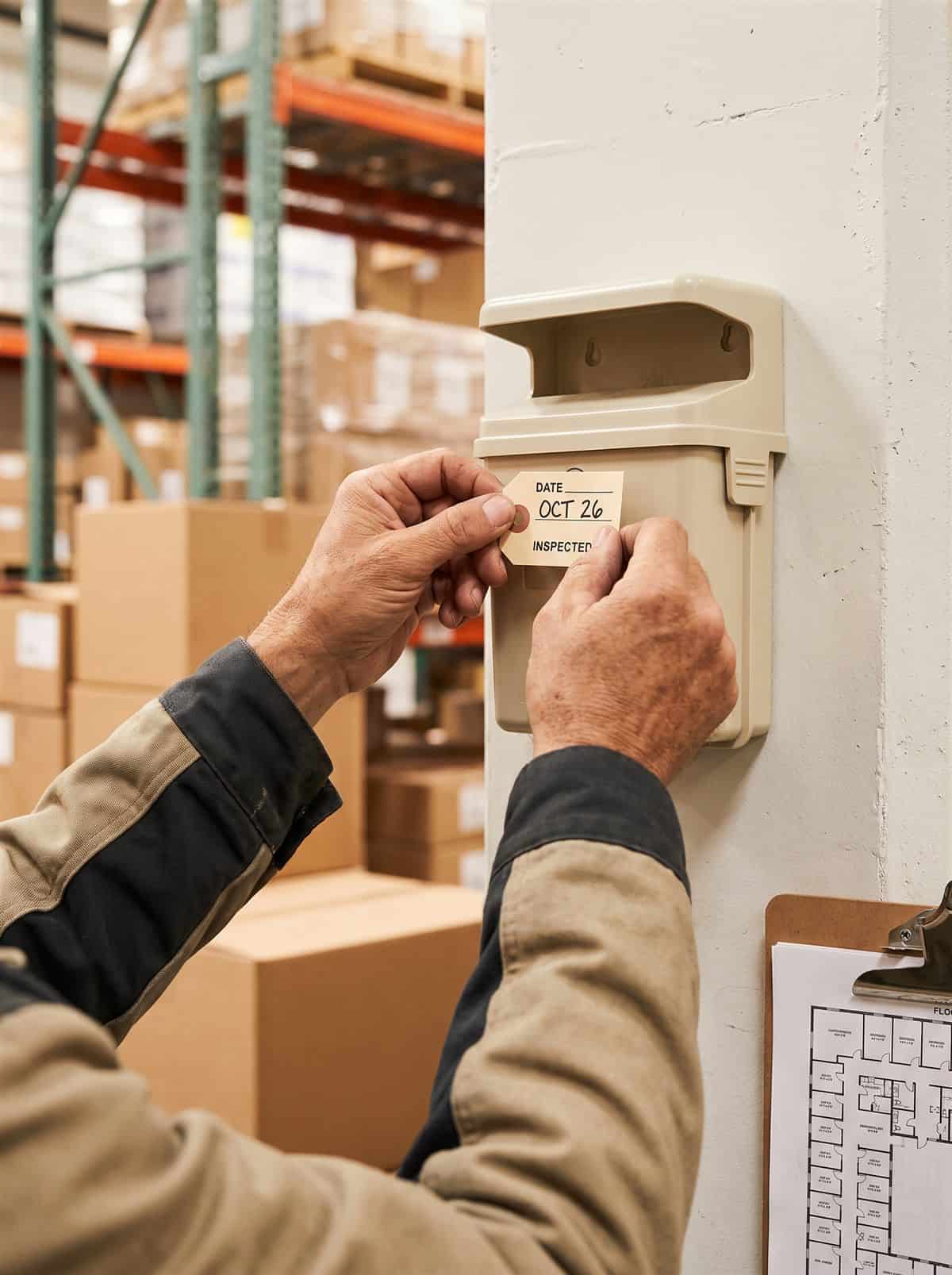
Here is the uncomfortable lesson from the story that opened this playbook: the competitor who took the restaurant group was not a better technician. He was a better record-keeper — and to the district manager facing an audit, those were the same thing.
Commercial clients answer to auditors, inspectors, insurers, and corporate compliance teams, and every one of those parties asks for paper. The operator who can hand over a complete audit package — device network map, inspection history, activity trends, corrective actions, product records — gives the facility manager something to forward upstream. The operator who cannot becomes a risk the manager has to explain. For that reason, documentation, not response time, is the real moat around a commercial pest control business. It is worth understanding exactly why pest control documentation wins commercial accounts before your next audit season.
The mechanics are unglamorous and decisive. A rodent station checked but not logged is, to an auditor, a station that was never checked. An intervention applied without a product record is a compliance gap with your name on it. Therefore the discipline that protects the account is not heroics in the field. It is the habit of closing every device, every finding, and every corrective action on site, the same way, every visit. For operators managing device networks across dozens of premises, SendWork keeps each client’s service history, scheduled visits, and job records in one place. The audit package then builds itself instead of you assembling it from memory the night before.
Documentation-heavy compliance is where most operators see cost and sharp operators see a sales weapon. Food-safety schemes such as AIB, SQF, and BRC expect a pest management programme as a standard part of certification. Device maps, trend data, and corrective-action logs back that programme. Our walkthrough of how to prepare for a food-safety pest control audit breaks down what each scheme’s auditors actually look for. Healthcare and food-processing sites carry their own documented-prevention expectations. Meanwhile, pesticide-use records sit under label requirements the site — not just the applicator — is exposed to. The principles behind a defensible programme are laid out plainly in the EPA’s introduction to integrated pest management.
Picture the audit itself. An unannounced food-safety auditor arrives at a distribution centre and asks for the pest management file. The strong operator’s client hands over a tabbed package: a current device map, twelve months of inspection rounds, activity trends by zone, corrective actions closed out with dates, and product records with labels attached. The auditor spends twenty minutes, finds the programme defensible, and moves on. The weak operator’s client, by contrast, spends those twenty minutes apologising and promising to email documents later. That gap lands straight in the audit report the site’s head office reads. You did not simply pass an inspection. You protected the client’s certification, and that protection is what a renewal is really paying for.
Read that exposure from the buyer’s side and the pitch writes itself: “Your sites have documentation obligations attached to pest management, whether the last vendor tracked them or not. We build that record as part of the programme.” At that point you are no longer selling monthly visits. Instead, you are selling the absence of a problem the buyer did not want to own.
Our read: within a few years, a documented IPM programme will be a routine line in commercial property and food-safety reviews, the way water-management plans became routine in cooling systems. Treat that as interpretation rather than prophecy. But position for it now, because the operators who build the logs early will inherit the accounts of those who did not.
The last layer is technical range. A residential-rooted operator can handle general callouts competently. Commercial portfolios, though, increasingly carry pressures that punish generalists. Think of stored-product pests in food warehouses, or bird management under welfare and exclusion rules. Add bed bugs across hospitality rooms where one missed unit spreads, and rodent pressure in structures where baiting alone is the wrong answer. Climate is widening that range further, a shift we covered in rising pest pressure and the changing climate.
Consider bed bugs in a hotel. One overlooked room becomes three within a fortnight, guest complaints reach the review sites, and the property blames the vendor who “missed it.” A documented bed bug detection and treatment protocol includes room-by-room inspection records, visual or canine confirmation, treatment verification, and a follow-up schedule. That protocol is what separates the operator who keeps the account from the one who becomes the scapegoat. The same logic holds for stored-product monitoring in a food warehouse or a bird-exclusion plan on a loading dock: the specialist wins because the record proves the work.
Each of these is its own discipline, and each is where the biggest audit-driven accounts are won or lost. Anyone can set a few stations. Few, however, can hand a food-safety manager a documented stored-product monitoring programme or a defensible bird-exclusion plan — and that gap is exactly what justifies premium programme pricing. The day-to-day reality of building this expertise solo is worth reading in our field piece on the life of a solo pest management contractor. The wider direction of the trade — connected monitoring and data-driven intervention — runs through our overview of where pest control is heading.
PESVARO — Precision Protection. Documented Proof.
For operators running commercial and IPM pest management portfolios — structured inspections, device networks, and audit-ready documentation across every premises.
Not every operator starts from the same place, so do not run someone else’s sequence. Use this decision tree instead:
Whichever branch fits, the destination is the same. You want a commercial pest control business that clients renew for what it can prove, not just what it can catch. The operator who lost the restaurant group eventually rebuilt — standard round, mapped networks, smaller portfolio, better margins. The account never came back, but the system he built afterward made sure no other account left the same way. For more operator-economics coverage across the trades, our contractor resources and tips archive is the place to dig. The pest control section collects the niche-specific pieces.
A prevention programme is a promise. Your records are the proof.
SendWork keeps every inspection round, service visit, and client history in one place — so audit season is a formality, not a scramble.
A route that lives in one technician’s head doesn’t build anything.