Go to SendWork
— Free for 7 Days
Full access
Full access

Every plumbing business sells two products. The first is the work — the soldering, the snaking, the swap, the rough-in. The second is the proof that the work happened and was done right. Most operators are excellent at the first and careless about the second, which is why they do the job and then have to argue for the money. Good job documentation is what turns a finished repair into a clean, undisputed payment.
None of it is glamorous. A signed estimate, a before photo, an after photo, a dated invoice — this is the unsexy spine of the business. Yet the difference between an operator who gets paid on time and one who chases disputes for three months is rarely skill at the trade. It is whether the job documentation was captured while the work was happening, or scrambled together afterward from memory. Here is the file every job should close with.
Documentation is not paperwork for its own sake. It protects three things at once: your payment, your reputation, and your warranty position. When a customer questions a charge, the photo of the corroded valve before replacement ends the conversation faster than any argument. When a fixture fails six months later, the dated record of what you installed decides whether it is your problem or the manufacturer’s. And when a homeowner leaves a review, the operator who can show exactly what was found and fixed looks like a professional, not a guess.
The reverse is also true. Thin job documentation is how good work turns into a he-said-she-said dispute, an unpaid balance, or a warranty claim you eat because you cannot prove the original condition. The cost of skipping it never shows up on the day of the job — it shows up weeks later, when the file is empty and the customer’s memory has rewritten the story.
You do not need a binder for every service call. You need a consistent, lightweight set of six artifacts attached to each job before the file closes. Capture them as you go and the file builds itself.
The six-artifact job file
Notice that five of the six can be captured on a phone in under two minutes, on site, while you are already standing there. The only one that happens later is the invoice — and even that should go out the same day. Job documentation fails not because operators do not know what to keep, but because they try to reconstruct it at night instead of capturing it in the moment.
Once a plumbing business adds a second technician, job documentation becomes the only honest mechanism for quality control. A photo log of every job is not about distrust — it is the operating standard that keeps work consistent when you are not on site to see it. Indeed, the technicians who resist photo logs are usually the ones who most need them. The owner who can pull up any job from the last six months and show the customer exactly what was found and exactly what was fixed has built something a one-truck competitor cannot match.
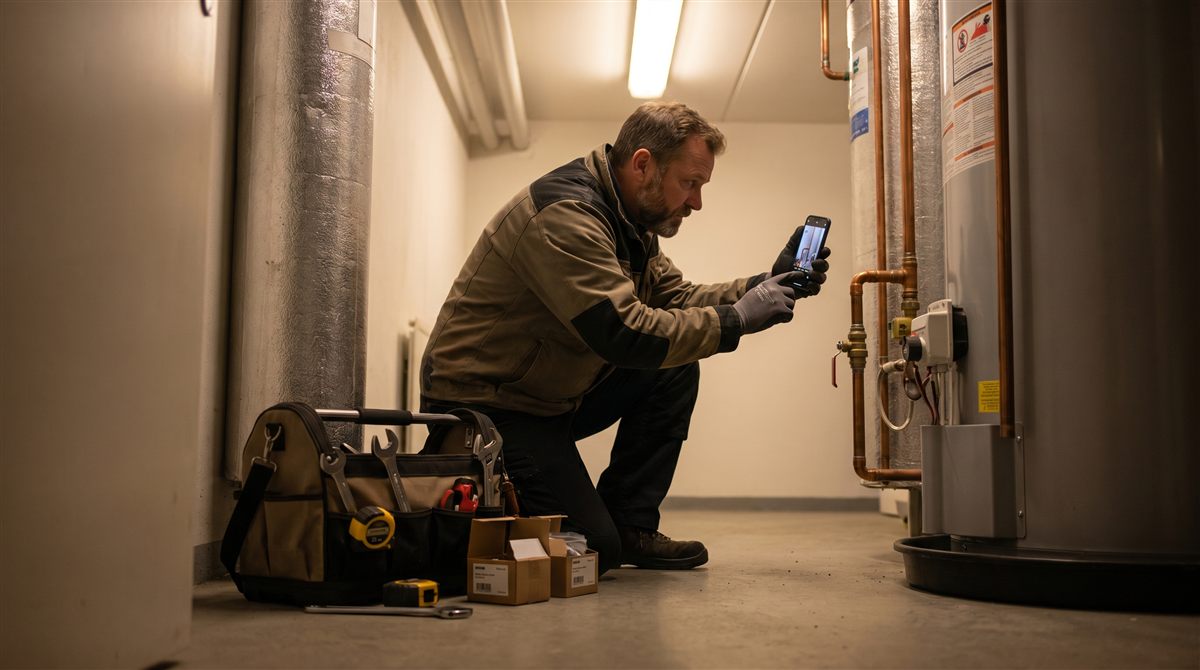
Picture a routine water-heater swap. Before touching anything, you photograph the old unit, the corroded fittings, and the model plate, and the customer signs the estimate on your phone. Mid-job you find the shutoff valve is seized, so you add a line item and capture a quick signature for the change order. When the new unit is in, you shoot the finished connections from the same angles, log the manufacturer and serial number for the warranty, and generate the invoice before you leave the driveway. The extra time adds up to maybe three minutes spread across the whole job. Six months later, when the homeowner asks why the final bill ran higher than the original quote, you do not argue — you send the signed change order, and the question disappears. That is job documentation quietly doing its job.
The trap is treating documentation as a separate task you will get to later. Later never comes, and the file stays empty. The fix is to fold each artifact into a step you already perform: photograph the problem when you diagnose it, photograph the result when you test it, capture the signature when you collect payment. When the record is a byproduct of doing the work well, it stops being a chore and starts being automatic.
This habit also matters before you grow. A plumbing business that wants a second technician needs the documentation system in place before the hire, not after — because the day you stop seeing every job yourself is the day the record becomes your only window into quality. For the staffing realities of that shift, the workforce side of running a plumbing business looks very different from a one-truck operation. And for how documentation fits the wider operator picture, see the guide to building a plumbing business that is profitable, not just busy.
Capture the record while you work
You learned a trade so you could build something — not so you could file something.
Photos, estimates, change orders, and client history attached to every job automatically — the file builds itself while you do the work.
External reference: Plumbing-Heating-Cooling Contractors Association (PHCC) — national trade body for plumbing operators in the United States.