Go to SendWork
— Free for 7 Days
Full access
Full access

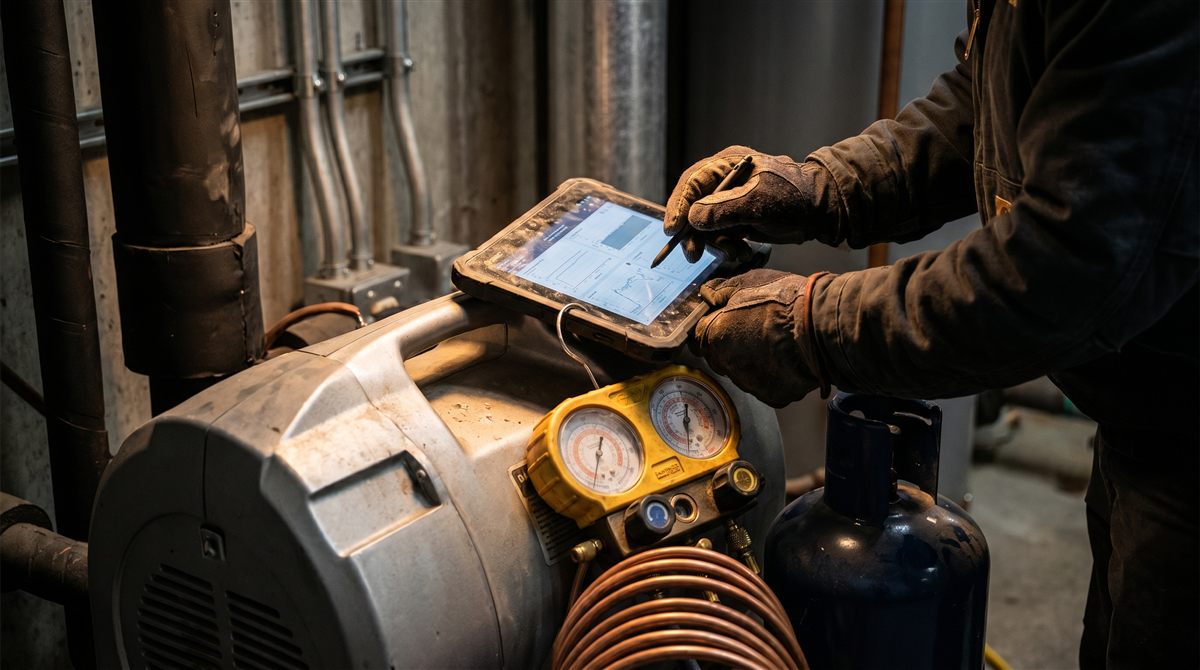
EPA 608 compliance for commercial HVAC operators: the records you must keep, the ODS leak-rate thresholds, and the new 15-lb HFC rule now in effect.
Every commercial HVAC operator who handles refrigerant is now closer to a federal audit than they were a year ago. As of January 1, 2026, the threshold for full leak-management scope dropped from 50 pounds to 15 pounds. That lower line applies to systems charged with high-GWP HFCs. For most portfolios, it turns a pile of previously exempt rooftop units, splits, and process equipment into tracked assets. That single change also raises the stakes on EPA 608 compliance for the whole operation.
The consequence lands fast. A unit you topped off twice last summer without a second thought may now sit above a leak-rate trigger. Then comes a 30-day repair clock, plus the expectation that you can produce a documentation trail on demand. Operators who treated refrigerant logs as an afterthought are discovering the difference. “We serviced it” is not the same as “we can prove what we did, when, and to which asset.”
Section 608 of the Clean Air Act governs the handling of refrigerants in stationary equipment. The core obligations have been stable for years. Technicians servicing covered equipment must hold EPA 608 certification. The rules prohibit intentional venting and allow only certified recovery equipment. In addition, owners and operators of appliances containing 50 or more pounds of refrigerant must keep servicing records. Those records must be available for EPA inspection. In practice, that means retrievable now, not after a weekend of searching trucks and text threads.
Historically, the leak-repair provisions applied to ozone-depleting refrigerants such as R-22. When a covered system exceeds its leak-rate threshold, the operator must repair the leak within 30 days. If that isn’t possible, the operator must put a retrofit or retirement plan in place. Those thresholds still stand for ozone-depleting systems, as shown below.
| Equipment category | Leak-rate threshold (annual) |
|---|---|
| Industrial process refrigeration | 30% |
| Commercial refrigeration | 20% |
| Comfort cooling | 10% |
The expansion comes from the AIM Act rather than Section 608 itself. The HFC management rule, finalized in late 2024 and effective January 1, 2026, extends leak-repair and management requirements. They now reach appliances containing 15 or more pounds of HFCs (and substitutes). The scope is refrigerants with a global warming potential above 53 — a group that includes R-410A, R-404A, and R-134a. For the first time, equipment in the 15-to-49-pound range carries these obligations: leak-rate calculation, 30-day repair, and retrofit-or-retirement. Previously, they applied only to much larger systems.
To make that concrete, picture a light-commercial split charged with roughly 20 pounds of R-410A. A year ago it sat comfortably below the 50-pound line and carried no leak-rate obligation whatsoever. Today, however, it falls squarely inside the 15-pound HFC scope. That means a documented leak-rate calculation on every refrigerant addition. It also means a 30-day repair clock once it crosses the threshold. Multiply that single reclassification across a portfolio of rooftop units and splits. Then the administrative load becomes real rather than theoretical.
There is also an automatic leak detection requirement, but it is narrower than the headlines suggest. It applies to industrial process and commercial refrigeration systems holding 1,500 pounds or more. New installations must comply from January 1, 2026, and qualifying existing systems by January 1, 2027. Comfort cooling is generally outside that automatic-detection scope. The table below contrasts the two regimes operators now juggle.
| Factor | Section 608 (ozone-depleting) | AIM Act HFC rule (effective 2026) |
|---|---|---|
| Refrigerants | R-22 and other ODS | HFCs / substitutes, GWP > 53 (R-410A, R-404A, R-134a) |
| Charge threshold | 50+ lbs | 15+ lbs |
| Repair window | 30 days, then retrofit/retire plan | 30 days, then retrofit/retire plan |
| Records retention | 3 years, inspectable | 3 years, inspectable |
One forward-looking caveat belongs here, framed as exactly that. The companion Technology Transitions Rule caps the GWP of refrigerant used in new equipment. It has pushed new air-conditioning gear toward R-454B and R-32, and it was reopened for reconsideration in late 2025. Our read is that the direction of travel is unlikely to reverse: lower-GWP refrigerants and tighter leak accountability. Specific effective dates and limits could still shift, though. Treat that piece as live policy to watch, not settled fact, and verify current applicability for your equipment.
Strong operators do not chase compliance after the fact; they capture it during the round. At minimum, your refrigerant records should let you reconstruct the history of any covered asset on demand.
Here is the field reality that trips operators up. On a hot Friday, a technician adds two pounds to a chronically weeping condenser. The tech logs nothing and moves to the next call. Repeat that across a season and the asset has quietly blown past its leak-rate trigger. As a result, there is no calculation, no repair record, and no plan. That is the textbook profile of a violation if an inspector ever asks. The refrigerant was cheap. The exposure is not.
Frigalto is the specialist brand for teams that need refrigerant documentation to hold up under audit. It focuses on commercial HVAC maintenance, inspection records, and refrigerant compliance tracking across a portfolio.
The smartest move this quarter is unglamorous. Inventory every system against the new 15-pound HFC threshold and find out which assets just entered scope. From there, standardize how your team calculates leak rates. Then make refrigerant logging a non-negotiable step of the round rather than a memory exercise. Penalties for noncompliance run to tens of thousands of dollars per day. The more common cost is quieter, though. It is a lost contract when a building owner asks for a refrigerant history you cannot produce. Airtight records are quietly part of how strong operators win commercial HVAC accounts that renew.
Get the asset register and the logging discipline right, and the rest of EPA 608 compliance becomes routine. For the official requirements, consult the EPA Section 608 program. For more HVAC compliance coverage, see our HVAC maintenance resources.
Compliance lives or dies on records you can actually find.
SendWork keeps every job, visit, and invoice in one place, so when it’s time to compile your documentation the service history is already there — not scattered across trucks and text threads.