Go to SendWork
— Free for 7 Days
Full access
Full access

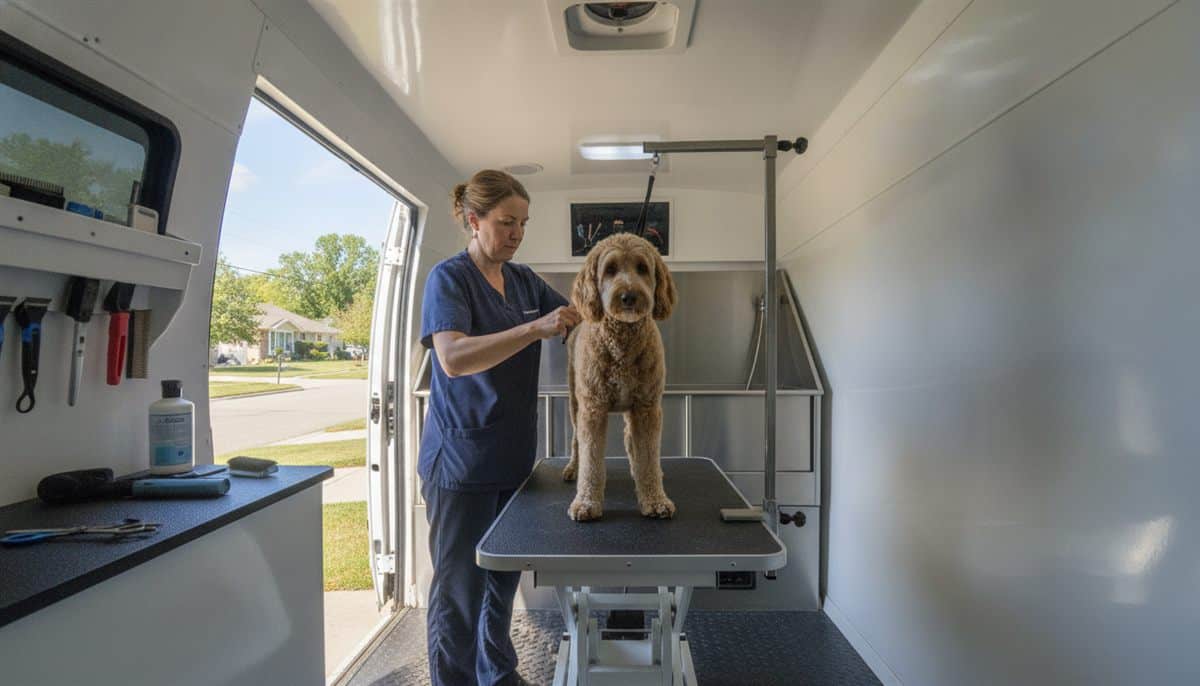
Fewer new laws than you might think, but real costs: Colorado renewals, bills in New Jersey and New York, wash-water fines for mobile vans and the first 1099s at $2,000.
The dog grooming trends that will matter to your business in 2027 are less about new products and more about paperwork, water and money. Colorado’s grooming licenses, mobile vans included, come up for renewal between January 1 and March 1, 2027, under a law that raised the state’s fee ceiling and maximum fines. New Jersey and New York are weighing groomer licensing bills that are not law yet. Cities can fine a mobile groomer heavily for dumping wash water in the street. And the first 1099-NEC filings at the new $2,000 threshold are due on February 1, 2027.
Few grooming rules carry a 2027 start date, so this is less a list of new laws than a check of the rules that already bite, plus the dates that do fall next year. Each point comes from the statute, regulation or agency page behind it, as checked in October 2026.
Licensing is patchy. The two state licenses we verified both cover vans, and two more states have bills pending. Here is where things stand:
| State | What the law covers | Status in October 2026 |
|---|---|---|
| Colorado | License for grooming facilities, including mobile ones ($400 a year; $350 for an independent-contractor groomer) | In force; renewals January 1 to March 1, 2027 |
| Connecticut | License for grooming facilities, including any vehicle or trailer ($200, renewed every two years) | In force |
| New Jersey | Bills S387 (licensing, no drying cages) and S3512 (a registry of negligent groomers) | In committee, not law |
| New York | Bills S6963 (groomer registration) and A1108 (facility licensing, mobile included) | In committee, not law |
Colorado’s license comes from the Pet Animal Care and Facilities Act, which the state Department of Agriculture runs. Its licensing page sets the renewal window at January 1 to March 1 each year, with an automatic 10% late fee after March 1. New licenses need a short qualifying course and an inspection of the facility or vehicle. In 2026 the legislature passed HB26-1183, which took effect on August 12, 2026. It raised the cap on the annual license fee from $700 to $1,500 and the maximum penalty from $1,000 to $2,500 per violation. The actual fee has not changed yet, but the room to raise it now exists.
Connecticut’s Commissioner of Agriculture licenses “any place, including any vehicle or trailer,” maintained as a business where dogs are groomed, under chapter 435 of its General Statutes. New Jersey’s earlier “Bijou’s Law” bills died when the 2024 to 2025 session ended in January 2026. Two new bills, S387 and S3512, sit in committee. If you groom in New Jersey or New York, watch those bills, but do not tell clients they are law.
This is where a mobile groomer is most exposed. Federal stormwater rules, in 40 CFR 122.34, require cities with storm sewer permits to ban non-stormwater discharges, with limited exceptions, from storm drains. Cities enforce that locally. San Diego, for example, names mobile pet grooming among the businesses that may not discharge to storm drains. It warns of fines of up to $10,000 a day per incident.
Guidance from Alameda County’s clean water program, updated in October 2025, spells out the practice. Filter the water, and discharge it only to a sanitary sewer connection with the wastewater agency’s approval. Products labeled “biodegradable” or “non-toxic” are not exempt.
Take a hypothetical end of day. Your van’s gray-water tank is full after six dogs, and the last client lives near a storm drain. Emptying the tank into the gutter would be the quick fix, and it is exactly the discharge cities fine. The safer routine is a tank big enough for a full day and an agreed dump point, such as an approved sanitary connection at your base. Ask your city’s stormwater office where mobile businesses may dispose of water.
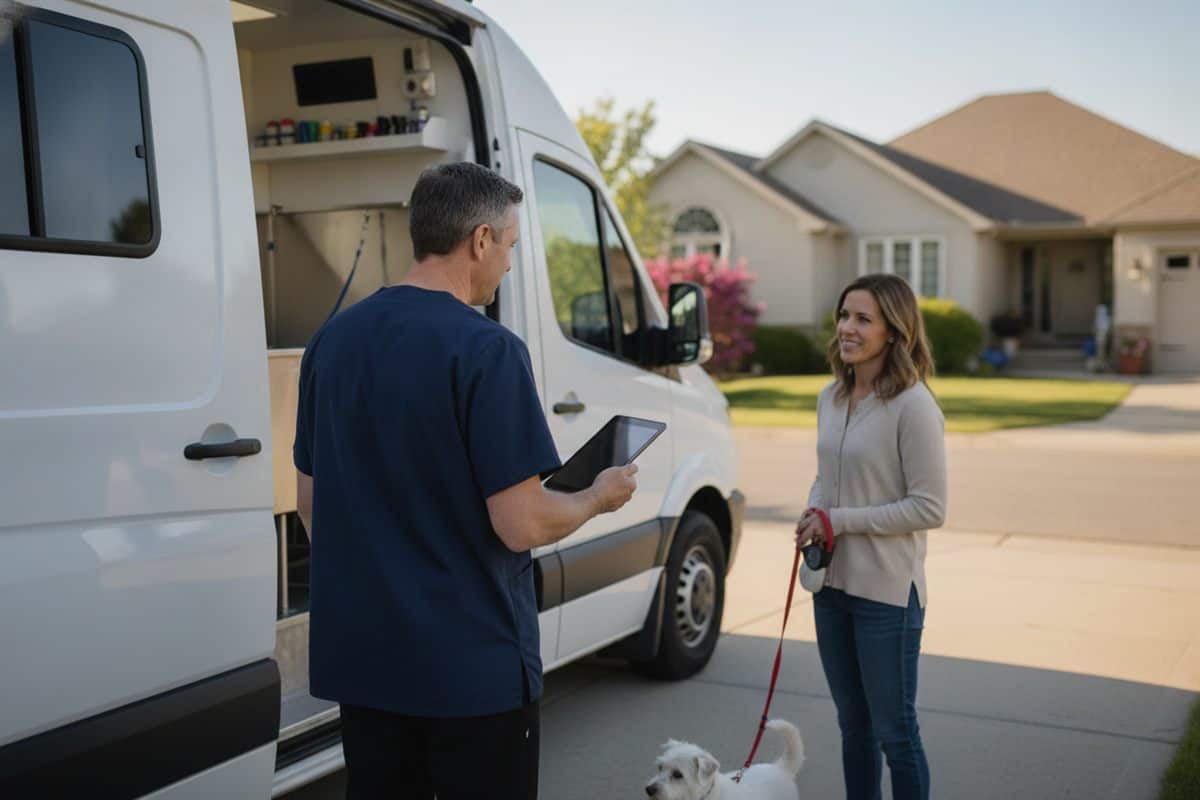
A few cities regulate grooming equipment directly. West Hollywood, California, licenses mobile groomers and bans fully enclosed cage dryers without safety vents. Its code also requires dryers to be watched at all times and to shut off after 15 minutes, and staff to stay within four feet of a dog during bathing and grooming. New Jersey’s S387 would ban drying cages statewide if it passes. Even where no rule applies, those are sensible limits to put in your own procedures.
Whether federal motor carrier rules reach your van depends on its weight rating and where you drive. A vehicle counts as a commercial motor vehicle under 49 CFR 390.5 when it is rated at 10,001 pounds or more and used in interstate commerce. Only then do the federal rules require a USDOT number, and a trailer counts toward the weight. In 2026 the Federal Motor Carrier Safety Administration moved registration to a new online system called Motus, and existing numbers carry over. If your van is heavy and you cross state lines, check your registration there. Some states set their own rules for in-state carriers, so check with yours too.
Public Law 119-21, the budget law signed on July 4, 2025, raised the reporting threshold for Form 1099-NEC from $600 to $2,000 for payments made after December 31, 2025. If you pay contract groomers or bathers, you only need to file for those you paid $2,000 or more in 2026. Those first filings are due on February 1, 2027, because January 31 falls on a Sunday. Our guide to the $2,000 1099 threshold explains who still gets one.
For driving between clients, the IRS business mileage rate is 76 cents a mile from July 1, 2026, up from 72.5 cents in the first half of the year. If you are buying a van, 100% bonus depreciation is now permanent for equipment acquired after January 19, 2025. Section 179 expensing, an optional election to deduct equipment in the year you buy it, caps heavy SUVs at $32,000 for 2026. That cap may not apply to an enclosed cargo-style van with no seating behind the driver. Confirm with your tax adviser, and see our list of tax deductions US contractors can claim.
Spending on pet services keeps rising, but the figures are broad. The American Pet Products Association puts spending on “other services” at $14.3 billion, with $14.9 billion projected for 2026. That category also includes boarding, insurance, training and walking, so it is not a grooming-only number. The Bureau of Labor Statistics puts the median pay for animal caretakers, the group that includes groomers, at $35,360 in May 2025. It projects 12% job growth from 2025 to 2035.
Repeat clients carry a grooming business. If you are building yours, our pieces on building strong relationships with mobile grooming clients and starting a mobile grooming business are good next reads. For the payroll and tax rules that reach every trade, see our overview of 2027 rules for US service contractors.
The dog due back in six weeks
Regulars who rebook before they leave keep a grooming van full.
Every rule above adds a cost to each stop, so the stops have to keep coming. SendWork keeps each dog’s history, notes and next appointment with the client record, and books the next visit from your phone, so regulars rebook without a chase.