Go to SendWork
— Free for 7 Days
Full access
Full access

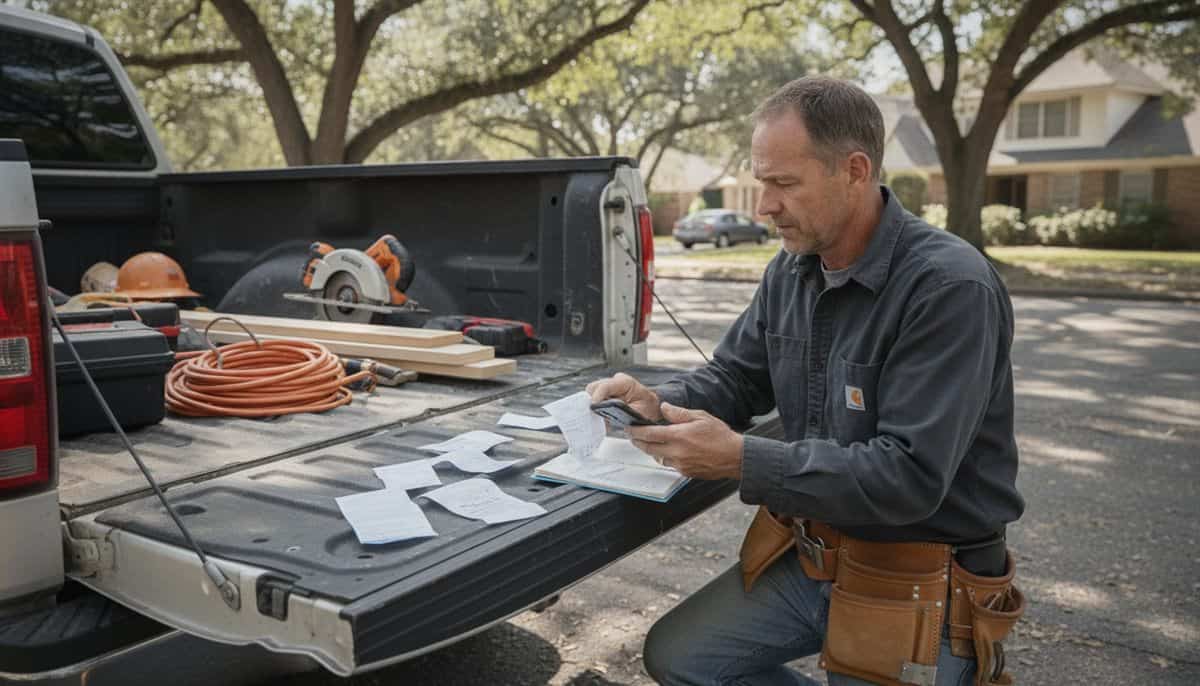
The contractor tax deductions US operators can legally claim, plus the records that keep every write-off audit-proof.
Most contractors overpay their taxes not through fraud but through neglect: a glovebox full of faded receipts, a mileage log that never got kept, and a vague sense that “the accountant handles it.” Every dollar of legitimate contractor tax deductions you fail to claim is a dollar of profit you handed back to the IRS for no reason. For a self-employed operator, that adds up fast.
Here is the consequence in plain numbers. A deduction is not a refund, but it lowers the income you are taxed on — and because you pay both income tax and 15.3% self-employment tax on your profit, a $10,000 stack of missed write-offs can cost you $2,500 or more in a single year. So the goal is simple: claim every contractor tax deduction you are legally entitled to, and keep the proof that lets you.
The IRS standard is that a business expense must be “ordinary and necessary” for your trade. That is a wide door for a working contractor. The categories below are the ones operators most often leave money on the table with.
| Category | Common examples | Watch-out |
|---|---|---|
| Vehicle | Mileage or actual costs, fuel, repairs | Pick one method; keep a log |
| Tools & equipment | Power tools, ladders, safety gear | Big items may be depreciated |
| Home office | Dedicated office or storage space | Must be used regularly and only for work |
| Insurance | General liability, commercial auto, tools | Personal policies do not count |
| Materials & supplies | Job materials, consumables | Track per job where possible |
| Phone & software | Business phone, apps, subscriptions | Deduct the business-use share only |
That last column matters. Furthermore, the fastest way to lose a deduction in an audit is to claim 100% business use of something you clearly also use personally, like a phone or a truck.
For most contractors, three categories carry the real weight of their contractor tax deductions. Getting them right is where the meaningful money is.
You can deduct vehicle costs one of two ways: the standard mileage rate or actual expenses. The IRS standard mileage rate ran 72.5 cents per business mile at the start of 2026 and was raised to 76 cents effective July 1, so verify the current figure before you file. For a contractor putting 20,000 business miles on a truck, mileage alone can mean a five-figure deduction. Meanwhile, the actual-expense method — fuel, insurance, repairs, depreciation — sometimes beats mileage for heavy trucks, so it is worth running both.
Small tools are deducted the year you buy them. Larger purchases can be written off immediately too: Section 179 lets you expense qualifying equipment up to a cap well over $2.5 million in 2026, and 100% bonus depreciation was made permanent under the 2025 tax law. In other words, a new work trailer or a major tool purchase can often be fully deducted in year one rather than spread over time.
If you run the business side of your operation from a dedicated space at home — even a converted garage bay used for storage and paperwork — it can qualify. The simplified method deducts $5 per square foot up to 300 square feet, a clean $1,500 with almost no recordkeeping. Nevertheless, the space must be used regularly and exclusively for business; the kitchen table does not count.
A few of the biggest contractor tax deductions never appear on a single receipt, which is exactly why operators miss them. They live in the tax return, not the shoebox, and reviewing this short list with an accountant once a year routinely pays for the meeting many times over.
None of these show up when you sort receipts, so they only get claimed when someone deliberately looks for them. That is the difference between filing and planning.
A deduction you cannot prove is a deduction you will lose the moment anyone asks. Therefore the real skill is not knowing the categories — it is capturing the evidence as you go. Build these habits into the workweek:
This is where a system earns its keep. Tools like SendWork will not file your Schedule C, but capturing every job cost, invoice, and expense in one place as the work happens means your contractor tax deductions are already documented when tax season arrives — a report to hand your accountant instead of a shoebox to dread. The operators who keep the most are simply the ones who never let a receipt go untracked.
The editorial bottom line: aggressive is not the goal, complete is. Claim every legitimate deduction, document each one, and skip the gimmicks that invite an audit. Done right, good recordkeeping is the highest-paying hour of admin you will do all year.
Gut feeling isn’t a financial plan. Real numbers are.
SendWork tracks every job, expense, and payment automatically — so at tax time your write-offs are a clean report, not a shoebox you have to reconstruct from memory.
The IRS spells out the rules on its deducting business expenses page, and current-year figures live there too. Every deduction you capture also lowers the quarterly estimated taxes you prepay through the year, and rising material costs make tracking every deductible dollar matter even more — see our breakdown of how tariffs are pushing up contractor material costs. For more US admin and tax guides, browse the Business Admin & Taxes: USA archive.