Go to SendWork
— Free for 7 Days
Full access
Full access

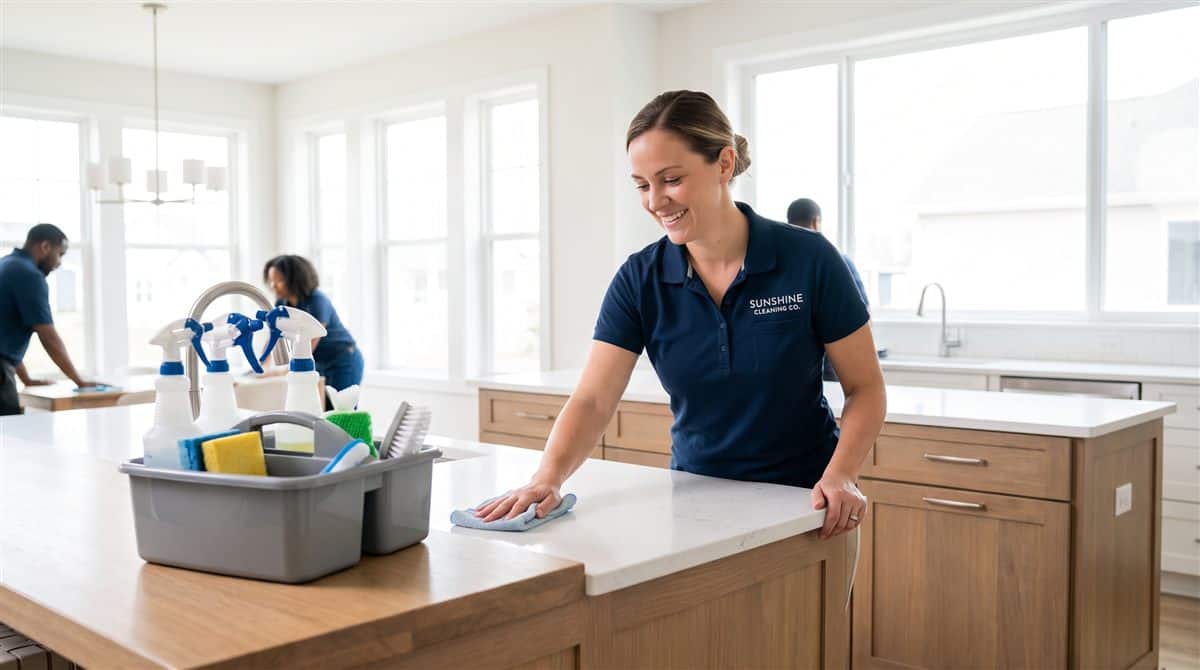
Real 2026 US cleaning rates — per hour, per square foot, and per visit for house and commercial cleaning — plus how to price recurring work.
Cleaning is deceptively simple to price and brutally easy to underprice. A house cleaner who charges by the hour and a company that charges by the square foot can look at the same home and land $80 apart — and the one billing by the job usually wins on both profit and customer trust. Setting your cleaning rates USA well means picking a pricing model that rewards your speed instead of punishing it, then holding to it job after job.
Here is what residential and commercial cleaners charge across the United States in 2026 — hourly, per square foot, and per visit — plus how to price the recurring work that turns a cleaning gig into a real business. The ranges move with region, home condition, and frequency, so use them as a market map and localize.
Hourly pricing spans a wide band. An individual cleaner often charges $15 to $25 an hour, a professional per-cleaner rate runs $25 to $75, and a two-person crew from a company bills $75 to $100 an hour together. Priced per square foot, a standard cleaning runs $0.10 to $0.17, a deep clean $0.11 to $0.30, and a move-out clean $0.22 to $0.33. For a typical 2,000-square-foot home, therefore, a standard visit lands around $135 to $180 and a deep clean around $180 to $280.
For a wage anchor, the U.S. Bureau of Labor Statistics reports median pay for janitors and building cleaners at $17.27 an hour — about $35,930 a year — as of May 2024. That is the cleaner’s wage; your rate has to carry supplies, travel, insurance, and profit on top of it. This is exactly why billing by the job usually beats billing by the hour: it rewards an efficient crew instead of capping your income at the clock.
| Cleaning work (2026) | Typical US price |
|---|---|
| Individual cleaner (hourly) | $15–$25/hr |
| Professional, per cleaner (hourly) | $25–$75/hr |
| Company crew of two (hourly) | $75–$100/hr |
| Standard clean (per sq ft) | $0.10–$0.17 |
| Deep clean (per sq ft) | $0.11–$0.30 |
| Move-out clean (per sq ft) | $0.22–$0.33 |
| Standard visit (2,000 sq ft) | $135–$180 |
| Commercial office (per sq ft) | $0.04–$0.16 |
Commercial work plays by different math. Office and facility cleaning is usually priced per square foot at $0.04 to $0.16, or hourly at $50 to $100, and it rewards volume and consistency over the premium detail a homeowner expects. Residential cleaning, by contrast, is relationship-driven and pays more per square foot, because trust, discretion, and attention to detail carry real value. Many successful operators run both: commercial contracts for steady baseline revenue, and residential for margin. Whichever you focus on, do not price one using the other’s assumptions — that is how cleaners quietly lose money on half their book. Facilities that outsource cleaning frequently bundle grounds upkeep too, so compare landscaping rates if you quote exterior work alongside the interior.
The single biggest lever in cleaning is frequency. A weekly or biweekly recurring client is worth far more than a string of one-time deep cleans, because the home stays easier to clean, your routing tightens, and the revenue becomes predictable. As a result, you can price recurring visits slightly below one-time rates to reward the commitment — but never so low that the discount eats your margin. A one-time visit for two workers over two hours commonly runs $150 to $170, while the same crew on a recurring schedule might run $120 to $155, a discount that pays for itself in retention and tighter routes.
Pick one model — per visit is usually best for residential — and quote from the real cost of putting a crew in the home: labor, supplies, travel, and a margin. Being busy is not the same as being profitable, and cleaning is a trade where a full schedule can still lose money if the per-visit price is wrong. On that point, it is worth reading why a busy business is not the same as a profitable one — the lesson translates directly from plumbing to cleaning. Localize the ranges above and revisit them yearly, and compare against other USA pricing benchmarks as the series grows.
The spread in the numbers above comes down to a few concrete drivers. Home condition is the biggest: a regularly maintained house cleans fast, while a first-time deep clean or a move-out with built-up grime can take two or three times as long and must be priced accordingly. Size, the number of bathrooms, pets, and clutter all add time, and so do premium finishes that demand careful products and attention. This is exactly why a flat per-visit price built from a walk-through beats a blind hourly quote that punishes you for working quickly.
Frequency and location then do the rest. A weekly or biweekly recurring client keeps the home easy and the route tight, which supports a lower per-visit rate, while one-time jobs carry a premium for the unknowns. High-cost metros push every number toward the top of the range, and dense routes let you serve more homes per day with less windshield time. Quote from what the specific home needs, hold your recurring structure, and you protect the margin that a full but underpriced calendar quietly erodes over a year.
Your cleaning rates USA should reward speed, not punish it, and recurring clients should be the backbone of the book. This quarter, move to per-visit pricing built from real cost, set a clear recurring-versus-one-time structure, and separate your residential and commercial pricing so neither one drags the other down. The cleaner who prices by the job and fills the calendar with recurring clients is the one building something that lasts.
Cleaners who get paid fast don’t chase. They have a system that closes the loop.
SendWork’s AI office manager turns a finished clean into a sent invoice from your phone, tracks who has paid, and follows up with the ones who haven’t — so the money side runs itself.
Pick a model, price from real cost, and let recurring clients — not a busy but breakeven calendar — carry the business.