Go to SendWork
— Free for 7 Days
Full access
Full access

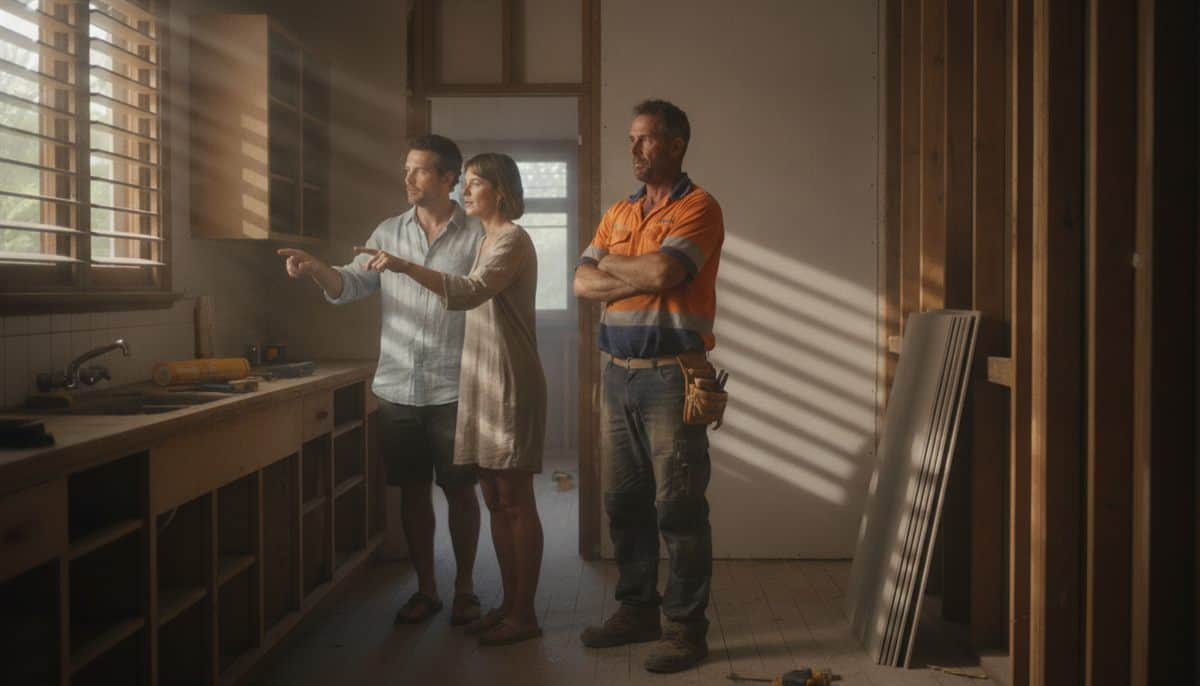
An extra the homeowner asks for on site is a contract variation, and in NSW, Victoria and Queensland it has to be agreed in writing before you start. What each state requires, what to say at the laundry door, and what happens to payment if you don't.
In New South Wales, Victoria and Queensland, contract variations on a home building job have to be agreed in writing. Queensland and Victoria require that before the extra work starts, with one small exception in Victoria. Here’s a hypothetical you’ll recognise. A Brisbane builder is three weeks into a $38,000 kitchen and laundry reno. On Saturday morning the owners walk him to the laundry and ask whether the wall could come out 600 millimetres to fit a pantry. He says no worries, it’s half a day and some sheeting. Monday he starts on it.
In Queensland he has just broken the law. That pantry is a variation to the contract, and under the Queensland Building and Construction Commission Act 1991 he can’t start work on it until the owners have agreed to it in writing. New South Wales and Victoria have their own versions of the same rule. In Victoria, getting it wrong can cost the builder the price of the extra altogether.
Each of the three states sets out home building contract rules in its own Act, and each Act treats a change to the agreed work or price as a variation with paperwork attached. All three rules are legal requirements, not good practice:
| State | What the law requires | When | Consequence |
|---|---|---|---|
| Queensland | A written variation the owner agrees to in writing; must describe the change, the date of the request, any delay, the price change or how it’s worked out, and when it’s paid | Owner agrees before the variation work starts; owner gets a copy within 5 business days or before work starts, whichever comes first | Up to 20 penalty units per offence; no extension of time for delay from a non-compliant variation |
| New South Wales | Any agreement to vary the contract or the plans “must be in writing signed by or on behalf of each party” | Before the work starts, according to Building Commission NSW guidance | No express payment bar in the Act; recovery becomes harder and uncertain |
| Victoria | A notice from the builder setting out the effect on the work, any permit change, any delay and the cost, with the owner’s signed consent or request attached | Before the builder gives effect to the variation | Builder “is not entitled to recover any money” for it, unless VCAT allows it |
Victoria has one exception for owner-requested changes. Under section 38(2), the builder can go ahead without the paperwork if he reasonably believes the change won’t need a permit change, won’t cause any delay and won’t add more than 2% to the original contract price. On the hypothetical $38,000 job, that’s $760, and moving a wall for a pantry is likely to cost more than that.
The conversation at the laundry door is where you set this up. The owners don’t want to sign anything on a Saturday; they want to know if you can do it. You can say yes to that without starting work.
Something like: “Yes, we can do that. I’ll write it up tonight with the price and whether it adds any days, and once you’ve signed it I’ll get onto it.” That answer keeps the job moving and gives the owners what they actually want, which is a number before they commit.

Then write it up properly. Queensland lets you send the copy by email, and the QBCC publishes variation forms for its contract types. In New South Wales, the government’s consumer guidance says the variation should show the calculation behind the price change, “rather than just a simple dollar amount”. It also says owners don’t have to pay for extra work to fix the builder’s own mistake, so don’t write those up as variations.
Two points from the Queensland rules are good practice anywhere. You can’t require the extra money before the variation work starts. And the variation should say when the owner pays it, so it doesn’t turn into an argument at the final invoice.
This is where the three states part company, and where the Saturday handshake costs money.
In Victoria, the Act is blunt. For an owner-requested variation done without compliance, the builder “is not entitled to recover any money” unless VCAT finds exceptional circumstances or significant hardship, and that it wouldn’t be unfair to the owner. Even then, the builder gets the cost plus a reasonable profit. For a change the builder asked for, he must also show it was needed because of something he couldn’t reasonably have foreseen when the contract was signed.
In Queensland, a missed variation doesn’t void the contract. But it’s an offence each time, and you lose the right to claim extra time for any delay it caused. Whether you can still recover the money depends on your contract and how a tribunal sees the facts. That’s an uncertain and expensive place to argue from.
In New South Wales, the Act has no express rule that an unwritten variation can’t be paid for. The same caution applies, though: recovering money for work the owner says they never agreed to is uncertain, and if it comes to that, get legal advice. One NSW rule is clear-cut. If a variation takes the job over $20,000 and the home warranty insurance isn’t in place, section 94 says you can’t recover money for the uninsured work, except where a court or tribunal finds it just and equitable.
The law treats emergencies differently, but narrowly. In New South Wales, where work has to be done promptly to avoid danger to people or damage to property, the government’s guidance says the written variation can be done after the work. In Queensland, the urgent-work defence covers only the timing of the owner’s copy. You still need the owner’s written agreement before you start. In Victoria, a change ordered by a building surveyor has its own route under section 37.
A variation changes the contract price, and the price drives home warranty insurance. In New South Wales, a job pushed over $20,000 needs cover. Victoria’s Building and Plumbing Commission says that if eligible work is varied by more than $5,000, you have to pay an additional premium. The QBCC says that in Queensland, amending the cover when variations increase the value of the work is the contractor’s responsibility. Our guide to the contract price that makes home warranty insurance compulsory sets out each state’s line.
Put these together and one written variation will meet the rules in all three states:
Pricing an extra quickly matters as much as writing it down, because owners decide fast on site. Our piece on how slow estimates lose work covers that side. More state rules are in our Australian licensing and regulations guides.
THE SATURDAY HANDSHAKE
The extras you get paid for are the ones written down before the work.
An extra agreed at the laundry door is the hardest line on the final invoice to collect. SendWork keeps each change to the quote attached to the job, so the price the owner signed is the price that goes on the invoice.