Go to SendWork
— Free for 7 Days
Full access
Full access

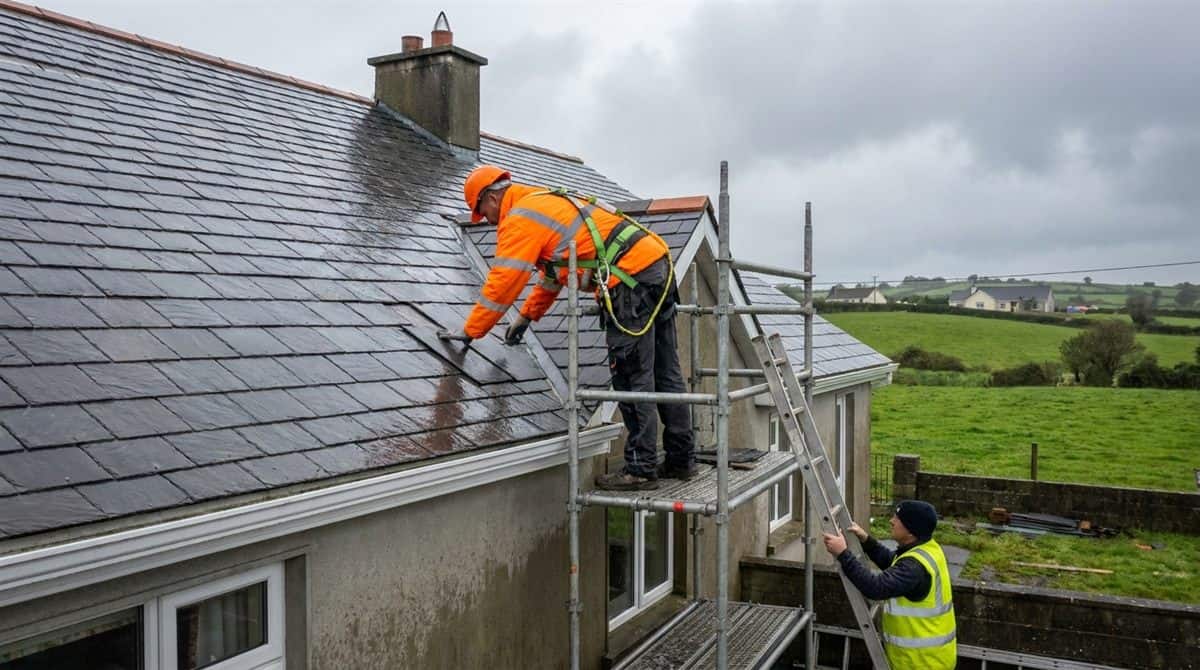
Ireland has no compulsory employers' liability law and no compulsory public liability. Here's the short statutory list, the long list the site demands instead, and the helper who falls between them.
Contractor insurance in Ireland has a feature that surprises operators who trained in the UK. Almost none of it is required by law. There is no Irish equivalent of Britain’s compulsory employers’ liability statute. Public liability is not compulsory either. The only cover the State insists on is motor insurance for the van, and even then it is a third-party minimum. Everything else is a private decision. That is exactly why so many small trades businesses in Ireland are carrying risks they think are covered.
The operator consequence is a gap between two sets of rules. On one side, the law leaves you free to work uninsured. On the other, the main contractor, the local authority, the housing body and the homeowner’s solicitor do not. A roofer with no employers’ liability cover can legally send a helper up a ladder in Wexford tomorrow. But he cannot get onto a site that asks for certificates. And if the helper falls, the claim comes to him personally, through the Injuries Resolution Board, against everything he owns. Contractor insurance is optional in the way a hard hat is optional.
It is worth separating the short list of legal duties from the long list of commercial ones. Operators confuse the two in both directions. Some buy cover they believe is mandatory, because the broker assumed it was. Others skip cover they believe is optional and then discover the site will not have them.
Required by statute, not by the client
Motor insurance. Third-party cover is compulsory under the Road Traffic Act for any vehicle on a public road. A van carrying tools and materials for reward needs a commercial class of use. Indeed, a private policy can refuse a claim on that basis alone.
A duty of care, not a policy. The Safety, Health and Welfare at Work Act 2005 obliges every employer to protect employees so far as is reasonably practicable. It also obliges every self-employed person to protect themselves and others affected by the work. It requires a written safety statement, though employers with three or fewer staff can rely on the sector code of practice instead. However, it does not require insurance against the duty.
Safe Pass. Every worker on a construction site must hold a valid SOLAS Safe Pass card. It is a training requirement rather than insurance, and sites check it at induction.
Project supervisors. A client must appoint a PSDP and a PSCS for any project lasting more than 30 working days or 500 person-days. The same applies when particular risks are involved. The contractor appointed as PSCS inherits duties, so insurers ask about them.
That is the whole statutory list. Employers’ liability, public liability, contractors’ all risks and professional indemnity appear nowhere on it. Instead, they appear in the tender pack, the subcontract, the local authority framework and the mortgage lender’s conditions. In practice, those documents have more force over a trades business than the statute book does.

Main contractors and public bodies in Ireland have settled on customary minimums. They rarely negotiate them downward for a small subcontractor. The figures most often asked for are €6.5 million of public liability and €13 million of employers’ liability. Usually there is also an indemnity to principal clause, so the main contractor is covered under your policy for claims arising from your work. So read the tender before you buy, because the number is set by the client, not by your broker.
Contractors’ all risks cover protects the works themselves, the materials on site and the plant. It responds to fire, theft, storm and collapse while the job is open. On any contract using a standard Irish form, one party is required to carry it. If it is not the client, it is you. Professional indemnity covers advice and design, which reaches further than it sounds. A builder who signs the Certificate of Compliance on Completion under the Building Control Regulations is certifying that the work meets the Building Regulations. So a defect claim years later is a design-and-workmanship argument, not a slip-and-trip one.
Then there is the contractor insurance nobody requires and everybody regrets skipping. Tools and plant left in a van overnight are stolen with grim regularity in every county. Yet a standard commercial motor policy does not cover the contents. Personal accident cover replaces the income of a sole trader who is off for three months with a broken wrist. No employer exists to pay sick pay in that case.
Take a roofer in Wexford, a sole trader with one regular helper he pays cash on Fridays and describes as self-employed. He carries public liability at €2.6 million because a broker sold it to him years ago. He has no employers’ liability, because he has “no employees”. The helper falls from a scaffold and fractures a hip. Under the Karshan test, the helper works the roofer’s hours, uses the roofer’s gear and has no other customers. So he is an employee for liability purposes. Unfortunately, the public liability policy excludes employees, and the employers’ liability policy does not exist.
The claim goes first to the Injuries Resolution Board, which assesses it under the Personal Injuries Guidelines. Then it goes to court if either side rejects the assessment, and the roofer has no insurer to instruct a solicitor. The roofer meets it personally: the van, the savings, and eventually the house. None of that was illegal. Yet all of it was uninsured. The site he was working on will also want to know why a subcontractor was on the roof without the certificates the subcontract required. That conversation ends the relationship.
With contractor insurance, the premium is not the decision. What decides it is who counts as your employee, what the client’s paperwork demands, and whether the limits match the contract rather than the broker’s default. Irish claims costs have been reshaped since 2021 by the Personal Injuries Guidelines and by the 2023 changes to occupiers’ liability. The trade press reads that as a settling market. Our read is more cautious. Awards have come down, but a small operator’s exposure is measured in the claim it cannot pay, not in the average. One uninsured injury is still enough to end a business. Operators who can show, from job records, exactly who was on site and in what capacity are the ones whose insurers pay without a fight. SendWork keeps crew assignments and job history attached to each job, which is the record a claims handler asks for first.
Ireland’s approach leaves the decision with you, and the trap is that it looks like freedom. In practice the market has written its own compulsory contractor insurance law through tender documents and subcontracts. It is stricter than any statute. So buy the cover the contract requires, and decide who counts as your employee before an accident decides it for you. Then treat the certificate as part of the job file.
The employer’s duty of care, the safety statement rule and the project supervisor thresholds that shape contractor insurance decisions are set out by the Health and Safety Authority. Where a helper is found to be an employee, the insurance gap is only half the cost. The employer PRSI and payroll obligations arrive with the same finding.
What can wait is shopping the premium. What cannot wait is reading the subcontract you are already working under and checking whether your certificate says what it demands.
ON THE CERTIFICATE THE SITE ASKED FOR
Nothing made you insure the helper. Everything will make you pay for him.
Claims are decided on who was on site, in what capacity, doing what. SendWork keeps crew assignments and the job record together. So when a claims handler or a main contractor asks, the answer is already on file rather than reconstructed from memory.
See how Irish trades keep site records ready for the question →
More Ireland business admin and tax guides for contractors →