Go to SendWork
— Free for 7 Days
Full access
Full access

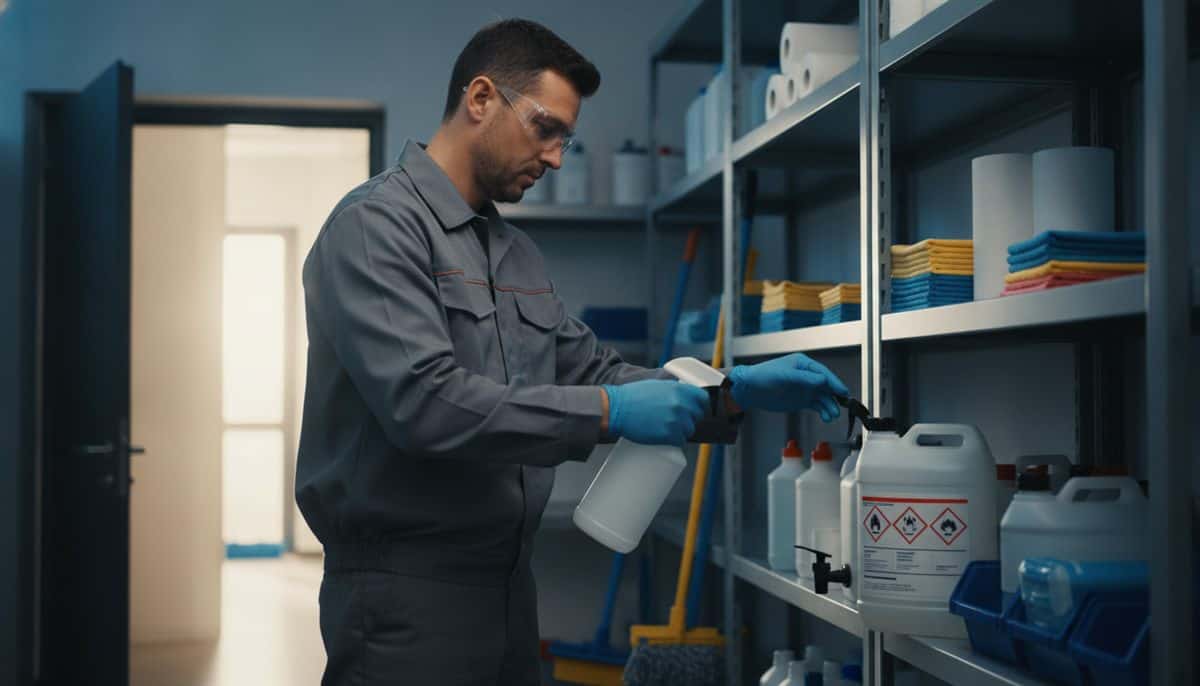
OSHA's 2024 hazard communication update mostly lands on chemical suppliers. What cleaning, pest control and painting employers must update by November 20, 2026 or May 19, 2028, and why the spray bottle filled each morning needs its own label.
The Occupational Safety and Health Administration (OSHA) rewrote its Hazard Communication Standard in 2024, and most of the rewrite lands on the companies that make and sell chemicals. They reclassify their products, reprint the labels and reissue the safety data sheets. OSHA is the federal workplace-safety agency in the U.S. Department of Labor. Its standard is a federal regulation, 29 CFR 1910.1200, so the employer duties in it are legal requirements, not guidance. Your job as the employer who buys those products is smaller, but it is specific. It also has two deadlines of its own: November 20, 2026 for single-substance chemicals and May 19, 2028 for mixtures. Mixtures are most of what sits on a cleaning, pest control or paint shelf.
If you run a cleaning company, a pest control route or a painting crew with employees, hazard communication is not new to you. The standard has required the written program, the labels, the safety data sheets and the training for decades. What the 2024 update changes is what your suppliers send you. It also changes what you do when a product comes back with a hazard nobody has told your crew about. Here is what that means in practice, where the rule is easy to miss, and what can wait.
OSHA published the update on May 20, 2024 and it took effect on July 19, 2024. On January 15, 2026, OSHA pushed every compliance date back four months. Its own guidance was not ready in time. Many compliance pages online still show the original dates, so check which set you are reading. The current dates are in the Federal Register notice of January 15, 2026 and in paragraph (j) of the standard:
| Who | Substances (a single chemical) | Mixtures (most cleaners, pesticide products and paints) |
|---|---|---|
| Manufacturers, importers and distributors: new classifications, labels and safety data sheets | May 19, 2026 | November 19, 2027 |
| Employers who use the chemicals: workplace labels, written program and training, as necessary | November 20, 2026 | May 19, 2028 |
Until the relevant date, anyone may comply with the 2012 version, the 2024 version, or both. OSHA’s inspection directive for the new rule, CPL 02-02-079, took effect on May 19, 2026. During the transition, inspectors cite only a business that meets neither version. Once a date has passed, they cite only under the 2024 rule.
The words “as necessary” carry the weight in the employer row. The standard does not order you to retrain everyone because the rule changed. It requires you to update your workplace labels, written program and training where a supplier’s reclassification turns up a new physical or health hazard. Say the new safety data sheet for your floor stripper shows the same hazards as the old one. Then nothing changes for that product.
For an end user, the 2024 update shows up in three places.
That is the list you respond to. The work sits in comparing each new SDS with the old one when it arrives, instead of filing it unread.
In fiscal year 2025, hazard communication in general industry ranked second on OSHA’s Top 10 list of the standards it cited most often. Only fall protection in construction ranked higher. For a crew that decants chemicals every morning, the containers on the van are the first thing to check.
The standard lets you skip a label on a portable container in one case only (1910.1200(f)(8)). The worker fills it from a labeled container for their own immediate use. That exemption is narrow. Take a hypothetical cleaning company. Each morning a supervisor dilutes a disinfectant concentrate into twelve spray bottles for two vans. Different cleaners use them through the shift. None of those bottles qualifies. The person who filled them is not the only person using them, and the use lasts all day. Each bottle needs a workplace label.
A workplace label is simpler than a supplier label. It needs the product identifier, which is the same name used on the SDS and your chemical list. It also needs words, pictures or symbols giving at least general information about the hazards (1910.1200(f)(6)). For the disinfectant, that could be the product name, “Causes serious eye damage” and the corrosion pictogram. It must be in English and legible. If your crew works in Spanish, you can add Spanish as well, but not instead.
Those bottle labels are one of the three things you update under the 2024 rule. That happens when the supplier’s new SDS shows a new hazard. Update the bottle, update the chemical list, and tell the crew what changed.
You may have heard that pesticides are exempt from HazCom. That is true only of the label on the registered container. Pesticides labeled under the Federal Insecticide, Fungicide, and Rodenticide Act do not need an OSHA label as well (1910.1200(b)(5)(i)). Safety data sheets and employee training still apply. OSHA’s directive says so plainly: the EPA label preempts OSHA’s label requirement, “but not the requirements for SDSs and worker training”. The exceptions are certified applicators and agricultural workers, because EPA’s own training rules cover them.

The directive goes one step further, and this is the part that reaches the truck. Say one technician dilutes a concentrate into a backpack sprayer or tank mix. A second technician uses it later in the day. That is a container used in-house, and OSHA may enforce the workplace labeling rule on it. Its EPA label covers the original jug. The sprayer is your container, so label it the way you would label any other chemical your crew decants.
EPA’s Worker Protection Standard takes over from OSHA only for pesticide handlers and workers on farms, in forests, nurseries and greenhouses. A technician treating homes and offices is outside that setting.
The standard exempts consumer products, but only where you can show your crew uses them the way a consumer would (1910.1200(b)(6)(ix)). That means for no longer and no more often. The exemption turns on how your crew uses the product, not on where you bought it. The burden of showing it is on you.
OSHA settled the cleaning question in a 1991 memorandum that still stands. An employee whose job is to clean sinks “all day, or part of the day” has far more exposure than a person cleaning at home. That employee gets the SDS and the training. The glass cleaner a receptionist uses once a day on her own desk may be exempt. The same bottle used on every restroom mirror across a shift is not. Painters using retail paints and thinners every day fall on the same side of that line. If you are unsure, OSHA’s long-standing advice is to get the SDS and train on it.
Painting and decorating count as construction work under OSHA’s definitions. On a renovation or new-build job, OSHA cites a painting contractor under the construction version of the rule, 29 CFR 1926.59. That section states that its requirements are identical to 1910.1200. The citation number changes. What you have to do does not.
Two parts of the program matter more for crews who work in someone else’s building. Sometimes your chemicals could expose another employer’s workers, or theirs could expose yours. Then the written program must cover how you share SDS access, precautions and your labeling system (1910.1200(e)(2)). That covers a general contractor’s site and a client’s office alike. Where crews travel between sites during a shift, the program and the SDSs can stay at the office. The condition is that a worker can “immediately obtain” the SDS information in an emergency. A phone link that opens without a login fits that. A binder locked in the office at 9 p.m. does not.
The maximum federal OSHA penalty is $16,550 for a serious violation and $165,514 for a willful or repeated one, under 29 CFR 1903.15(d). There was no inflation adjustment for 2026, so those 2025 amounts still apply. States that run their own OSHA plans, including California, Washington and Oregon, set penalties at least as high. They also adopt the 2024 update on their own timetable, so check your state plan’s dates.
The fine is usually not the costly part. Hazard communication also comes up after an injury: a splash to the eye while diluting concentrate, or two products mixed that should never meet. The questions then are whether the bottle had a label, whether the SDS was reachable and whether the worker had training on that hazard. The answers are paperwork you either have or do not.
None of this needs a consultant. It needs someone who opens each new safety data sheet when it arrives. It also needs a list of which crew members use which products on which jobs. OSHA’s label QuickCard and safety data sheet QuickCard, both updated for 2024, are useful for the crew training itself. For the other OSHA rules that most often catch service contractors, see our guide to OSHA compliance for contractors.
ON THE BOTTLE FILLED AT 7 A.M.
Training records hold up best when they come from the schedule you already run.
When a supplier’s new safety data sheet shows a new hazard, the question is which crew members use that product and on which jobs. SendWork keeps crew assignments and job history in one place, so the people you need to retrain are a search away rather than a guess.