Go to SendWork
— Free for 7 Days
Full access
Full access

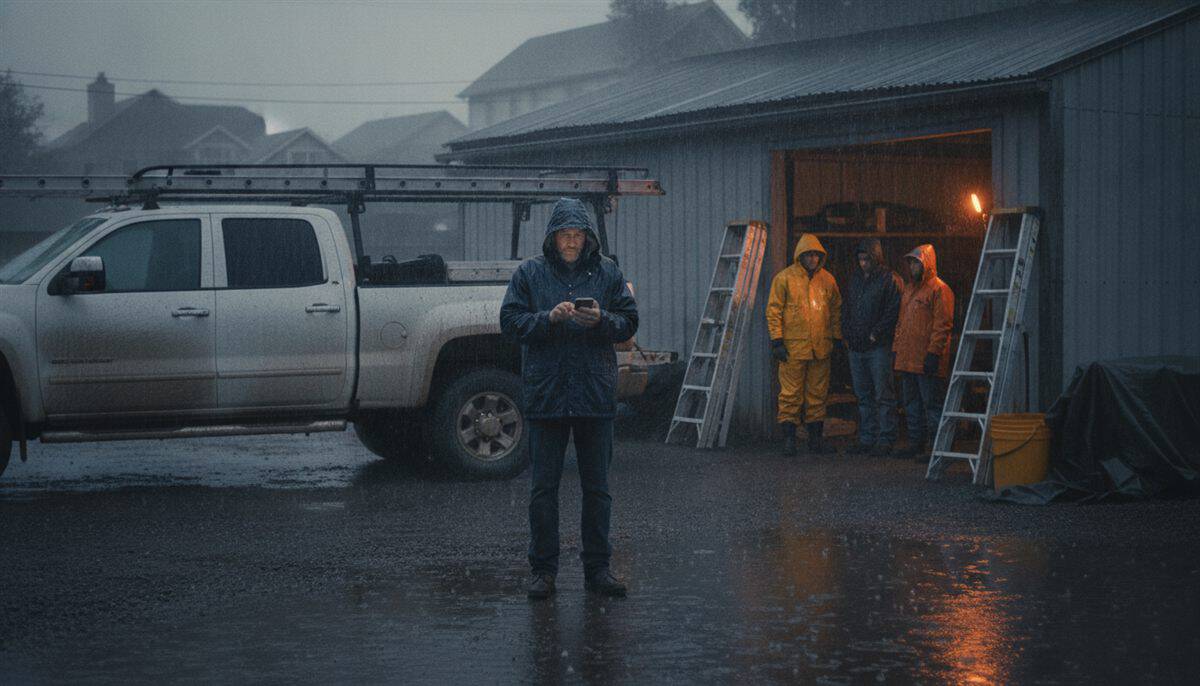
Federal law has no show-up pay, but waiting at the yard and the drive to a rained-out site are working time, a salaried foreman keeps his full week, and seven jurisdictions guarantee reporting time pay. What a weather day costs, state by state, and how to make the 6 a.m. call.
“No work, no pay” is where federal law starts on a rained-out day. For a crew you tell to stay home before they leave the house, it is usually where it ends too. The Fair Labor Standards Act makes you pay hourly workers for the hours they actually work, and federal law has no reporting time pay. But those hours include time your crew spends waiting at the yard for the rain to clear. You also cannot dock a salaried foreman for a day you shut down. And seven jurisdictions, including New York and California, have reporting time pay for a worker you send home, although California excuses weather that makes the work unsafe.
So most of what a weather day costs you comes down to three things. Did the crew hear before they drove in? Did you keep them waiting? And which state is the job in?
The Fair Labor Standards Act (FLSA) is the federal minimum wage and overtime law. The Department of Labor’s Wage and Hour Division enforces it. The Act has no show-up pay rule, but it does define hours worked, and the Department’s interpretation in 29 CFR Part 785 settles most weather-day questions.
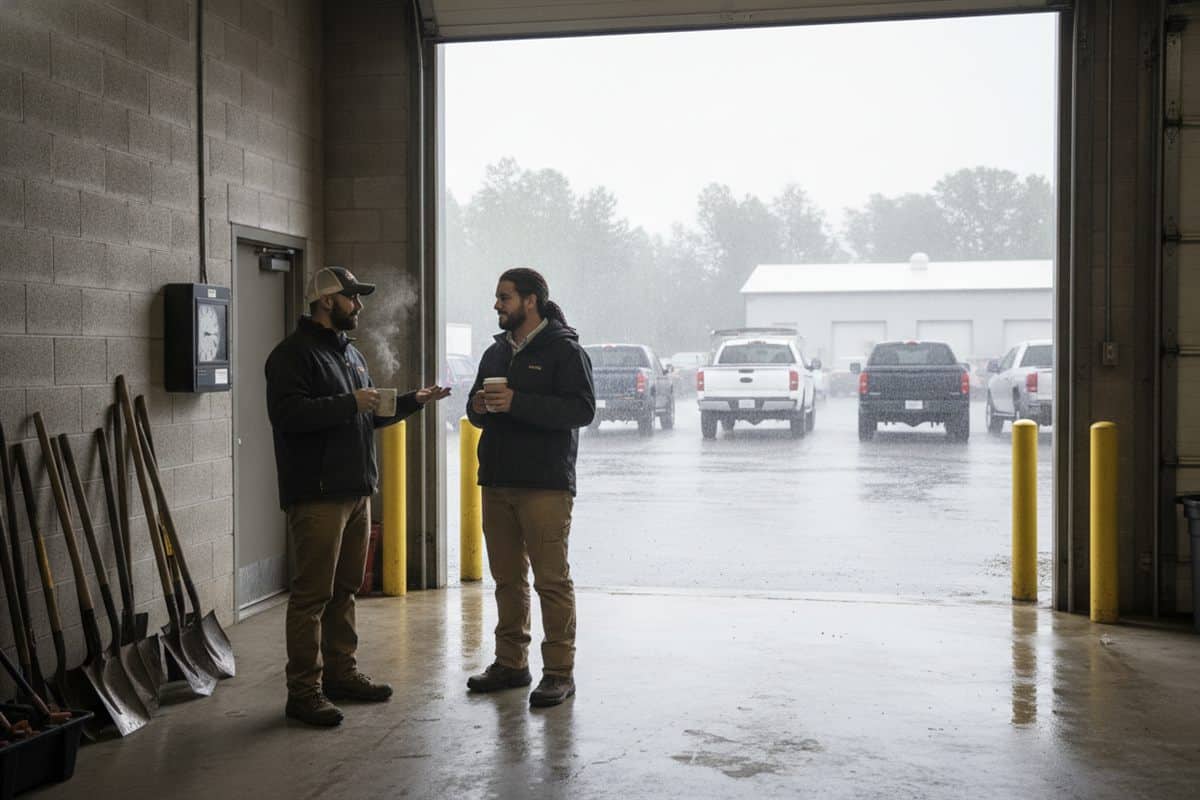
Waiting is the big one. Say you keep the crew at the yard or the site until you know whether the weather will lift. The regulation calls that being “engaged to wait” (section 785.15), and you owe pay for it. The clock only stops when you release them completely and tell them in advance exactly when to come back (section 785.16). “Hang around the shop and we’ll see” counts as working time. “Go home and be back at 1 p.m.” does not, for the gap in between.
Travel works the same way. When your crew meets at the yard to pick up the truck and materials, the drive from the yard to the job is part of the workday under section 785.38. Picture a crew that drives out, gets rained off after twenty minutes and drives back. They have been working the whole time, and you owe the hours.
A foreman or office manager on salary, exempt from overtime, follows a different rule. To keep that exemption, you must pay at least $684 a week, the level the Department of Labor enforces under 29 CFR 541.600. You must also pay it as a fixed salary.
Section 541.602 spells out what that means for a weather shutdown. If the employee is “ready, willing and able to work,” you cannot make deductions “for time when work is not available.” In any week your foreman works at all, he gets the full salary, even if a storm shuts you down on Thursday and Friday. Dock him for those days and you put the exemption at risk, along with his overtime status.
The Department of Labor answered the weather question directly in opinion letter FLSA2005-41. If you close for less than a full workweek, you pay the full salary. You may charge the closed day to his vacation or PTO bank, but an empty bank does not cut his pay. Things change if you stay open and he decides the roads are too bad to come in. That counts as a personal absence, so you can deduct a full day, though never part of one.
Reporting time pay is a state rule that guarantees some pay to an employee who comes in for a scheduled shift and gets less work than expected, or none. California calls it reporting time pay and New York calls it call-in pay. These jurisdictions have a rule that reaches construction and trade crews. We read each one in its official text in October 2026.
| Jurisdiction | What you owe a worker who comes in and goes home | Weather or notice exception in the text |
|---|---|---|
| California (Wage Order 16, section 5) | Half the scheduled day, at least 2 and at most 4 hours, at the regular rate | Yes: an “Act of God or other cause not within the employer’s control” |
| New York (12 NYCRR 142-2.3) | 4 hours or the scheduled shift, whichever is less, at the minimum wage ($17.00 in New York City, Long Island and Westchester; $16.00 elsewhere in 2026) | None written; it applies when the employee reports at your request or with your permission |
| New Jersey (N.J.A.C. 12:56-5.5) | At least 1 hour at the applicable wage rate | None owed if you made the agreed minimum hours available |
| Massachusetts (454 CMR 27.04) | At least 3 hours at no less than the $15.00 minimum wage, for a worker scheduled for 3 hours or more | None written |
| New Hampshire (RSA 275:43-a) | At least 2 hours at the regular rate | None owed if you made a good-faith effort to tell the worker not to come in |
| Rhode Island (R.I. Gen. Laws 28-12-3.2) | At least 3 times the regular hourly rate if the shift gives fewer than 3 hours of work | None written |
| District of Columbia (7 DCMR 907) | 4 hours, or the regular schedule if shorter: the regular rate for hours worked and the minimum wage for the rest | None written |
Watch the pay rate. In New York, a roofer on $35 an hour whom you send home gets call-in pay at the minimum wage, not at $35. California, New Hampshire and Rhode Island use the regular rate, so the same morning costs more there.
It does not cover every state. Connecticut’s minimum daily pay rule reaches only retail and restaurant or hotel workers, and Oregon’s scheduling law covers only large retail, hospitality and food-service employers. We did not check the other states for this article, so confirm your own state’s rule with its labor department. If your crew works under a union agreement, check that too. Collective bargaining agreements often carry their own show-up pay, and it can beat state law.
California is the one jurisdiction above whose text excuses weather. Wage Order 16 is the state’s wage rule for on-site construction and work that needs a contractor’s license. It lifts reporting time pay when “an Act of God or other cause not within the employer’s control” interrupts the work. The Labor Commissioner’s enforcement manual adds that rain or other bad weather qualifies when it makes the work impossible or unsafe.
Two limits come with it. First, the manual is the Labor Commissioner’s enforcement position, not a court ruling. A send-home based only on a forecast, or because it suited the schedule, makes a weaker case. Second, the exception covers the reporting pay, not time the crew actually spent with you. The same manual says employees “must be paid for all time they are restricted to the employer’s premises, or worksite, while ‘waiting out’ a delay.”
You control most of a weather day’s cost in its first hour. This routine works in every state:
The rule of thumb is simple. Tell the crew early and in writing, and a rained-out day costs nothing in most of the country. In the states that guarantee some pay, it costs the minimum. Make the call at the yard instead, and the whole morning goes on the clock.
Either way, weather days belong in what an hour of your crew really costs you, next to payroll taxes and insurance. Our guide to what hiring your first employee costs sets out those other lines. Worker classification explains why none of this applies to a genuine subcontractor. You will find more in our USA business admin guides.
BEFORE THE TRUCKS LEAVE THE YARD
A rained-out day costs least when the crew hears about it first.
The expensive weather day is the one the crew learns about at the yard. SendWork keeps each day’s jobs and crew assignments in one schedule. You can move a rained-out job and see who it was assigned to before anyone drives in.