Go to SendWork
— Free for 7 Days
Full access
Full access

From November 2027, water systems must start replacing the lead lines they control. What that means for plumbers, plus copper prices, water heater rules and PFAS questions.
Of the plumbing industry trends for 2027, the biggest is lead pipe replacement. From November 1, 2027, US water systems must start replacing the lead service lines they control, and most must finish within ten years. Copper tube and fittings now carry a 50% import tariff, and copper mill prices rose about 21% in a year. The federal heat pump water heater credit has ended, while a 2029 federal standard will push most electric tanks toward heat pumps. And by April 2027, water utilities must finish their first round of PFAS testing, so more customers will ask you about the results.
For a plumbing contractor, each of those lands in a different place. One brings new work, one squeezes your margin, and two change what you say at the kitchen table. Here is each one, with the source behind it, as checked in October 2026.
The Lead and Copper Rule Improvements (LCRI) is EPA’s drinking water rule for lead. It sits in 40 CFR Part 141, Subpart I, under the Safe Drinking Water Act. It binds community water systems and non-transient non-community systems, such as schools and factories with their own supply. The rule does not bind homeowners or plumbers, and state drinking water programs enforce it. Systems must comply by November 1, 2027.
From that date, each system must run a replacement program for lead service lines and galvanized lines that need replacing. Most systems must replace every line under their control within ten years, at an average of at least 10% a year. Systems with very many lead lines can take longer, but must still replace at least 39 lines per 1,000 connections a year. Where the system has legal or physical access, the rule counts the line as under its control. That includes the customer’s side of the curb stop. EPA estimates that about 4 million lead and galvanized lines still need replacing nationwide.
The rule does not decide who pays for the customer’s portion. Instead, each system’s replacement plan must say whether it will charge customers. It must also explain how it will help those who cannot pay. Federal money helps here. EPA’s May 2026 allotment memo puts the final annual round of infrastructure-law lead line funding at $2.875 billion. States can apply for it until September 30, 2027.
Here is a hypothetical call you may get in 2027. A homeowner reads you a letter from her water utility. It says her service line is galvanized and the utility plans to replace it. She asks whether she should pay you to do it first. The useful answer starts with the utility’s replacement plan. It tells you whether the utility will charge her, and when her street is scheduled. Then you can quote the work inside the house that the new line may expose, such as a corroded shutoff or an old pressure regulator.
The bigger opportunity may sit on the utility side. Systems that must replace about 10% of their lines a year may need outside crews to do it. If you want that work, ask your local water system how it plans to bid it. Check which license your state requires for work in the public right of way. State timelines can add pressure. In Illinois, the Lead Service Line Replacement and Notification Act, which Illinois EPA enforces, requires community water supplies to submit a final lead line replacement plan by April 15, 2027.
The rule still faces a legal challenge from the American Water Works Association, the water utilities’ trade group. At the D.C. Circuit hearing on September 30, 2026, EPA defended it. The court has not ruled, so the November 2027 date stands for now.
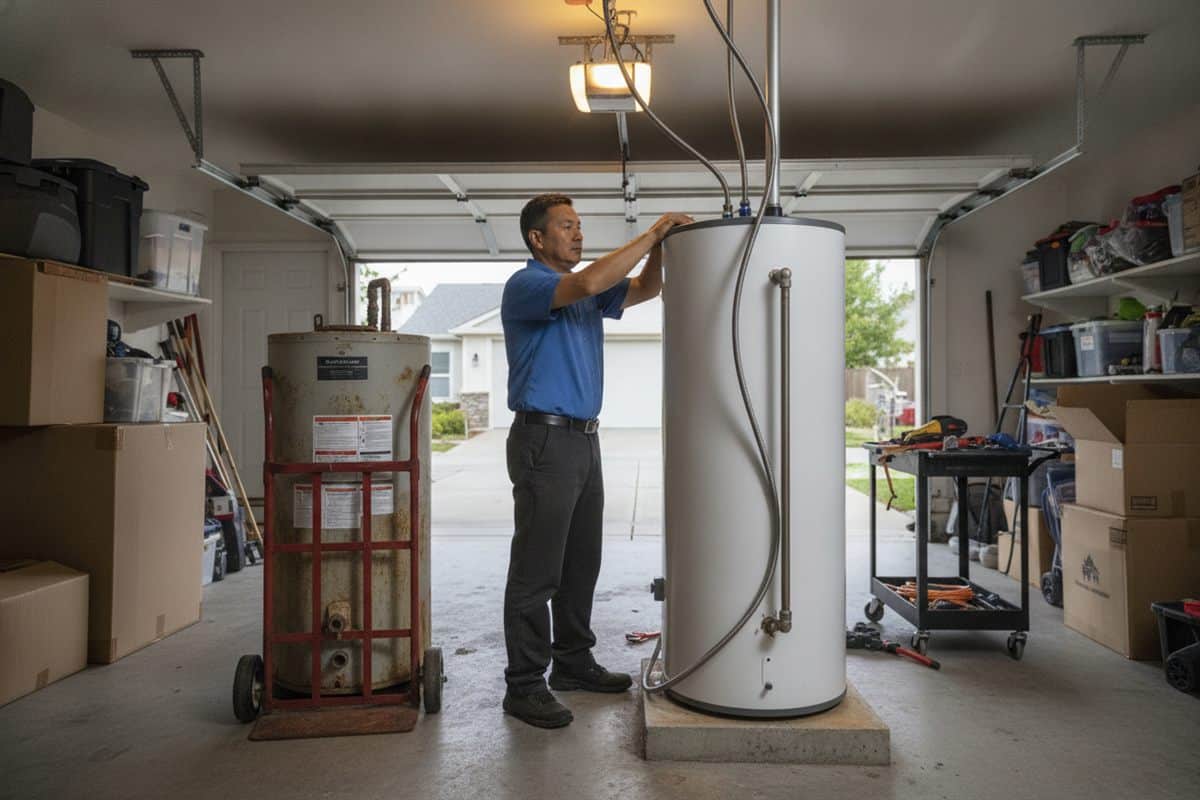
DOE sets minimum efficiency for new residential water heaters under the Energy Policy and Conservation Act. The current standard sits in 10 CFR 430.32(d). From May 6, 2029, most electric storage water heaters of 20 to 55 gallons must reach a uniform energy factor of 2.30. In practice that takes heat pump technology. The date applies to manufacture, so you can still install compliant tanks made earlier. Even so, 2027 is a sensible year to train installers and learn the venting, condensate and space needs.
The federal credit is gone. Section 25C of the tax code paid homeowners up to $2,000 a year toward a heat pump water heater. Public Law 119-21, the budget law signed on July 4, 2025, ended it for property placed in service after December 31, 2025. Our guide to what your quotes should say now covers the customer conversation.
State rebates still exist, but with narrower rules. The High-Efficiency Electric Home Rebate program, which DOE first marketed as HEAR, runs on Inflation Reduction Act money under 42 U.S.C. 18795a. Each state energy office decides whether to launch it. Where a state has, it can pay up to $1,750 toward a heat pump water heater for households below 150% of area median income. Since May 29, 2026, DOE Program Notice 26-2 has limited new rebates to upgrades from existing electric equipment. So a heat pump replacing an electric tank may qualify, but a switch from gas generally will not. Check your state’s program before you mention a rebate on a quote.
Two other water heater rules moved. Congress cancelled DOE’s 2024 efficiency standard for gas tankless water heaters in May 2025, so that rule will not take effect. For commercial gas water heaters, DOE will not seek penalties on units made before October 6, 2027. A Bay Area rule also matters if you work there. Air District Rule 9-6 sets a zero-NOx standard for water heaters under 75,001 Btu/h made from January 1, 2027. Draft amendments would push that to 2028, and the board hears them on November 4, 2026.
Section 232 tariffs are import duties that the President sets by proclamation, under the Trade Expansion Act of 1962. Since August 1, 2025, Proclamation 10962 has put a 50% tariff on semi-finished copper. That covers copper pipe and tube. Since April 6, 2026, a later proclamation has applied it to the full value of the product. Its 50% list, as published in April 2026, includes copper and brass tubes, pipes and fittings.
Prices have climbed too. In the producer price index from the Bureau of Labor Statistics, copper and brass mill shapes rose 20.9% from August 2025 to August 2026, on preliminary figures. Plastics pipe rose 4.6% over the same year. The 2025 proclamation also floated a 15% tariff on refined copper from January 1, 2027. No decision on it had appeared by early October 2026.
Build that into your quotes. Shorten how long a copper-heavy quote stays valid, price copper at order date on longer jobs, and put an adjustment clause in writing. Where the code and the customer allow it, quote the PEX or CPVC option beside the copper one. Our piece on protecting a bid from material price changes covers the clause, and our guide to setting plumber rates in the USA covers the labor side.
PFAS are the long-lasting “forever chemicals.” EPA’s 2024 drinking water regulation for them is mandatory for community and non-transient non-community water systems, and it sits in 40 CFR Part 141. Under it, systems must finish their first round of PFAS monitoring, including reporting to the state, by April 26, 2027. The legal limits apply from April 26, 2029. In May 2026 EPA proposed letting systems ask for more time on PFOA and PFOS, to 2031, and dropping the limits for four other PFAS. Neither proposal is final.
Once results go public, some customers will ask you about filters. Be careful what you promise. EPA tells households to look for filters certified for PFAS to NSF/ANSI 53 or 58, which are voluntary product certification standards from NSF International. But EPA’s own guidance says those certifications “do not yet indicate” removal down to the new federal limits. Quote the certified product and its listed claim, and leave the health claims to the utility and the manufacturer.
Remodeling is slowing rather than shrinking. Harvard’s Joint Center for Housing Studies projects $519 billion in homeowner improvement and repair spending through mid-2027. It expects annual growth to slow to 0.5% by the second quarter of 2027. New construction is flat. The Census Bureau put August 2026 housing starts at an annual rate of 1,275,000, down 1.2% on a year earlier. Read together, those numbers point to a year when repair, replacement and mandated work matter more than new builds.
Labor stays tight. The Bureau of Labor Statistics puts the median wage for plumbers, pipefitters and steamfitters at $63,800 in May 2025. It projects 7% job growth from 2025 to 2035, with about 42,000 openings a year. If you plan to chase lead line contracts, hire and train for them early. And if busy months still leave little profit, our guide to building a plumbing business that is actually profitable is the place to start.
The model codes change too, but more slowly. IAPMO published the 2027 Uniform Plumbing Code in June 2026, with new sizing rules for tankless and dual-purpose water heaters. ICC expects the 2027 International Plumbing Code in early October 2026. Neither applies anywhere until your state or city adopts it.
| Date | What happens | Status in October 2026 |
|---|---|---|
| January 1, 2027 | Bay Area zero-NOx standard for water heaters under 75,001 Btu/h | Adopted; draft delay to 2028 heard on November 4, 2026 |
| April 15, 2027 | Illinois water supplies submit final lead line replacement plans | In force |
| April 26, 2027 | Water systems finish initial PFAS monitoring and report to the state | In force |
| September 30, 2027 | Last day for states to apply for the final federal lead line funding round | In force |
| October 6, 2027 | DOE’s penalty forbearance ends for commercial gas water heaters made from this date (a manufacturer rule) | Enforcement policy |
| November 1, 2027 | Lead service line replacement programs must start | In force; court ruling pending |
| May 6, 2029 | Most 20 to 55 gallon electric tanks made from this date must reach heat pump efficiency | In force |
Ten percent of the lines, every year
Steady mandated work rewards the shop that can keep its crews booked.
Lead line programs run street by street for ten years, on top of your service calls. SendWork keeps each day’s jobs, addresses and crew assignments in one schedule, so a utility job and a burst pipe can share the same week without a phone chain.