Go to SendWork
— Free for 7 Days
Full access
Full access


Passing inspection is not the same as complying. Here's where renovation work creates ADA exposure, which dimensions actually fail, and who ends up paying.
A tenant-improvement crew finishes a dental office in a strip mall. The city inspector signs off. The certificate of occupancy goes up behind the front desk. Fourteen months later the practice owner is served. The complaint names the restroom door, the ramp at the side entrance, and the reception counter. All three passed inspection. None of them met the 2010 ADA Standards. That gap is where ADA compliance contractors get caught, because the sign-off everyone relied on was never an ADA sign-off in the first place.
The bill does not stop with the owner, either. You are rarely the entity the statute targets. Yet you are the one named in the back-charge, the rework order, or the third-party claim your client files to spread the loss. That demand arrives long after retainage was released. By then the crew has moved on, the subs are paid, and the correction comes out of this year’s margin.
Building departments enforce the building code. They do not enforce the ADA, and they are not authorized to. The US Access Board puts it plainly: there is no plan review or permitting process under the ADA, and an occupancy permit does not ensure compliance. Some departments even print a disclaimer on their plan checks saying so.
The confusion is understandable. Most jurisdictions adopt the International Building Code, which references ICC A117.1 for accessibility. That standard is substantively similar to the 2010 ADA Standards. It is not identical. Scoping provisions diverge, and the ADA applies nationally on top of whatever the local code requires. So a project can satisfy the inspector, collect its certificate of occupancy, and still carry federal exposure.
Enforcement then arrives from a completely different direction. The ADA is a civil rights statute, enforced through Justice Department investigations and private lawsuits rather than through the permit counter. No agency certifies your finished work as compliant. That absence is the real problem, because it removes a checkpoint most operators assume is there. Compare OSHA compliance, where an inspector may genuinely turn up on your site. Here, nothing external tells you this went wrong until someone files.
Renovation is where exposure concentrates. Under Title III, altering an area that contains a primary function triggers a second obligation. The path of travel to that area has to be made accessible too. So do the restrooms, drinking fountains, and telephones serving it.
That obligation is capped, though. Costs count as disproportionate once they exceed 20% of the cost of the alteration to the primary function area. Below that line, the work is owed. Above it, you do what the budget reaches, in a priority order the regulation actually sets out: an accessible entrance first, then the route to the altered area, then at least one accessible restroom, then telephones, then drinking fountains.
Two provisions catch people. First, the duty cannot be dodged by splitting one renovation into a series of small alterations served by the same path of travel. Second, a safe harbor runs the other way. Elements already built to the 1991 Standards need no retrofit merely because you altered a primary function area they serve. Read both before you price the job, alongside the license requirements in the state you are bidding.
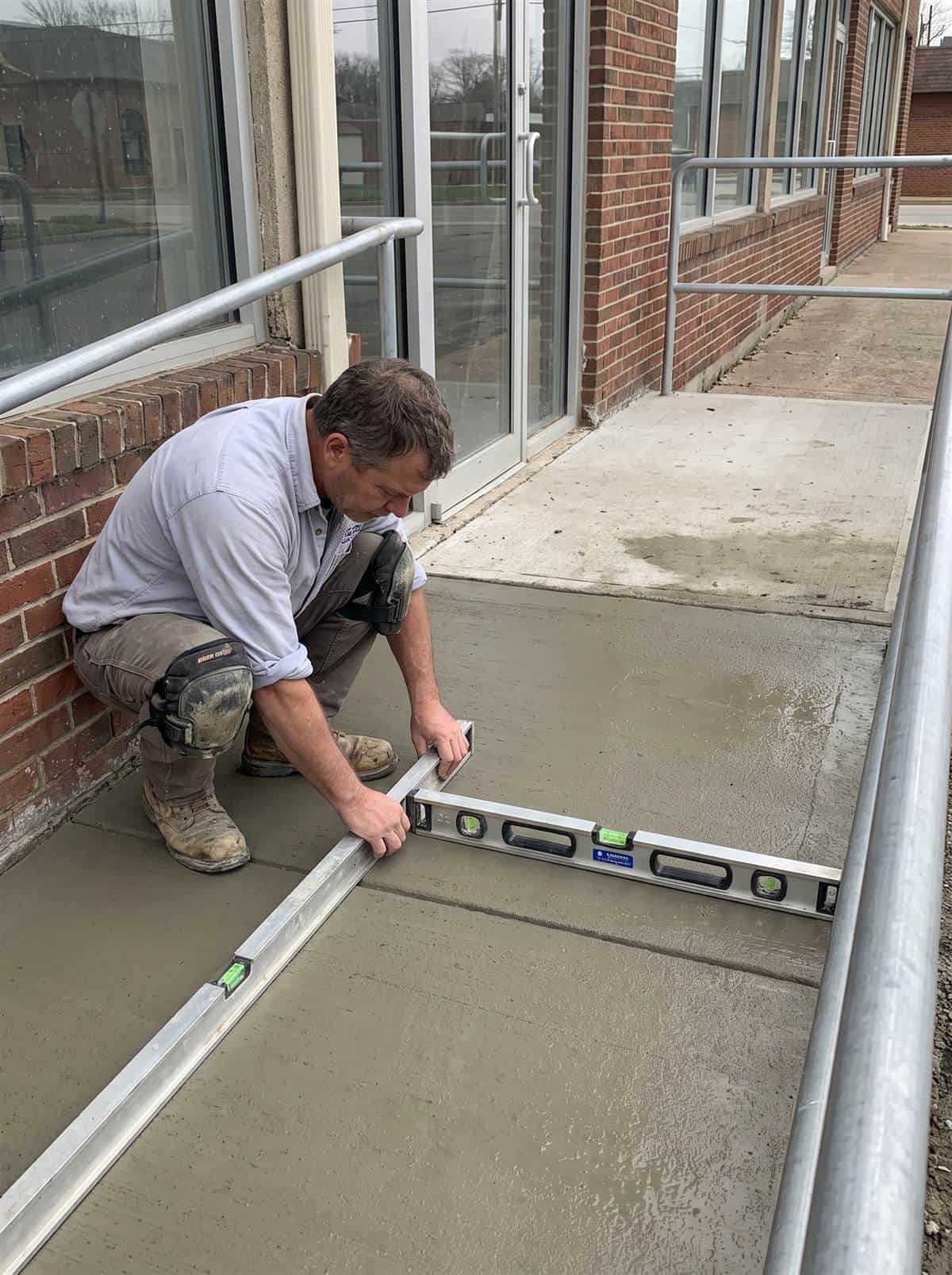
Field changes are the usual culprit. A grab bar shifted an inch to catch blocking. Then a threshold raised by new flooring. Or a ramp poured to grade instead of to slope. Each is small, defensible in the moment, and independently enough to fail.
| Element | 2010 Standard | Where it goes wrong on site |
|---|---|---|
| Door clear opening | 32 in. minimum, measured with the door open 90 degrees | A 36 in. slab loses clear width to the stop and the hardware |
| Accessible route | 36 in. clear width, narrowing to 32 in. for no more than 24 in. | Extinguisher cabinets, fountains, and shelving pinch the corridor |
| Threshold | 1/2 in. maximum, beveled above 1/4 in. | New flooring builds up over an existing sill |
| Ramp running slope | 1:12 maximum, with a 30 in. maximum rise per run | Concrete poured to drainage rather than to a measured slope |
| Cross slope | 1:48 maximum | Exterior landings pitched for runoff |
| Turning space | 60 in. diameter, or a 60 in. T-shape | A restroom trimmed to fit a plumbing chase |
| Grab bars | Mounted 33 to 36 in. above the finished floor | Blocking set to a habit height instead of a dimension |
| Operable parts | Within a 15 to 48 in. reach range | Thermostats, dispensers, and switches set by trade convention |
Measure the clear opening, never the door. That one habit prevents the most common finding on the list.
Existing buildings are not grandfathered, whatever a client tells you. Title III puts an ongoing duty on public accommodations to remove architectural barriers where removal is readily achievable. That means easily accomplishable without much difficulty or expense. That standard flexes with the size and resources of the business. It does not vanish.
Strictly, the duty belongs to the owner or the tenant. You are not the covered entity. Yet the practical allocation runs through your contract, and it usually runs downhill toward you. Indemnity clauses, warranty language, and a plain assumption that the builder knew the standard all push the cost your way.
Here is the judgment worth carrying off this article. On accessibility work, documentation outranks craftsmanship. The contractor who recorded what he was told to build stands far better than one who simply built it well. Get the direction in writing. Flag the deviation in writing. Then price the flag rather than quietly absorbing it. A dimension you queried and were overruled on is a different conversation from a dimension nobody can account for.
Capture it while it happens, rather than at closeout. Photographs and field notes logged against the job in SendWork stay attached to that project. They do not sit in a phone gallery nobody can search two years later.
The Justice Department can seek civil penalties in Title III cases it brings itself. Current maximums are $118,225 for a first violation and $236,451 for each subsequent one. Those took effect on 3 July 2025. DOJ then confirmed on 15 July 2026 that they do not rise this year, because no cost-of-living adjustment applies for 2026. Note the limit on them, though. Only government-initiated cases reach those figures. A private plaintiff cannot trigger the penalty and typically pursues injunctive relief plus attorney’s fees instead.
Money also moves the other way, and hardly anyone claims it. Two federal incentives sit on the books. The Disabled Access Credit under Section 44 covers half of eligible access expenditures above $250, up to $10,250. That caps the credit at $5,000. It is claimed on Form 8826. Eligibility runs to businesses with $1 million or less in gross receipts, or 30 or fewer full-time employees, in the prior tax year. Separately, Section 190 lets a business of any size deduct up to $15,000 a year for barrier removal. Where expenses qualify under both, both can be used.
Mention these to your clients. It is the cheapest way to move an accessibility line item from a grudge purchase to an approved one. Approved work gets built properly instead of value-engineered away. Eligibility turns on the client’s own tax position, so send them to their accountant for the arithmetic.
Run this before you demobilize, rather than after a demand letter turns up:
Accessibility is the one obligation that sits outside every system a contractor is trained to trust. No inspector clears it, no certificate closes it, and the clock on it runs for years after the punch list. So the only workable defense is a measured, photographed, written record of what you built and why. Much of that overlaps with paperwork you already produce for licensing and insurance. So the marginal effort is smaller than it sounds. The US Access Board publishes a plain-language guide to using the ADA Standards. Check a dimension there before the pour rather than after it. Build to the number, keep the proof, and the fourteen-month-old demand letter becomes somebody else’s problem.
ON THE SIGN-OFF THAT ISN’T ONE
The job closed two years ago. The question about it arrives today.
Field changes, approvals, and site photos are worth nothing if nobody can find them. SendWork keeps each job’s documents, photos, and client history attached to the project. An old job then answers for itself years later.