Go to SendWork
— Free for 7 Days
Full access
Full access


In any building put up or refurbished before 2000, the law expects you to know whether asbestos is present before you disturb anything. Who holds the asbestos register, when a refurbishment survey is needed, and which work needs a licence.
Before you drill, cut, sand or strip anything in a building built or refurbished before 2000, the law expects you to know whether asbestos is there. If you can’t establish that, you must assume it is and work accordingly. In an office, shop, school or the common parts of a block of flats, that starts with asking for the asbestos register. In a private house nobody holds one, so the check is yours. And if the job breaks into the fabric of the building, a management survey may not be enough.
The rules are in the Control of Asbestos Regulations 2012. They are binding law in Great Britain, made under the Health and Safety at Work etc. Act 1974 and enforced by the Health and Safety Executive (HSE) and local councils. HSE’s Approved Code of Practice, L143, explains how to comply and carries special legal weight if a case goes to court. Northern Ireland has its own, separate Control of Asbestos Regulations (Northern Ireland) 2012.
Regulation 5 applies before any work that could disturb asbestos, in homes as well as workplaces. An employer must not start demolition, maintenance or other work that could expose their workers to asbestos unless they have done one of two things. The first is an assessment of whether asbestos is present, what type, in what material and in what condition. The second is to assume it is present, and that it is “not chrysotile alone”, and follow the Regulations on that basis.
If you work for yourself, regulation 3 treats you as both the employer and the employee. So a sole trader electrician has the same duty as a firm of fifty, for their own safety and for anyone else in the house.
Why 2000? The UK banned imports of blue and brown asbestos in 1985 and white asbestos in 1999, according to the UK Health Security Agency. HSE says asbestos can be present today in any building built or refurbished before 2000. Its July 2026 statistics put asbestos-related deaths at around 5,000 a year, and skilled trades were the only major occupational group of men with a significantly raised mesothelioma death rate.
In non-domestic premises, regulation 4 puts a duty to manage asbestos on the dutyholder. That’s whoever has a contract or tenancy obligation to maintain or repair the building, or whoever controls it where nobody does. The dutyholder has to record where the asbestos is and what condition it’s in. That information must reach “every person liable to disturb it”. You, as the contractor, have to cooperate with them.
The same duty covers the common parts of flats: foyers, corridors, stairs, lift shafts, roof spaces and shared garages. It doesn’t cover the inside of each individual flat. So before you quote for a landlord, a managing agent or a commercial client, ask for the asbestos register and the survey behind it. Then read what it says about the rooms you’ll be working in.
The duty to manage doesn’t apply to private houses. HSE is plain about the homeowner’s position. Someone living in their own home isn’t carrying out a work activity, so the law doesn’t make them responsible for risks to contractors. Regulation 4 doesn’t reach a tenanted house either, though HSE’s survey guide notes that landlord organisations still have general health and safety duties.
That leaves regulation 5 with you. Before work starts, look at what you’re about to disturb, and check the house’s build date and any refurbishment since. HSE’s guidance names pipe lagging, insulating panels, asbestos cement and sprayed coatings among its past uses. Asbestos can also hide in places such as cavity walls. HSE’s task sheets add textured coatings, insulating board and vinyl floor tiles. Ask the customer what they know, but don’t treat “I don’t think there’s any” as an assessment.
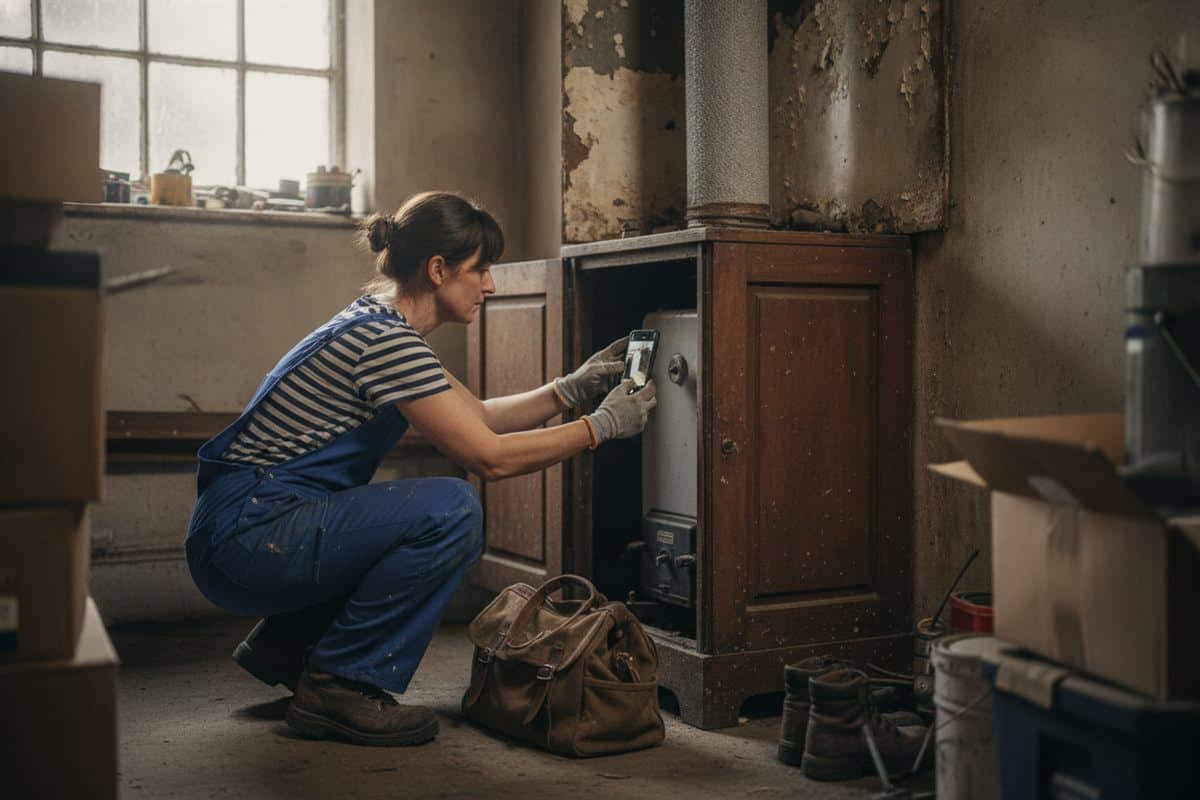
HSE’s survey guide, HSG264, describes two kinds of asbestos survey. A management survey is the standard survey. It looks for asbestos that normal use and routine maintenance could damage or disturb. A refurbishment and demolition survey is more intrusive. HSG264 says you need one “before any refurbishment or demolition work is carried out”, and intrusive maintenance and repair may need one too.
For a tradesperson, the practical line is this. Replacing a socket face only touches what’s already exposed. Chasing a wall for a rewire, lifting floors for a heating run or opening up a ceiling breaks into the fabric. HSE tells employers that may call for a refurbishment survey. HSG264 also says you must presume asbestos in any area a survey didn’t reach, unless there’s strong evidence it isn’t there.
If asbestos is present, or you’re presuming it is, the type of work decides who can do it. The Regulations set three categories. The examples below are HSE’s.
| Category | Examples | What it needs |
|---|---|---|
| Licensed work | Sprayed coatings, pipe lagging, loose fill, millboard, and most work on asbestos insulating board (AIB) | An HSE-licensed contractor, written notice to the enforcing authority at least 14 days before, and medicals every 2 years |
| Notifiable non-licensed work | Short-duration removal of AIB during refurbishment, minor repair of damaged pipe insulation, asbestos cement sheets that are badly broken up | Online notification to HSE before work starts, medicals at least every 3 years, and records kept for 40 years |
| Non-licensed work | Drilling textured coatings to put up fittings, drilling a few holes in AIB for short durations, maintenance on intact asbestos cement or vinyl tiles | A risk assessment, a written plan of work, trained workers and the right controls |
The dividing line for AIB is short duration. Under regulation 2, work isn’t short duration if it takes more than two hours in total in any seven days. The same applies if any one person does it for more than one hour. HSE’s task sheet A1 for drilling AIB includes a method for one to five holes up to 20 mm across in board less than 6 mm thick, within those limits. Beyond them, the job belongs to a licensed contractor. HSE’s advice to workers is blunt: if in doubt, assume the work needs a licence and stop until someone tells you otherwise.
Halfway through a job, you lift a floor or open a boxed-in pipe and find something that looks like asbestos. HSE’s sheet EM1 sets out what to do:
If any waste does contain asbestos, it’s hazardous waste. It goes double-wrapped and labelled to a permitted site, with a registered carrier and a consignment note. Our guide to waste carrier registration covers the carrying side.
Regulation 10 requires information, instruction and training at regular intervals for anyone liable to disturb asbestos. HSE lists electricians, plumbers, joiners, painters and decorators, plasterers, gas fitters and heating engineers among those who need asbestos awareness training. Awareness training doesn’t qualify anyone to work on asbestos. It teaches you to recognise it and stop. Work in the non-licensed and notifiable categories needs its own training, and L143 expects a refresher every year. For awareness training, L143 says the law doesn’t require a formal course every 12 months, though it still expects some refresher.
Keep the training certificates for everyone on the crew, and keep the asbestos register, survey or your own assessment with the job. If a client or inspector asks how you knew the ceiling was safe to drill, that’s your answer.
The cheapest point to deal with asbestos is before you and the customer agree a price. On a pre-2000 property, ask for the register or survey before you quote. Where none exists and the work breaks into the fabric, say in writing whether the job needs a refurbishment survey and who arranges it. State what happens to the price and the programme if suspect material turns up. A clear line in the quote turns a stopped job into a change everyone expected, not an argument on site.
On a bigger project, the asbestos information is part of the pre-construction information the client has to provide, and the CDM duty holders guide explains who must supply what. For electrical work in homes, the Part P rules sit alongside all of this. More regulation guides for UK trades are in our UK licensing and regulations section.
The duty doesn’t change with the size of the job. A two-hole shelf bracket in a 1970s kitchen and a full rewire both start with the same question: what’s in the wall, and how do you know?
BEFORE ANYONE PICKS UP A DRILL
Make sure the whole crew sees the asbestos note on the job.
The survey only helps if the person drilling has read it. SendWork keeps job notes and the client’s details on each job and shares them with everyone assigned to it, so the warning travels with the work.