Go to SendWork
— Free for 7 Days
Full access
Full access

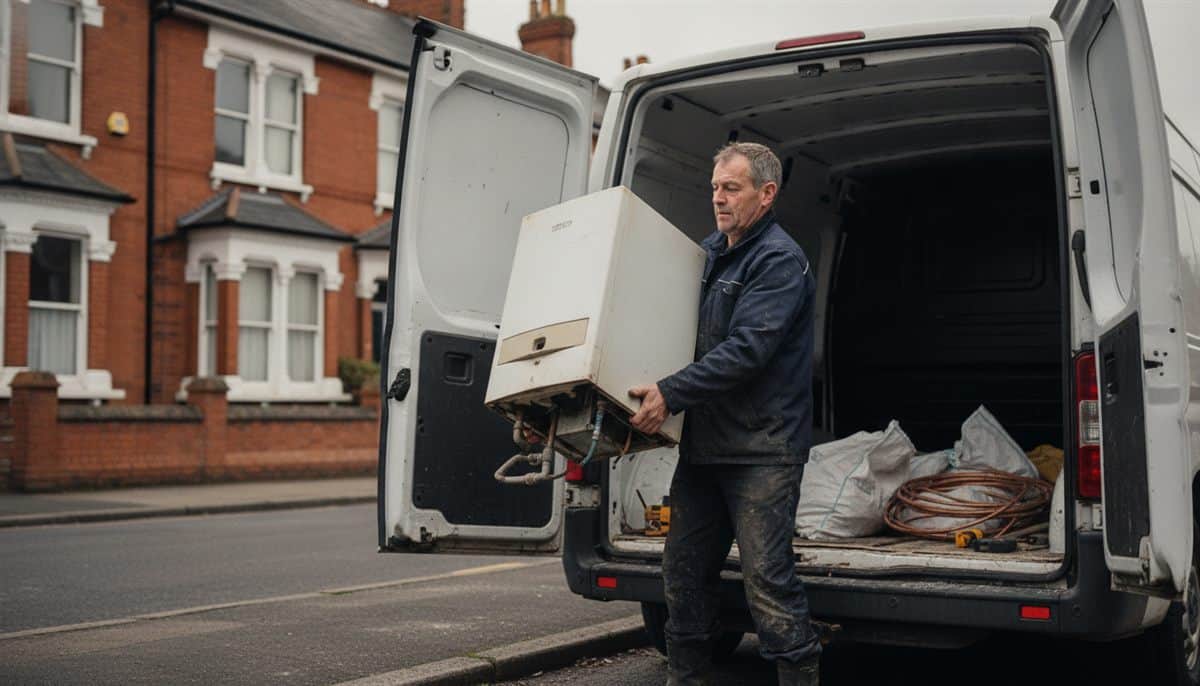
Most trades who take away what they rip out need upper-tier waste carrier registration, because repair and refit waste counts as construction waste. What it costs, the paperwork each load needs, and what England's 2027 permits change.
The new combi is on the wall and commissioned, and the old boiler is going in the back of the van with the copper offcuts. For the next hour you are not just a heating engineer. You are a waste carrier, and in England the kind of waste carrier registration you hold matters.
Waste carrier registration is the Environment Agency’s register of businesses allowed to transport waste in England. It is a legal requirement, not a trade badge: carrying waste for your business without it is a criminal offence. The rules are in the Waste (England and Wales) Regulations 2011, and the register has two tiers.
Most tradespeople who take away what they rip out need the upper tier of waste carrier registration, not the free lower tier, because what comes out of a repair or refit counts as construction waste. Here is where that line sits, what registration costs, the paperwork that goes with each load, and what the new permits replacing registration in England from July 2027 will mean for a small trade business.
The lower tier is free and never expires, and it covers a business that only carries waste it produces itself. There is one big exception. Under regulation 24 of those Regulations, the free tier does not cover construction or demolition waste, and “construction” is defined to include improvement, repair and alteration.
That definition is what catches most trades. The boiler you replaced, the bath from a bathroom refit, the consumer unit you swapped and the rubble from knocking through a wall all come out of repair, improvement or alteration work. Carrying them, even though they are your own waste from your own job, puts you on the upper tier. Natural Resources Wales, working from the same regulations, gives plumbers and electricians carrying removed sinks and baths as an example of upper-tier carrying.
Waste from your work that is not building work can stay on the lower tier. Grass cuttings and hedge trimmings from a maintenance round are one example. Lift the old patio for the same customer, though, and the slabs are construction waste. And anything you carry for someone else, or for money as a clearance job, is upper tier whatever it is.
In England, the Environment Agency charges £191.02 for a new upper-tier registration, which lasts three years. Renewing costs £130.25. You apply through the GOV.UK waste carrier service, and your registration number starts with CB.
Two details matter later on. The registration belongs to the business, so moving from sole trader to limited company means a new registration at the full fee, not a transfer. And changes to your contact details, the people running the business or any relevant conviction have to be reported within 28 days.
If you are pricing the job properly, the tip fees and the registration are part of what the customer pays for. The guide to builders’ rates makes the same point about waste sitting inside the price of an outcome, not on top of a day rate.
Registration is one half. The other is the duty of care under section 34 of the Environmental Protection Act 1990. Anyone who produces or carries waste has to keep it secure, and pass it only to someone authorised to take it, with a written description.
For a job at someone’s home, the government’s duty of care code is clear about whose waste it is. “If a tradesperson carries out work on your property, they are responsible for the waste they produce including its transport and disposal.” The homeowner is not handing the waste to you, so there is usually no transfer note at the doorstep. The note comes when you hand the load on, at the merchant’s skip, the transfer station or the scrap yard.
A waste transfer note has to record:
Keep each note for at least two years, and be ready to produce it within seven days if the Environment Agency or the council asks. An invoice from the receiving site can serve as the note if it carries all of that information.
Things change when the customer asks you to take their own rubbish as well: the old wardrobe, the garden junk, the boxes in the garage. That waste was theirs, so their duty of care applies. Councils can fine a householder whose waste is fly-tipped by an unregistered carrier, with a default fixed penalty of £200 that a council can set anywhere from £150 to £600. That is why more customers are checking the Environment Agency’s public register before they hand anything over. A registration number on the quote answers the question before it is asked.

Some of what comes out of a job is hazardous waste, and that has its own paperwork. GOV.UK’s examples include asbestos, oils, batteries and equipment containing ozone-depleting substances such as fridges. The List of Waste also marks fluorescent tubes and other mercury-containing waste as hazardous. For an electrician or an air-conditioning engineer, that covers tubes and refrigerant-containing equipment.
Moving hazardous waste needs a consignment note rather than a transfer note. The exception for domestic hazardous waste removed from a household does not extend to asbestos. Where you work on a home and asbestos comes out, you are treated as its producer and consignor, which puts the note in your name. Older boilers can contain asbestos rope or panels, so check before it goes in the van, not after. Consignment records are kept for three years.
Carrying controlled waste in the course of business without being registered is a criminal offence. GOV.UK is blunt: “You can get an unlimited fine if you do not register.” Separately, failing to produce proof of registration when an officer asks can bring a £300 fixed penalty. The Environment Agency, the police and council officers can also stop, search and seize a vehicle used in waste offences.
The honest arithmetic is simple. Three years of registration costs less than many trades charge for a day, and the risk it removes includes the van itself.
Registration in England is being replaced by environmental permits. The Environmental Permitting (Waste Controlling or Transporting) Regulations, SI 2026/873, were made on 22 July 2026. The main regime starts 12 months later, in July 2027.
What that means for a small trade business, from the regulations and the government’s policy paper:
Digital waste tracking is coming alongside. It becomes compulsory for permitted receiving sites from 1 October 2026. For carriers it is still a plan, with a government target of October 2027 and no legislation yet.
None of this changes what you need today. If you carry repair or construction waste without an upper-tier registration, register now. The new permit follows from your current registration’s expiry date, so knowing that date is the first step towards 2027.
| Nation | Carrying your own construction waste | Upper-tier cost | From 2027 |
|---|---|---|---|
| England | Upper tier | £191.02 new, £130.25 renewal (3 years) | Permits replace registration |
| Wales | Upper tier | £184 new, £126 renewal (3 years) | Not part of the England reform |
| Scotland | Free “transporting your own waste” registration | £304.10 new, £198.55 renewal for carrying others’ waste | Rules changed on 1 November 2025 |
| Northern Ireland | Upper tier | £180 new, £90 renewal (3 years) | Not part of the England reform |
Scotland is the outlier. Under its authorisation system, SEPA says a business producing its own construction and demolition waste needs only the free “transporting your own waste” authorisation. Anyone carrying other people’s waste pays the higher fee.
If anything you take away came out of a building you worked on, you need upper-tier waste carrier registration in England, Wales and Northern Ireland. Scotland needs its own-waste authorisation. Put the number on your quotes, get a transfer note wherever you hand a load on and keep it for two years, and treat anything that might be asbestos as a separate job. Then note your registration’s expiry date. From July 2027 in England, that date decides when your permit application is due.
AFTER THE STRIP-OUT
Two years from now, the question will be which job that load came from.
A transfer note only helps if you can match it to the job it came from. SendWork keeps each job’s notes and history against the customer and the address, so the date, the site and what came out of it are in one place when someone asks.