Go to SendWork
— Free for 7 Days
Full access
Full access

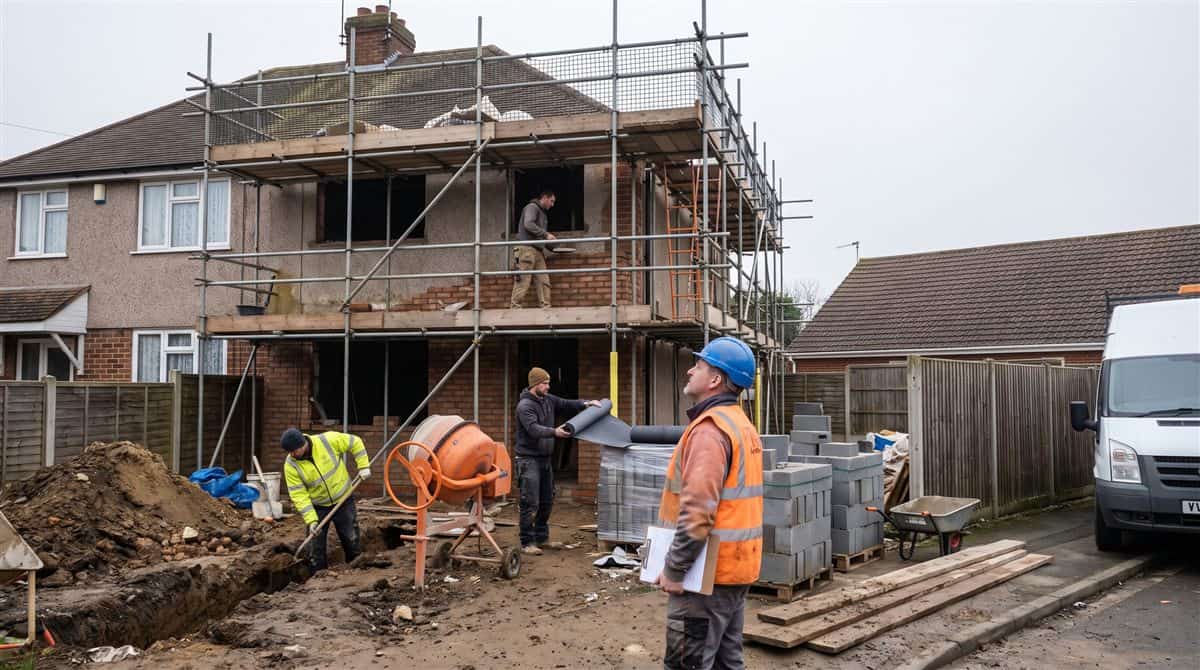
The CDM Regulations cover every construction project, not just big ones. Here's who holds which duty, and how a domestic client's duties land on the builder.
A two-storey extension on a semi in the Midlands. One builder, one groundworker, one roofer, one electrician. The homeowner engaged them separately because a friend told her it would save money, and it did, until an operative went off a hop-up and broke a wrist. The inspector’s first question was not about the platform. It was who the principal contractor was, and whether there was a construction phase plan.
Nobody had appointed anyone. Nobody had written anything down. And because the client was a domestic client who had not made the appointments in writing, the duties did not simply evaporate — they landed on the contractor doing the work. The builder discovered he had been the principal contractor for eleven weeks without knowing it, which is the single most expensive misunderstanding in the CDM Regulations.
The assumption underneath it is common and wrong. Small jobs are not outside the regime.
This is the myth worth killing first. The Construction (Design and Management) Regulations apply to all construction work, whatever the size, whatever the duration, and whether the client is a developer or a householder. There is no lower threshold below which the regime switches off.
What thresholds do is change which duties bite. A single-contractor job on a domestic property still needs a construction phase plan, proportionate to the risk. Add a second contractor and the picture changes materially, because written appointments are then required and two new roles appear. Consequently the practical question is never whether the regulations apply. It is which version of them applies to this job.
Six roles carry duties, and one person or firm can hold more than one of them at once. That last point catches people out on small jobs, where a builder may be contractor, principal contractor and, in effect, designer.
THE DUTY HOLDERS AND WHAT SITS ON EACH
| Role | Core duty | Where it usually goes wrong |
|---|---|---|
| Client | Make suitable arrangements, provide pre-construction information, appoint in writing | Appointments made verbally, or never made at all |
| Principal designer | Plan and manage the pre-construction phase, compile the health and safety file | Assumed to be the architect without anyone confirming it |
| Principal contractor | Plan and manage the construction phase, produce the construction phase plan | Inherited by default on domestic work, unnoticed |
| Designer | Eliminate or reduce risk through design decisions | Anyone specifying a detail is designing, including the builder |
| Contractor | Plan, manage and monitor their own work; check competence downstream | Treating the plan as the principal contractor’s problem alone |
| Worker | Cooperate, report risks, follow the arrangements | Nobody told them what the arrangements were |
Roles are functional, not job titles. If you are performing the function, you hold the duty, whatever the contract calls you.
Notice the competence thread running through the whole table. Every appointment carries a duty to check that the appointee has the skills, knowledge, training and experience for the work. That is the legal duty a site card is standing in for, which is why the schemes behind a CSCS card matter more than the plastic does. For gas work, the equivalent check is a registration duty with real criminal consequences, as covered in our guide to Gas Safe registration.

Householders are clients under the regulations. However, their client duties normally transfer automatically, which is a sensible policy that produces a predictable accident.
Where there is one contractor, the client’s duties pass to that contractor. Where there is more than one, they pass to the principal contractor. If the domestic client never made a written appointment, the contractor in charge of the construction phase is generally treated as holding the role anyway. Therefore the builder on a domestic extension with several trades is very often the principal contractor and the client, simultaneously, without a single document saying so.
None of this is exotic. It is simply invisible until an inspector asks.
Notification is a separate question from duty, and the two get conflated constantly. A project is notifiable to the enforcing authority when it runs beyond thirty working days with more than twenty people working simultaneously at any point, or when it exceeds five hundred person-days.
Notification does not make the duties apply, because they applied already. Equally, a project below those thresholds is not exempt from anything except the notice itself. The form is the client’s responsibility, which on domestic work means it usually becomes the contractor’s in practice.
Here is a live source of confusion worth naming plainly. Building regulations in England now carry their own dutyholder regime, with roles also called principal designer and principal contractor. Those roles sit under the building safety framework rather than under health and safety law, and they are appointed for different purposes.
In practice the same firm may hold both, or two different firms may hold one each. Either way, an appointment under one regime is not an appointment under the other. Neither, incidentally, is the same thing as the approval the work itself needs, which runs on its own route and its own timetable — the choice set out in our guide to full plans and building notices. So if a contract names you as principal contractor, read which regime it means before assuming you know what you have taken on. Where a project is large, higher-risk, or involves a building in scope of the newer requirements, that is a question for your contract adviser rather than a guide.
Scotland sits under the same construction health and safety regulations, since they apply across Great Britain. Northern Ireland runs its own equivalent instrument, so confirm the position there separately.
Enforcement visits are less mysterious than their reputation suggests. The questions are consistent, and almost all of them are about documents rather than about scaffolding.
Every one of those is answerable from a job record if the answers were captured while the job was running. SendWork keeps the appointment, the plan reference and the competence checks against the job itself, alongside the scheduling and invoicing, so the file does not have to be reconstructed from memory afterwards.
The work here is small and front-loaded. It costs an hour at the start of a job and saves considerably more than that later.
The regulations, guidance and current thresholds are published by the Health and Safety Executive. Duties, roles and the interaction with building safety legislation continue to develop, and the detail differs between Great Britain and Northern Ireland. So treat the above as orientation rather than authority, and confirm the live position for your project. Where an incident, an improvement notice or a prosecution is already in play, take advice from a solicitor experienced in health and safety work.
ON THE DUTY YOU INHERITED
The contractors who survive inspections don’t have better solicitors. They have better records.
An inspector asks for the appointment, the plan and the competence checks. Capture those against the job while it runs, and the visit is a conversation rather than an excavation.
More compliance coverage for UK operators in Licensing & Regulations: UK.