Go to SendWork
— Free for 7 Days
Full access
Full access

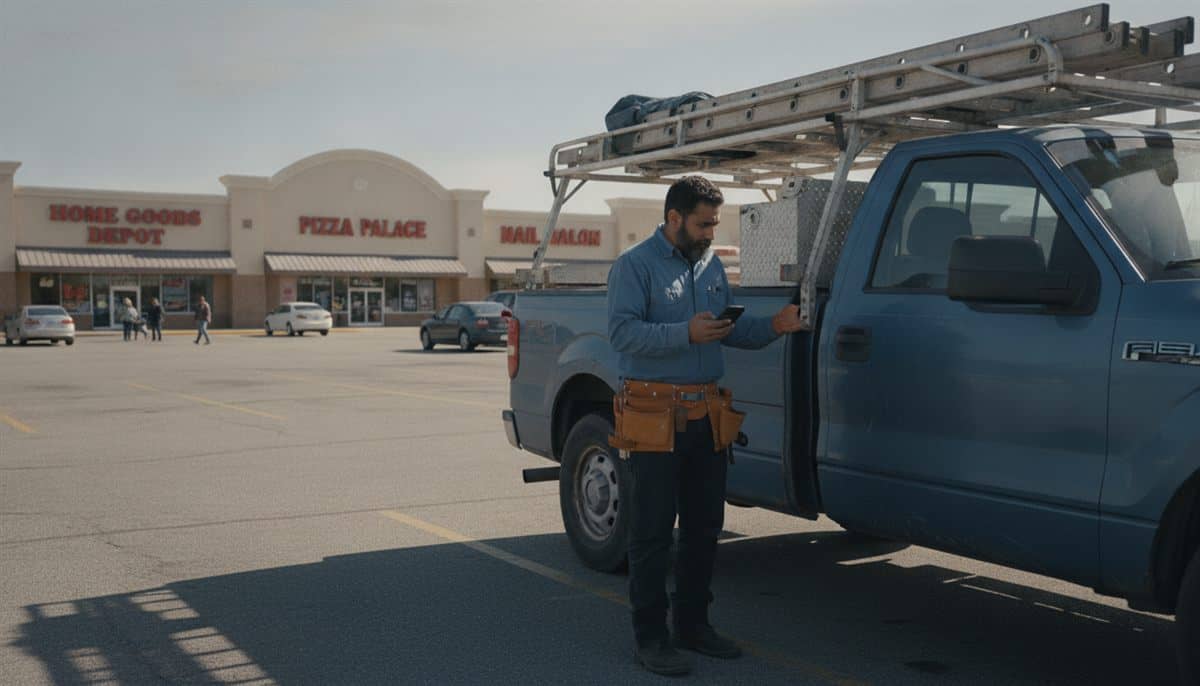
Why a personal policy won't cover your work truck, what commercial auto insurance you actually need, and what drives the price.
There is a costly assumption sitting in a lot of contractor driveways: that the truck hauling ladders, tools, and materials to job sites every day is covered by the same policy as the family car. It is not. Commercial auto insurance exists precisely because a work vehicle is a business risk, and a personal auto policy is written to exclude exactly that use. Learning this at claim time, after an accident, is one of the more expensive surprises in the trades.
Here is the operator consequence, and it lands fast. If your personal insurer discovers the vehicle was being used for business when a claim comes in, it can deny the claim outright — leaving you personally responsible for the other driver’s vehicle, medical bills, and your own truck and tools. For a working contractor, one denied claim can be a business-ending event. So commercial auto insurance is not an upsell; it is the coverage that keeps a bad day from becoming a bankruptcy.
Personal auto policies are priced and underwritten for personal use: commuting, errands, family driving. The moment a vehicle is used to haul tools to paid jobs, transport materials, or carry equipment, the insurer treats it as a different, higher risk. As a result, most personal policies contain a business-use exclusion that quietly voids coverage in exactly the situations contractors face daily. That gap is the entire reason commercial auto insurance exists as a separate product.
Picture the scenario. An electrician rear-ends another car on the way to a service call, truck loaded with gear. The personal insurer investigates, sees the magnetic company sign and the ladder rack, and denies the claim as business use. Now the repairs, the other party’s claim, and the ruined tools are all out of pocket. This is not a rare edge case; it is the predictable outcome of using the wrong policy.
Commercial auto insurance is built for the way contractors actually use their vehicles. It carries higher liability limits than a typical personal policy and extends to business-specific exposures. The core pieces are worth knowing by name.
| Coverage | What it does | Why contractors need it |
|---|---|---|
| Liability | Pays for injury/damage you cause | Higher limits than personal auto |
| Collision | Repairs your vehicle after a crash | Protects a working asset |
| Comprehensive | Theft, fire, vandalism, weather | Trucks are targets when loaded |
| Hired & non-owned | Covers rented or employee vehicles used for work | Fills a common blind spot |
| Uninsured motorist | Protects you against underinsured drivers | Common on the road |
One important limit: commercial auto insurance covers the vehicle and liability, but it usually does not fully cover the tools and equipment inside. For that, contractors add a separate inland marine or tools-and-equipment policy. Furthermore, if employees ever drive their own cars for work errands, hired-and-non-owned coverage closes a gap that catches many growing operations off guard.
Pricing varies widely by state, trade, and driving record, but the levers are consistent. Understanding them helps you shop intelligently instead of just taking the first quote. Premiums typically run a few thousand dollars per vehicle per year, though a clean record and higher deductibles pull that number down.
Meanwhile, do not shop on price alone. A cheap policy with thin liability limits can leave you exposed to exactly the six-figure claim the coverage exists to absorb. In a litigious market, adequate limits are not a luxury.
The practical path is straightforward. Insure every vehicle used for business under a commercial policy, carry liability limits that match the value of what you could be sued for, and layer a tools-and-equipment policy on top for what rides in the bed. Then keep your certificate of insurance somewhere you can produce it in seconds, because general contractors and commercial clients increasingly demand proof before you set foot on site.
That last point is where organization pays off quietly. Many jobs are won or lost on whether you can send a current certificate of insurance the moment a client asks. Tools like SendWork will not sell you a policy, but keeping your insurance documents, client records, and job history in one searchable place means the certificate is a two-second search rather than a scramble through the glovebox. Commercial auto insurance protects the asset; good records prove you have it.
One more habit separates the operators who never have a coverage gap: they review the policy once a year and every time the business changes. Adding a truck, hiring a driver, expanding your service radius, or landing bigger commercial contracts can all change what you need. Because commercial auto insurance is priced on those exact factors, an annual check keeps you from carrying either too little protection or more premium than the business actually requires. Set the review next to your renewal date so it never quietly gets skipped.
The editorial takeaway: this is not the place to save money by cutting corners. The right commercial auto insurance, with real limits and the tools coverage to match, is the difference between an accident that is an inconvenience and one that ends the business. Buy it before you need it, because you cannot buy it after.
Compliance isn’t the hard part. Finding your proof of it six months later is.
SendWork keeps every job, client, and document in one searchable history — so your certificate of insurance and job records are always one search away when a client or claim asks for them.
The Small Business Administration’s guide to business insurance is a solid starting point before you talk to an agent. Your premiums are also deductible, so log them with your other contractor tax deductions, and because your rates need to cover overhead like insurance, it is worth knowing where your pricing stands — see our US general contractor rates guide. For more US admin and insurance guides, browse the Business Admin & Taxes: USA archive.