Go to SendWork
— Free for 7 Days
Full access
Full access

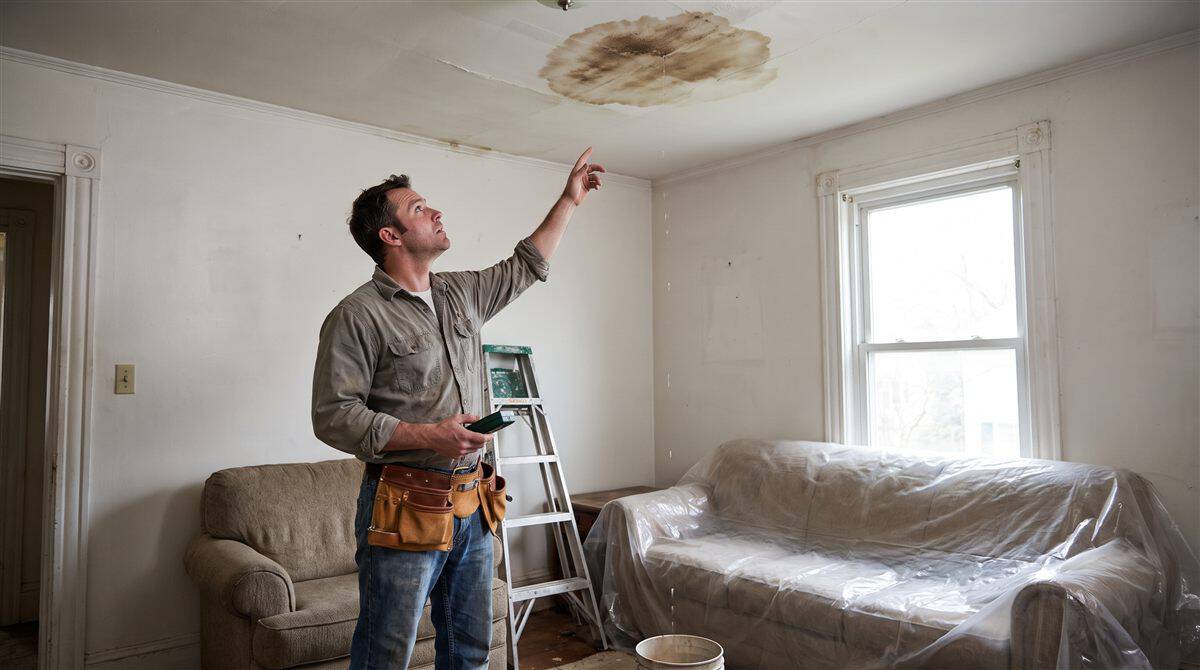
General liability pays for what your work damages, not to fix your work. Here's the exclusion that catches contractors, and what GCs will make you carry.
A remodeler reworks the plumbing in a second-floor condo bathroom. Three weeks after handover, the joint he sweated lets go overnight. The unit below takes water through its ceiling, into the drywall, across an oak floor. He files a claim, expecting the policy to make all of it go away. It pays for the neighbor’s ceiling, floor, and ruined furniture. It pays nothing toward reopening his own wall and redoing the joint that failed. That split is the single most misunderstood thing about general liability insurance.
The distinction is not a technicality either. It decides which line of your P&L absorbs the loss. Damage your work causes to other people and other property is the insurer’s problem. The cost of fixing your work is yours, every time. Contractors who learn this during a claim usually learn it alongside a five-figure number they had not budgeted.
A commercial general liability policy covers third-party bodily injury and property damage. Third-party is the operative word. It means someone who is not you and not your employee, and property you do not own or control.
The standard form runs three coverages. Coverage A handles bodily injury and property damage. Personal and advertising injury sits under Coverage B, which picks up libel, slander, and copyright problems in your marketing. Then Coverage C pays small medical bills with no finding of fault, so minor injuries settle quickly.
Defense costs matter as much as the payout, and contractors routinely overlook them. The insurer’s duty to defend means it pays your attorney even for a claim that turns out to be meritless. Those supplementary payments sit on top of your limits rather than eating into them. On a nuisance suit that never reaches a verdict, defense is the entire value of the policy.
Buried in the standard form is the exclusion that generates most of the disappointment. It removes coverage for property damage to your work within the products-completed operations hazard. Put plainly, the policy is not a warranty on your craftsmanship.
Go back to the flooded condo. The neighbor’s ceiling is third-party property damage, so it is covered. The failed joint and the wall opened to reach it are your work, so they are not. Tear-out and redo comes out of your margin.
There is a carve-back worth knowing if you run subs. The exclusion generally does not apply where the damaged work was performed on your behalf by a subcontractor. So a general contractor usually keeps coverage for defective work a sub performed. That holds even though the work forms part of the GC’s overall project.
Some carriers then remove that carve-back by endorsement, commonly ISO form CG 22 94. If it appears on your policy and you build with subs, completed-operations property damage coverage is effectively gutted. Check the endorsement schedule on your declarations page rather than assuming, because nobody points this out at renewal.
Most contractors carry three or four policies without quite knowing where the seams are. This is the map.
| What happens | Covered by GL? | What actually responds |
|---|---|---|
| A client trips over your extension cord and breaks a wrist | Yes | Coverage A, bodily injury |
| Your crew cracks a stone countertop carrying material through | Yes | Coverage A, property damage |
| Your finished pipe joint fails and floods the unit below | Partly | GL pays the neighbor’s damage, not your joint |
| Tearing out and redoing your own defective work | No | Your margin |
| Your employee falls from a ladder | No | Workers compensation |
| Your truck hits a car on the way to the job | No | Commercial auto |
| Tools stolen from the van overnight | No | Inland marine, or a tools and equipment policy |
| You specified an undersized beam and it deflects | No | Professional liability, if you carry it |
The employee row surprises people most often. An injured worker is a workers compensation matter, and GL specifically excludes it. Vehicles sit under commercial auto for the same structural reason.
Almost every contractor policy is written on an occurrence basis, and that is what you want. An occurrence policy responds to injury or damage that happened while the policy was in force, no matter how much later the claim arrives. A claim filed in 2032 over a failure in 2026 goes to the 2026 policy.
A claims-made policy works the other way. It responds only to claims made during its own period. That leaves a gap the moment you switch carriers or stop trading. Check which one you hold, because the declarations page says so at the top. The difference tends to become visible only when it is too late to change.
Completed operations is the piece that matters most in construction, because failures surface years after handover. Roofing, plumbing, electrical, and waterproofing all have failure windows well beyond a single policy year. Keep the coverage running after the job closes. And never destroy an expired policy, because under an occurrence form the old one is what answers.
Win commercial work and the contract will require more than a policy number. Three requests come up repeatedly, and each changes how your coverage behaves.
Additional insured extends your policy to protect the GC or owner for liability arising from your operations. Primary and non-contributory forces your policy to pay first, before theirs contributes anything. Waiver of subrogation stops your insurer from later suing the GC to recover what it paid out.
Together these shift risk onto your policy and away from everyone above you in the chain. That is the deal, and it is normal. Price it, though. Endorsements cost real premium. Agreeing to them in an exhibit you skimmed is how a thin job becomes a losing one. Read the exhibit before the bid, not after the award.
Ranges are wide because trade classification drives nearly everything. Small contractors commonly land between roughly $500 and $3,500 a year for a standard limit. The national average across trades sits near $340 a month as of 2026. Interior finish trades sit at the bottom, and roofing sits at the top, often four or five times higher.
Beyond trade, carriers price on payroll, revenue, years trading, claims history, subcontractor usage, and state. Litigation climate matters more than most operators expect, so identical businesses in different states can differ by multiples.
One structural point about limits. The licensing minimum is a floor, not a target. A state might license you at $300,000 while the GC on a commercial job requires $2 million plus endorsements. The contract requirement always governs, so check it alongside the license requirements for the state before you price the work. A $1 million per-occurrence and $2 million aggregate policy is the common commercial baseline.
Certificates get requested at the worst moment, usually a day before mobilization. Keeping each job’s contract, exhibit, and certificate together in SendWork turns that request into a search rather than an afternoon.
Run this at bid stage, while you can still price what the contract is asking for:
Treat this policy as protection against what your work does to others, never as a guarantee of the work itself. Every contractor who feels let down by a claim was, almost without exception, expecting a warranty. Buy the limit the contract demands rather than the one the license allows. Then keep the paperwork. Occurrence coverage is only as useful as your ability to find the policy in force six years ago. The Insurance Information Institute keeps a plain-English explainer on occurrence versus claims-made liability policies. It is worth ten minutes before your next renewal. The cheapest version of this lesson is the one you read rather than the one you fund.
ON THE CLAIM YOU ASSUMED WAS COVERED
The contract said what you had to carry. Nobody could find the contract.
Insurance exhibits, certificates, and signed contracts belong with the job they govern. SendWork keeps each project’s documents and client history in one place. The terms you agreed to stay findable for when they finally matter.