Go to SendWork
— Free for 7 Days
Full access
Full access

On a total fire ban day in Victoria or NSW, welding, grinding and gas cutting in the open stop unless you hold a permit or exemption. The fire season kit Victoria requires, what counts as the open air, the afternoon-before routine, permit and exemption lead times, and the penalties.
Can your crew do any welding on a total fire ban day? In Victoria and New South Wales, not in the open. Welding, grinding, soldering and gas cutting outdoors stop for the day unless you hold a permit or an exemption arranged in advance. Through the rest of the fire season, Victoria still lets the work go ahead, but only with a set of fire precautions in place on site. The ban rules for welding are the stricter of the two, and they can be declared for tomorrow at any time of year.
So a fabricator, roof plumber, fencer or sparky working on the fringe of town needs two things this summer. One is the kit that makes hot work lawful on an ordinary fire season day. The other is a routine for the afternoon a ban is declared.
The fire danger period is the fire season for an area. In Victoria, the Country Fire Authority (CFA) declares it council by council under section 4 of the Country Fire Authority Act 1958. It usually runs from October or November until as late as May. In NSW the Rural Fires Act 1997 sets a bush fire danger period of 1 October to 31 March, which the NSW Rural Fire Service (RFS) can move for a local council area. Both are legal requirements, not guidance.
A total fire ban is a single day, or part of a day, of extreme fire danger. The CFA declares one under section 40 of its Act for one or more of Victoria’s nine ban districts, or the whole state. In NSW it’s made under section 99 of the Rural Fires Act for a fire weather area. A ban can be declared outside the fire season too.
| Outdoor welding, grinding or gas cutting | Victoria | New South Wales |
|---|---|---|
| Fire danger period | Allowed only with the six precautions below in place | No published RFS hot work kit list; you are still liable if a fire escapes |
| Total fire ban day | Banned in the open air unless you hold a permit | Banned in the open unless an exemption covers you |
| How to get approval | Section 40 permit through Fire Permits Victoria, for necessary work only | A standard exemption named in that day’s order, or a specific exemption (at least seven days to process) |
| Maximum court penalty for breaking the ban | 240 penalty units ($50,184) or 2 years’ jail, or both | 50 penalty units ($5,500) or 12 months’ jail, or both; $2,200 on-the-spot fine |
Victorian figures use the 2026–27 penalty unit of $209.10, and NSW figures use its $110 unit.
Victoria’s Act defines it in section 34A. A fire is in the open air if it is anywhere other than a permanent structure with a roof that is fully enclosed on all sides. A caravan counts as enclosed, a tent doesn’t. The CFA’s guidance for businesses adds that a shed open on one side is not a permanent structure, and neither is a marquee.
In practice, grinding inside a closed workshop is not in the open air. Welding a gate on a driveway, a bracket on a roof, a frame on a slab, or anything in a carport or an open-sided machinery shed is. NSW doesn’t define the phrase in its Act, so treat the same jobs the same way there.
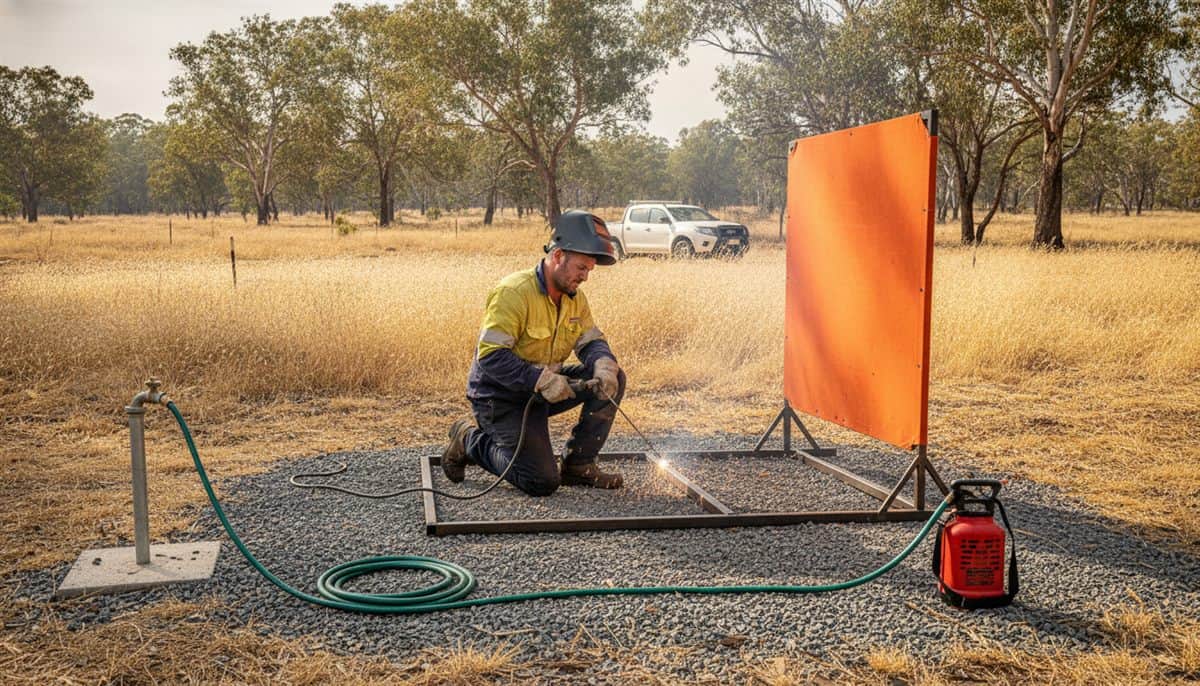
Section 38A of the Victorian Act makes hot work lawful during the fire danger period only if every one of these is in place. The CFA’s “Can I or can’t I?” page lists them for welding, grinding, soldering, abrasive cutting discs and gas cutting:
Most of it fits in the ute: a welding screen or blanket, a charged knapsack, a metal bucket with a lid. On a rural block, plan for the water first. If there’s no tap within reach, the knapsack has to be there, filled, before the first spark.
NSW has no equivalent published list. Its bush fire danger period is about permits for lighting fires. Even so, the same precautions are a sensible standard on a dry NSW site, because an escaped fire is an offence and a civil claim whatever the season.
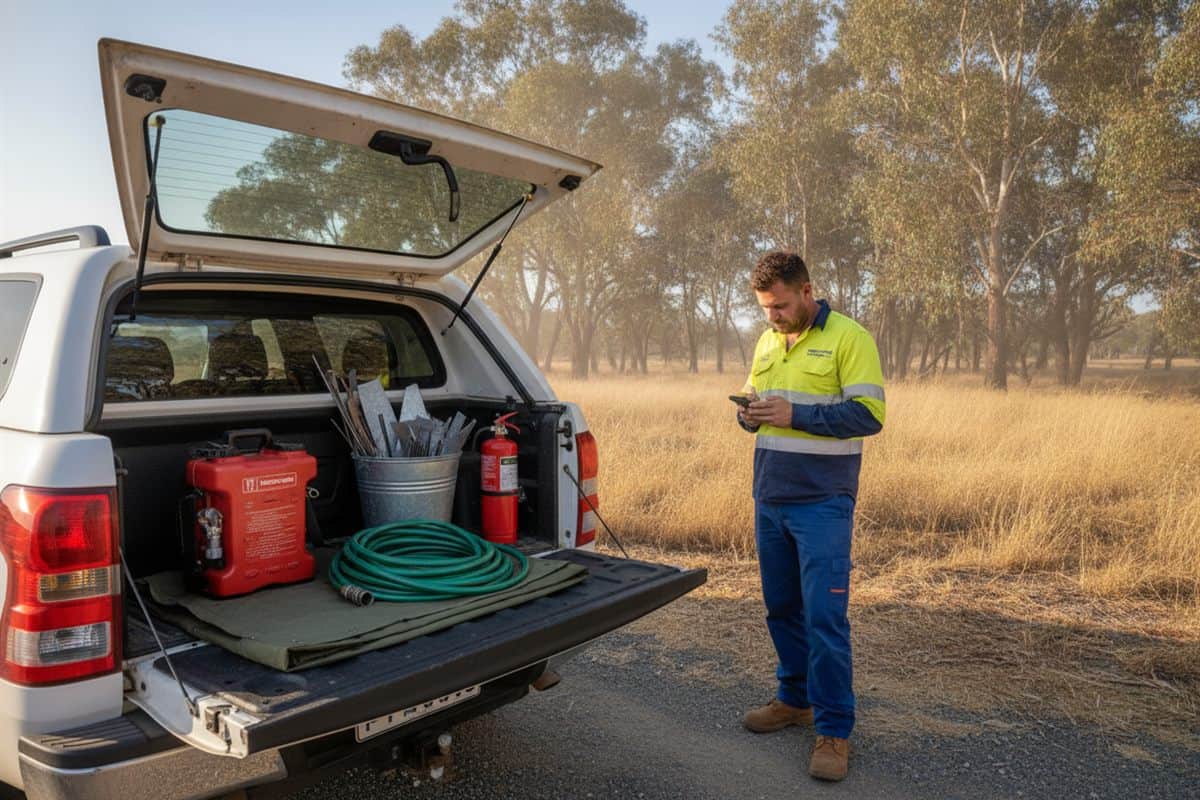
Both services usually declare total fire bans the afternoon before, once the forecast is firm. That gives you an evening to sort out tomorrow.
In Victoria, a ban also suspends every fire danger period permit, and any fire already burning must be put out before the ban starts.
Rescheduling is the normal answer. The approval routes exist for work that genuinely can’t be put off.
Victoria. The CFA lists “welding, cutting and/or grinding” among activities that need a total fire ban permit, and businesses and sole traders can apply through Fire Permits Victoria. Depending on where the job is, the CFA, Fire Rescue Victoria or the Department of Energy, Environment and Climate Action issues it. An officer grants a permit only when they agree the fire is necessary, and the CFA says that happens “in extreme circumstances”, such as safety or keeping essential services running. If you get one, you must tell the issuing agency before you use it, and some permits can’t be used on a catastrophic rating day. The CFA doesn’t publish a processing time, so apply well ahead.
New South Wales. Each ban order names the standard exemptions that apply that day. Some cover cutting, welding and grinding, including work done on behalf of a utility provider and “urgent and essential” building construction or demolition by an authorised person. They come with conditions. You need firefighting equipment on site and nothing combustible below work done above ground. You also call the RFS Fire Control Centre or the nearest Fire and Rescue NSW station first. Check the RFS total fire ban rules and that day’s order before you rely on one. If none fits, you can apply for a specific exemption online, and the RFS says it needs “a minimum of seven days processing time”.
That seven days decides a lot. Some summer jobs involve outdoor hot work that can’t move, such as an emergency repair contract or a fixed shutdown date. For those, apply before the season, not on the afternoon a ban is declared.
The penalties in the table are for breaking the ban itself. A fire that escapes is worse. In NSW, section 100 of the Rural Fires Act covers letting a fire escape and cause damage. If you knew a ban was in force, the maximum is 1,200 penalty units ($132,000), 7 years’ jail or both. The RFS website quotes a 14-year maximum, a figure we couldn’t find in the Act.
Following the rules doesn’t end your liability either. Victoria’s Act says complying with the hot work conditions, or with a permit, doesn’t relieve you of liability for damage the fire causes. The RFS warns that people who lose property can sue whoever started the fire. Check that your public liability policy covers hot work, and keep a photo of the setup on each fire season job.
The other states run their own rules, and they don’t match. Western Australia’s DFES lets businesses do hot work on a ban day under its regulations, after an online notification 30 minutes to 24 hours beforehand. South Australia’s CFS issues ban day permits for emergency use only. Tasmania allows sparks outdoors only under the Tasmania Fire Service hot work guideline. In Queensland, local fire bans come with their own notes, so read the current declaration. Check the state fire service’s own page before quoting a summer job there.
As of mid-October 2026, the CFA had declared the fire danger period for East Gippsland and Wellington from 5 October and for Mildura from 26 October. The rest of Victoria will follow council by council. Its fire restriction dates page shows where your jobs stand. Our guide to workplace exposure limits covers the welding fume side of the same job, and the White Card article covers site induction for new starters.
If your quote terms charge for a cancelled day, our article on unfair contract terms in trade quotes explains which cancellation clauses hold up.
The rule to work by: on a fire season day, weld outdoors only with the kit set up first. On a ban day, don’t, unless the permit or exemption is already in your hand.
WHEN THE BAN LANDS AT 4PM
Tomorrow’s hot work moves tonight, not at the gate in the morning.
A ban declared in the afternoon leaves one evening to reshuffle the crew and ring the customers. SendWork lets you move jobs on the schedule from your phone, with each customer’s details on the job, so the rebooking calls are quick.