Go to SendWork
— Free for 7 Days
Full access
Full access

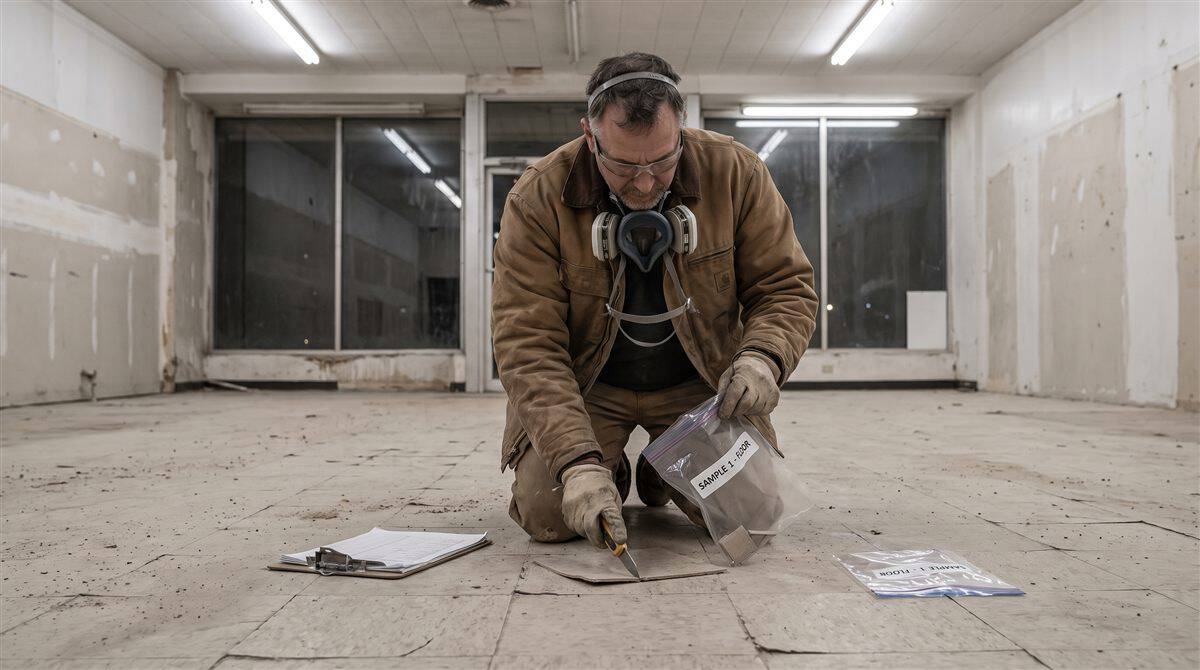
The threshold decides which work rules apply, never whether you need a survey. Here's what NESHAP actually requires before you disturb anything.
A demo crew opens up a 1974 strip-mall unit on a Monday. Nine-inch floor tile, black mastic underneath, and a schedule that says the slab is clear by Friday. Nobody ordered a survey, because the job looked small. By Wednesday an inspector is on site and the work has stopped. Tile that would have cost a few thousand to abate properly is now a reportable release across the whole tenancy. That sequence is routine. It starts with the same wrong assumption every time: that the amount of asbestos decides whether you needed to look for it. That single misreading is what catches asbestos regulations contractors.
It does not work that way. Under the federal rules, quantity determines which work practices and notifications kick in. It never determines whether an inspection was required. Skip the survey and you are in violation before a single tile comes up.
The Asbestos NESHAP sits at 40 CFR Part 61, Subpart M. It has been in force since 1973 and was overhauled in 1990. Its scope is wider than the threshold language suggests.
Every demolition and every renovation is subject to the rule in one respect. The owner or operator must first determine whether asbestos is present, and how much. That obligation attaches to the project, not to the quantity found. You cannot discharge it by eyeballing the material or by asking the building owner what they remember.
Here is the distinction that saves jobs. Thresholds govern the work practice standards — wetting, containment, trained on-site representation, disposal. Below threshold, those requirements generally do not apply, and material need not be removed before the work proceeds. The survey that established you were below threshold is what proves it.
Without that survey you have no defense and no documentation. An inspector does not need to watch you strip material improperly to establish a violation. Quantity and improper removal are proved separately, so an absent survey simply hands over the first half of the case.
Notification is where operators most often assume they are exempt, and most often are not.
| Situation | Notification required? | Timing |
|---|---|---|
| Any demolition of a regulated facility | Yes — even with zero asbestos present | 10 working days before |
| Renovation at or above 260 linear feet on pipes | Yes | 10 working days before |
| Renovation at or above 160 square feet on other components | Yes | 10 working days before |
| Renovation at or above 35 cubic feet where material cannot be measured | Yes | 10 working days before |
| Renovation below all three thresholds | Federal notification generally not triggered | Survey still required; check state rules |
| Emergency demolition or ordered demolition | Yes | As soon as possible, no later than the following working day |
| Scope grows beyond the original notice | Yes — a revised or new notice | Before the added work starts |
Read the first row twice. A demolition notice is owed even when the survey comes back completely clean. Contractors who found no asbestos routinely skip the filing. The absence of asbestos was never the trigger. On older buildings the dependency also runs the other way: many jurisdictions will not issue the demolition or renovation permit until the survey is in hand, which puts it on the critical path rather than alongside it.
The federal numbers are a ceiling on leniency, not a national standard. EPA delegated implementation to states and local air districts decades ago, and many set thresholds dramatically lower.
Georgia, for instance, requires notification and fees at ten linear feet or ten square feet of asbestos-containing material. That is roughly one twenty-sixth of the federal pipe threshold. Ohio adds licensing obligations above fifty square or linear feet regardless of whether the federal notification triggers. Several states charge per-project fees, and some require electronic filing through their own portal.
So the practical rule is simple. Federal thresholds tell you when you are definitely captured. Your state and your local air district tell you whether you were captured much earlier. Confirm both before you price abatement, in the same pass you use to check license requirements for the jurisdiction.
EPA governs the emissions side. OSHA governs your crew, under 29 CFR 1926.1101, and its logic differs in a way that matters on site.
Certain materials in buildings constructed before 1981 are treated as presumed asbestos-containing material. Thermal system insulation, sprayed-on surfacing, and resilient flooring all fall in. The presumption stands unless it is rebutted by proper sampling. In other words, on an older building the default answer is that the material is asbestos until a lab says otherwise. Your duty to protect workers begins from that default.
The permissible exposure limit is 0.1 fiber per cubic centimeter over eight hours. A short-term excursion limit of 1.0 applies over thirty minutes. Those numbers drive respiratory protection, regulated areas, and monitoring. This mirrors lead exactly. The RRP rule presumes lead in pre-1978 housing, and asbestos presumes itself in pre-1981 buildings. Both presumptions exist because the alternative is a workforce testing its luck.
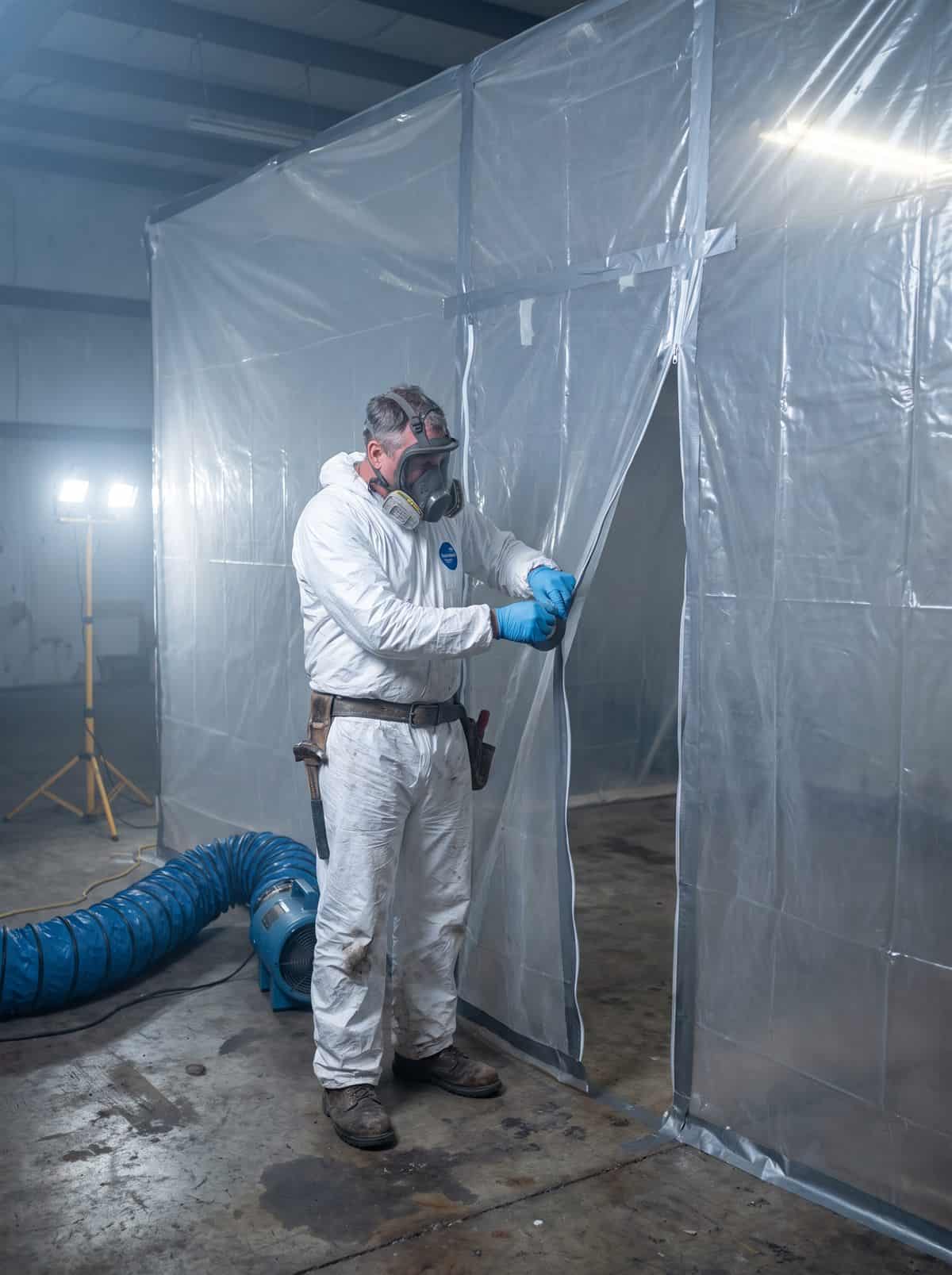
Asbestos violations are expensive in an unusual way. They accrue per day as well as per violation. So a slow response multiplies the exposure rather than merely extending it.
On the OSHA side the current maximums run to $16,550 for a serious or other-than-serious violation. Failure to abate costs $16,550 per day. A willful or repeated violation reaches $165,514. Those are 2025 figures still in force. OSHA confirmed in a May 2026 memorandum that no cost-of-living adjustment applies this year, so 2025 levels carry forward. EPA and DOT did the same, and the Justice Department reached the same position in July.
Do not read that freeze as leniency. It is an accounting artifact of a missing inflation input, not a policy shift. Enforcement posture on asbestos has not softened. Anyone treating a flat penalty schedule as a signal to take more risk has misread it entirely. Enforcement here also runs alongside OSHA compliance generally, so an asbestos inspection rarely stays confined to asbestos.
Work through this before mobilization, not after a stop-work order:
Those three documents also tend to scatter the moment a job closes. Filing them against the project in SendWork rather than an email thread keeps them retrievable years later. That is usually when an asbestos question arrives.
The costly mistake on asbestos is almost never the abatement. It is the decision, made early and quietly, that a job was too small to investigate. Surveys are cheap relative to a stop-work order. They are cheaper still relative to a crew exposure you cannot undo. Build the survey into the bid so it becomes the client’s line item rather than your write-off. Then file the notice on every demolition without pausing to weigh whether it feels necessary. EPA publishes an overview of the Asbestos NESHAP that is worth reading once properly. The rest is discipline. Look before you disturb, notify before you demolish, and keep the paper proving you did both.
ON THE TILE NOBODY TESTED
The survey, the notice, and the manifest. Three documents, three different inboxes.
Compliance paperwork is only worth what you can produce on demand. SendWork keeps each job’s reports, photos, and client history attached to the project. The file stays intact long after the crew has moved on.