Go to SendWork
— Free for 7 Days
Full access
Full access

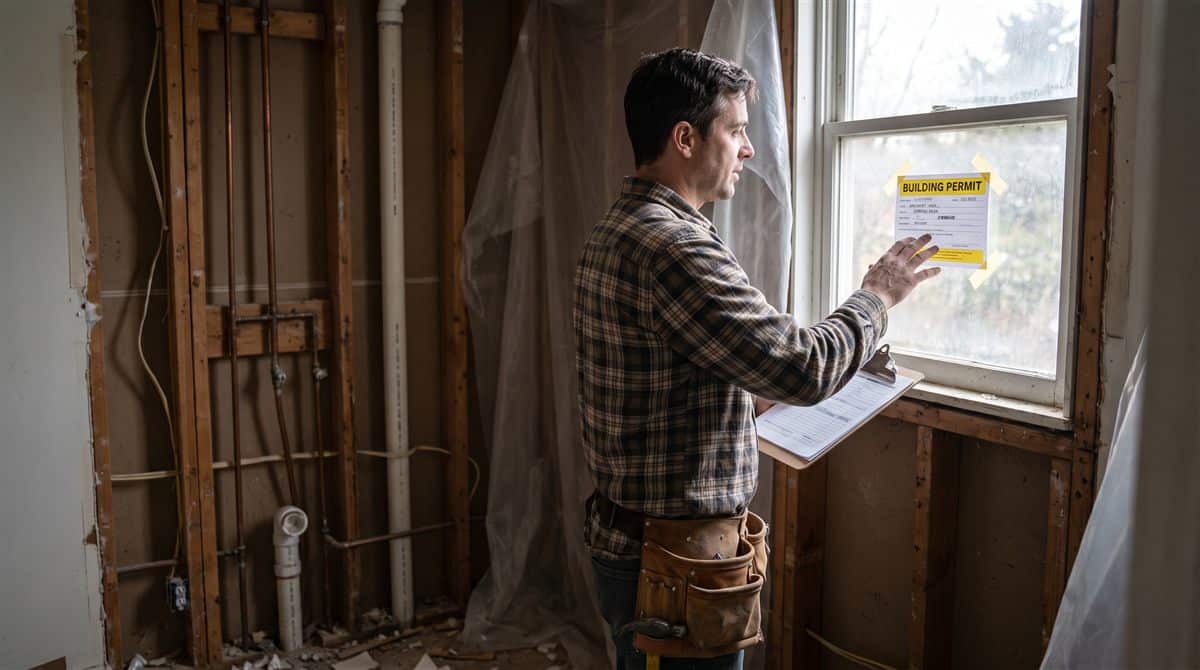
Passing inspection and closing out a permit are different events. Here's what triggers one, which code edition governs your job, and what an open permit costs at resale.
The bathroom was finished in March. The homeowner called in October, four years later, because the sale had stalled. A buyer’s inspector had found a relocated waste line and no permit record for any of it. The county wanted the wall opened to verify what was behind it. The contractor who did the work had closed his business. So the seller paid twice — once to expose the plumbing, once to bring it to current code — and the buyer walked anyway. None of that was a workmanship problem. It was a paperwork problem, and the building permit requirements that governed the job were never the mystery anyone assumed they were.
Here is the distinction that costs operators money. A permit is not permission to start. It is the record that the work happened, was inspected, and was signed off. Passing an inspection and closing out a permit are different events, and a job can clear the first without ever completing the second. When that gap surfaces, it surfaces years later, at a closing table, in front of someone with a lawyer.
The building department is not the adversary in that story. That role belongs to the buyer’s inspector, who arrives long after your warranty has run out.
Operators tend to treat the permit as a formality that delays the start date. In practice it is three separate things bolted together, and each one fails differently.
First, the application and plan review — the jurisdiction decides whether what you propose is allowed. Second, the inspections — rough-in, then final, sometimes more. Third, the closeout, where the permit is signed off and, on larger work, a certificate of occupancy issues. An open permit is a permit that passed step two and never reached step three. Most building permit requirements are satisfied at the inspection. The one that bites is the closeout. Title searches find open permits. Buyers’ attorneys find them. And in most jurisdictions the record attaches to the property, not to you, which is precisely why it becomes the homeowner’s problem and then, by way of a phone call, yours again.
There is no national answer, and any article that gives you one is wrong. What is consistent is the logic: jurisdictions permit work that affects structure, life safety, or the systems buried inside walls. Cosmetic work replaced in kind usually escapes.
THE USUAL DIVIDING LINE
Almost always permitted: removing or adding a wall · any change to a load path · new or extended electrical circuits · relocating plumbing supply or waste · new window and door openings · decks and structural exterior work · additions and conversions · most water-heater and furnace replacements · anything that changes egress
Usually exempt: paint · flooring · cabinets and countertops · fixture swaps in the same location · like-for-like finish replacement with no change to structure or systems
Both lists are orientation, not authority. Roofing, siding, and water heaters in particular flip from one column to the other depending on the jurisdiction — confirm each against your own building department before you price the job.
One trigger sits outside that logic entirely and catches operators every year. On pre-1980 buildings, many jurisdictions will not issue a demolition or renovation permit without an asbestos survey first, which folds the NESHAP notification requirements into your permit timeline rather than into a separate process. Notice what the exempt column has in common. Nothing on it is hidden by later work. That is the underlying test, and it is a more reliable guide than any checklist: if finishing the job conceals what you did, someone will want to look at it first.
This is the part most operators have never checked, and it is the single most useful thing in this article.
There is no federal building code. The International Code Council publishes model codes — the IBC for commercial and multi-family, the IRC for one- and two-family dwellings — on a three-year cycle. Those documents carry no legal force by themselves. They become law only when a state or a municipality formally adopts them, which means the code that governs your job is whatever edition your jurisdiction adopted, plus whatever local amendments it layered on top.
The 2024 editions are current. Many jurisdictions are still enforcing 2021, and plenty are still on 2018 or older. Some states never adopt on cycle at all. California, Florida and New York publish their own amended codes built on an IBC base rather than adopting the model text directly, and Texas has no statewide residential code outside of city and county adoption.
The governing edition is the one in effect when the permit was issued — not the newest published, and not the one in effect when you finish. Consequently a job permitted in December and completed in June is judged against December’s code even if the jurisdiction adopted a new edition in between. That cuts both ways, and it is a genuine argument to have with an inspector when it matters.
So the building permit requirements you are actually held to are local twice over — once in the edition adopted, once in the amendments. Local amendments are as binding as the base code, and they are frequently more stringent. So “the 2021 IRC says” is never a complete answer. The complete answer is the adopted edition plus the amendment document, and both are public.
Assume for a moment the permit was skipped. Here is where it comes back, roughly in the order operators encounter it.
The pattern worth noticing is that the cost curve is not linear. Getting caught on day two is cheap. Getting caught at closing is not.
Most jurisdictions let either the licensed contractor or the property owner pull a permit. The owner route exists for genuine do-it-yourself work, and it is legitimate when that is what is happening.
It is also the most common way contractors transfer liability without the client understanding it. When the homeowner pulls the permit, the homeowner becomes the responsible party for code compliance and for the inspections. Several state licensing boards treat a contractor who directs an owner to pull the permit for contractor-performed work as committing a violation. Some treat it as evidence the contractor was unlicensed or uninsurable for that scope. Either way, the building permit requirements do not move — only the name on the liability does. If you are asking a client to pull a permit for work your crew is doing, that is worth checking against your own board before it becomes a pattern.
This is also where the job record earns its keep. SendWork keeps the permit number, the inspection dates and the final sign-off in the same job record as the quote and the invoices, so four years later the closeout evidence is attached to the job instead of in a folder in somebody’s truck. That does not make the permit your client’s problem or yours — but it does mean the question is answerable.
The same discipline governs state contractor licensing, where the framework is national and the number never is, and it sits alongside the record-keeping that surety underwriting turns on.
Permit fees are set locally and are usually a function of project valuation, so a percentage or a flat schedule. They are rarely the real number. The real number is schedule.
Plan review takes as long as it takes, and it varies enormously between a counter-issued trade permit and a full structural review. On commercial and public-facing work it is also the stage where accessibility requirements get examined, which is a separate body of rules with its own rework risk if it is discovered late. Inspections are booked, not summoned, and a failed rough-in means rebooking. Consequently the operators who lose money on permits are almost never the ones who paid the fee. They are the ones who priced the job as though the inspection would pass first time and be scheduled the same week.
Build the review window into the schedule you quote. Then a delay is a fact you disclosed rather than a promise you broke.
Every item below is answerable before you price the work, by one phone call or one website. None of it requires a lawyer.
Which edition your jurisdiction has adopted is public information, and the ICC’s code adoption map is the fastest way to find the state-level answer before you call the local department for the amendments. Triggers, fees and inspection sequences are set locally and change without notice. None of this is legal advice. Confirm your scope with the authority having jurisdiction. And where an open permit or an enforcement action is already in play, bring in a construction attorney licensed in that state.
ON THE JOB THAT CAME BACK
Stay compliant without becoming a full-time administrator.
A permit closeout matters years after the invoice is paid. Keep the sign-off attached to the job, and the call about a four-year-old bathroom takes a minute instead of a weekend.
More coverage for US operators in Licensing & Regulations: USA.