Go to SendWork
— Free for 7 Days
Full access
Full access

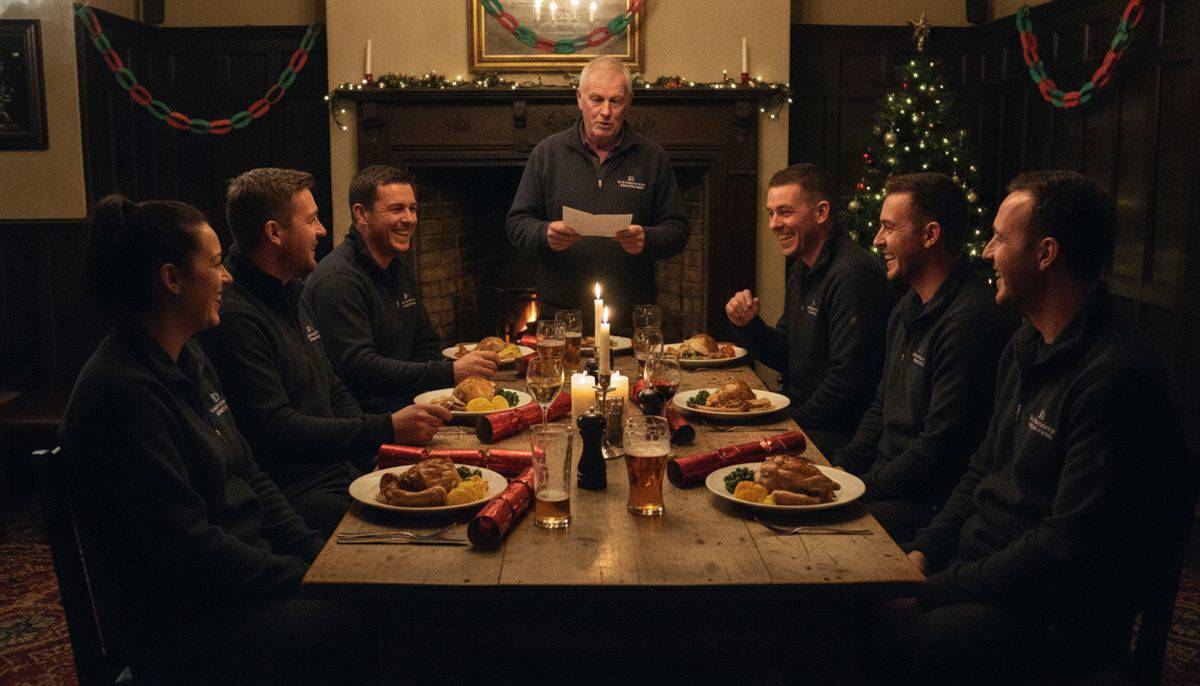
Up to £150 a head, VAT and transport included and guests counted, and the crew's Christmas do is tax-free. Go over and the whole cost is taxable. A worked bill for a five-person crew, what crossing the line costs on a P11D or a PSA, the VAT, and the £50 gift alternative.
How much can you spend on the crew’s Christmas party before it turns into a tax bill? Up to £150 a head, VAT included, counting every person who comes, partners and guests too. Go a pound over and the whole cost becomes a taxable benefit for your staff, not just the amount above £150.
That second sentence is where a generous evening goes wrong. The rest of this guide is the arithmetic: what goes into the £150, a worked bill for a five-person crew that tips over it, what crossing the line costs you and them, and the £50 gift rule that sits alongside it.
The exemption is in section 264 of the Income Tax (Earnings and Pensions) Act 2003. It says no income tax arises on an annual party or similar annual function for your employees if the cost per head is £150 or less. HMRC applies it; there is no form to fill in or claim to make. You either meet the conditions or you don’t. HMRC’s own guide to social functions and parties sums them up, and the same rule applies across England, Wales, Scotland and Northern Ireland.
Three conditions have to hold:
That last point matters if you already held a summer barbecue in June 2026. It falls in the same 2026-27 tax year as this Christmas, so the two events share one £150 a head between them.
Add up everything the evening costs: venue, food, drink, any entertainment, and transport or rooms you lay on to get people there and home. Use the prices you actually paid, VAT included. Then divide by everyone who attends, whether they work for you or not.
So your crew’s partners count in the head count, and so do any regular subcontractors you invite. That spreads the cost, but it also means each employee who brings a partner is taxed on two heads, not one, if the event goes over.
Here is an illustration, not a real firm. You run a small building company with five employees. Four of them bring a partner, and you come along, so ten people sit down at a pub restaurant. You book a minibus with a driver to take everyone home. The bill:
| Item (VAT included) | Cost |
|---|---|
| Christmas menu, 10 at £95 | £950 |
| Drinks tab | £600 |
| Minibus and driver | £180 |
| Total | £1,730 |
| Cost per head (÷ 10) | £173 |
At £173 a head, the party is £23 over the line, and the whole evening loses the exemption.
HMRC’s manual is blunt: “The figure of £150 is not an allowance.” Once a function is outside the exemption, each employee is taxed on the full cost per head for themselves and for any family member they bring. In the example, that’s £173 for the employee who came alone and £346 for each of the four who brought a partner, £1,557 in all.
You then have two ways to deal with it. Neither is cheap next to the £23 a head that tipped it over.
Report it on each employee’s P11D. The P11D is HMRC’s year-end form for benefits in kind, due by 6 July 2027 for this tax year. You pay Class 1A National Insurance, an employer-only charge on benefits, at 15% for 2026-27. On £1,557 that’s £233.55, due by 22 July 2027. Your staff then pay income tax on their share through their tax codes. A basic-rate taxpayer who brought a partner would owe £69.20 for a night out they thought was free.
Or settle it yourself with a PAYE Settlement Agreement. A PAYE Settlement Agreement, or PSA, is an optional arrangement with HMRC that lets an employer pay the tax on minor or irregular benefits, including staff entertainment that isn’t exempt, so the staff pay nothing. You pay their tax grossed up, plus Class 1B National Insurance at 15%. If all five are basic-rate taxpayers, the bill is roughly £681. You apply by 5 July 2027 and pay by 22 October 2027.
Either way, the £173 version of the evening costs you hundreds of pounds more than the venue’s bill. Trim it to the £83 a head below and there’s nothing to report.
Take the same ten people with a £45 set menu, a £200 drinks tab and the same minibus. That’s £830, or £83 a head, comfortably inside the limit. It also leaves £67 a head of room if you hold a summer barbecue before 5 April 2027.
Two practical points help you stay inside. Agree a fixed drinks tab with the pub, rather than an open bar, because drinks are usually what pushes the bill up. And ask for an itemised receipt with VAT shown, which you’ll need for the next section anyway.
The £150 decides only whether your staff are taxed. It doesn’t decide whether the business can deduct the cost. Staff entertaining is an allowable expense under the business entertainment rules, even at £173 a head. HMRC’s business income manual treats your employees’ partners as staff for this purpose, so their share is deductible too.
VAT works differently. If you’re VAT-registered, you can reclaim the VAT on your employees’ share, but the share for guests is blocked, partners included. With four partners among ten people, roughly four tenths of the VAT stays unrecoverable. A minibus with a driver and ten or more seats is zero-rated, so there’s no VAT on it to reclaim.
Subcontractors on CIS are different again. They count in the £150 head count, but they aren’t your employees. Their share is business entertainment, so it isn’t deductible and its VAT is blocked. A crew do with a couple of regular subbies invited is still a staff party. A thank-you evening for clients, with your staff as hosts, is not.
What about your own seat at the table? If you’re a sole trader or partner, HMRC’s guidance doesn’t spell out the treatment of your share, so check it with your accountant. A party for the owners alone, with no staff, is neither deductible nor VAT-recoverable.
If a big night isn’t the crew’s thing, a present can do the same job. A trivial benefit is a small non-cash gift that HMRC doesn’t tax, under sections 323A to 323C of the same Act. It’s a legal exemption, not a concession, and you don’t report it. HMRC’s trivial benefits guide lists the conditions:
A turkey, a hamper, a bottle of wine or a £25 supermarket gift card all fit, according to HMRC’s own examples. A cash bonus doesn’t. It goes through payroll like wages. Avoid a reloadable gift card you top up through the year, because HMRC treats the top-ups as one benefit.
The gift is separate from the party. Your crew can have an £83-a-head Christmas do and a £30 hamper, and HMRC taxes neither. If you’re a director of a close company, broadly a limited company controlled by five or fewer shareholders, your own trivial benefits can’t exceed £300 a year. Your employees have no annual cap, provided each gift meets the conditions.
So the number to plan around is £150 a head, VAT and transport in, guests counted. Keep the do annual, open to the whole crew and at or under that figure, and it costs you only the bill. Go over and HMRC taxes all of it, through your staff’s tax codes or your own PSA. Our guide to what a first employee really costs covers the rest of a UK crew’s running costs, and our article on the Employment Rights Act for small employers covers the changes coming for small crews. And if a slow-paying customer is what stands between you and the pub’s bill, see how late payment interest works.
PAYING FOR THE CREW’S NIGHT OUT
A good year for the crew starts with customers who paid on time.
The Christmas do comes out of December’s cash, and December is when unpaid invoices hurt most. With SendWork you raise and send the invoice from your phone as soon as you finish the job, so the money for the crew’s night has a better chance of arriving before the bill does.