Go to SendWork
— Free for 14 Days
Full access
Full access


Twelve on the payroll plus ten regular subbies makes 22 workers under New Zealand's health and safety law, and from 1 April 2027 that count decides whether a building firm is a small PCBU with lighter duties. Come in under 20, and the scaffold and the asbestos are still yours to manage.
Twelve on the payroll plus ten regular subbies makes 22 workers under New Zealand’s health and safety law, and from 1 April 2027 that count decides whether a building firm is a small PCBU with lighter duties. Come in under 20, and the scaffold and the asbestos are still yours to manage.
That is the trade-off in the new rules. A small PCBU can stop managing the low-harm risks, like a trip in the yard office. Its main duties now cover critical risks, though, and nearly everything dangerous a building crew does is one. Subbies and labour hire count toward the 20, so a firm with a modest payroll can still land on the large side.
The Health and Safety at Work Act 2015 (HSWA) is New Zealand’s workplace health and safety law, and complying with it is a legal requirement. WorkSafe New Zealand is the regulator for most workplaces. The Act puts its duties on a PCBU, a “person conducting a business or undertaking”, from a sole-trader sparky to a building company. Parliament changed it with the Health and Safety at Work Amendment Act 2026. It passed on 30 June 2026 and comes into force on 1 April 2027, and WorkSafe’s guide explains it in plain language.
The count is not your payroll. WorkSafe’s guidance on business size defines a worker as anyone who carries out work in any capacity for a PCBU. That “includes employees, contractors, subcontractors, labour hire workers, apprentices, trainees, work experience students, and volunteer workers”.
You are small if you have fewer than 20 workers. Where numbers go up and down during the year, the test changes shape. You are small if you expect fewer than 20 workers in at least nine months of the current financial year. You are large if you expect 20 or more for more than three months. WorkSafe lists workload that depends on projects or contracts as one reason numbers fluctuate. So a builder who brings subbies in job by job falls into that second version.
WorkSafe’s construction example settles two more points. A self-employed electrician or plumber you subcontract is a small PCBU in their own right, and also one of your workers. Scaffolders from a three-person company, and labourers sent by a labour-hire firm, are your workers while they work for you. They stay workers of their own employer as well. Nobody has to keep a record of worker numbers, but you can use your existing business records to work it out.
Take an illustrative residential builder in Hamilton. It employs 12 people: a foreman, carpenters, two apprentices and an office manager. It also uses ten subbies regularly: an electrician, a plumber, a roofer, a scaffolding crew of three, two GIB stoppers and two labour-hire labourers.
If those ten are on its jobs in a normal month, the firm has 22 workers for most of the year. That is 20 or more for more than three months, so it is a large PCBU. It manages every risk, critical ones first.
Now change one fact. The subbies come and go with each stage, and only the frame-to-roof stage of two big builds puts all ten on its jobs at once, for about ten weeks. In the other months the firm counts between 12 and 18 workers. It expects 20 or more for less than three months, and fewer than 20 for at least nine, so it is small.
The payroll is the same in both versions. What moves the firm across the line is how steadily the subbies work for it. The test rests on a reasonable expectation, formed from your own history and the work you have lined up, and you check it again when a big contract lands. A permanent change works differently: hire up to 20 or more, or cut back to 19 or fewer, and your size changes from the day that change takes effect.
Being small only helps with the risks that are not critical. WorkSafe defines a critical risk as one likely to result in death, a notifiable injury, illness or incident, or an occupational disease on ACC’s list in the Accident Compensation Act 2001. A risk managed by regulations under HSWA is critical too. A notifiable injury generally means one needing hospital admission for immediate treatment. “Likely” means more than a remote possibility, judged on the worst realistic outcome with no controls in place.
The regulated hazards are critical automatically. They sit in the new Schedule 1A of HSWA, and for a building firm that list reads like a programme of works:
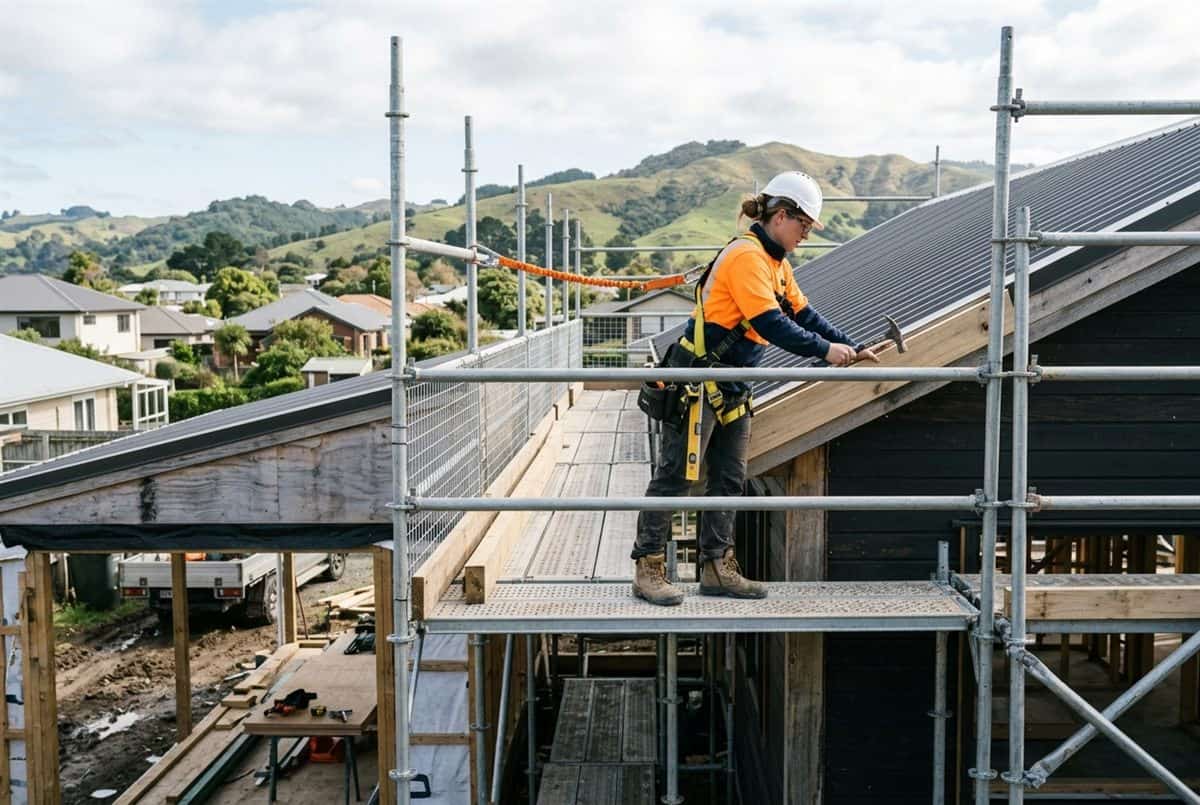
Some trade hazards are not on that list but still pass the harm test. Electricity is one: WorkSafe’s own example for a small farm counts electrocution as a critical risk. A fall from a stepladder or a single-storey roof sits under the 3-metre line, so it is not automatically critical. Ask WorkSafe’s question of it instead. With no controls in place, is a hospital admission a realistic outcome? If it is, the risk is critical. WorkSafe suggests writing down your reasoning on borderline cases, so keep that note with the job record.
For a small PCBU the main duties shrink to critical risks rather than disappear. WorkSafe’s guide to managing critical risks lists them. They include the primary duty of care and the duties of whoever controls a workplace or its plant. The upstream duties of a business that installs or constructs plant or structures are on the list too. Each critical risk has to be managed so far as is reasonably practicable: working controls, checked and revised, not a line on a list.
Two of those duties land on the crew directly. When a critical risk affects the work, your workers need adequate knowledge and experience, or adequate supervision and training. That bites hardest on a new starter. A summer labourer on a 90-day trial period who has never worked off a scaffold is exactly who the duty is for. Where managing a critical risk involves PPE, you provide it unless another PCBU already has. You also make sure it is suitable, maintained and clean.
Welfare is not tested by size. Every PCBU must still provide adequate facilities, so far as is reasonably practicable: toilets, drinking water, hand washing, first aid and emergency planning. On a bare section, sort that out before the crew turns up.
Enforcement follows the same line. A WorkSafe inspector can issue an improvement notice to a small PCBU only about a critical risk or welfare facilities. The same limit applies to a provisional improvement notice from a health and safety representative. ACC sits apart from all of this. Your ACC levies fund cover for injuries whoever caused them, while HSWA sets out what you must do to prevent them.
Plenty of small trade firms spend their days on someone else’s job. Where two PCBUs have duties about the same matter, they must consult, cooperate and coordinate so far as is reasonably practicable. From April, WorkSafe says a small PCBU must do that for critical risks, and a large one for all risks.
The contract can ask for more. A large main contractor can require a small subbie to cooperate on every risk, and nobody can contract out of their duties or transfer them. So on a main contractor’s site, what you have to manage may be wider than the legal minimum. Read the safety clauses in the subcontract before you sign it, and price what they ask for. If you are a large main contractor, your own duties do not narrow because your subbies are small.
An approved code of practice (ACOP) sets out how specific work can be done safely. The Minister for Workplace Relations and Safety approves each one on WorkSafe’s recommendation, and following one is optional. From 1 April 2027 some codes carry what WorkSafe calls safe harbour. Follow the actions in such a code that fit your role, and you are treated as having met your duty for that risk.
Safe harbour covers codes approved from 1 April 2027 and, for now, just two existing ones, on forestry and on loading cargo at ports and on ships. Other existing codes still count as evidence an inspector or a court can weigh, but give no safe harbour. Industry groups, unions and employer organisations can now draft codes for WorkSafe to assess, so a trade code with safe harbour may follow.
The reform also deals with double regulation. Where another Act manages the same risk, complying with its requirement counts as complying with HSWA. WorkSafe names the Building Act 2004, the Maritime Transport Act 1994 and the Land Transport Act 1998. Its worked example so far is seismic risk in workplace buildings, which covers building owners. Nothing WorkSafe has published treats a building consent as covering the risks to the crew doing the work, so plan site safety as before.
Company directors are officers, and so are partners in a partnership. The reform focuses the officer duty on governance. That means understanding the risks of the work, making sure the business has the resources and processes to manage them, and checking they are used. In a small PCBU, the officer’s due diligence is about the business identifying and managing its critical risks. The duty covers only what you do as an officer. When the director is also on the tools, that work is done as a worker.
For a small firm, the reform frees time from the low-harm list, not from the scaffold. The firm with the most to settle before April is the one that has always thought of itself as small and has never counted its subbies.
WHO WAS ON SITE
Your subbies count toward the 20, so know who is on which job.
With SendWork, each job carries its schedule, its job notes and its crew assignments, employees and subbies alike. The records show who worked on which job and when, and the scaffold or asbestos note goes out with the job to the crew you dispatch.