Go to SendWork
— Free for 7 Days
Full access
Full access


Crossed the ATO's thresholds on your last return? You are now paying this year's income tax in quarterly PAYG instalments, the first due on 28 October. How you were entered, the instalment amount versus the rate, when varying helps, and the interest charge for varying too low.
You lodged your 2025–26 return in September, paid the bill and thought that was tax done for the year. Then a notice turns up in myGov: an instalment of $3,150, due by 28 October. Nobody rang to explain. Your latest return simply crossed the thresholds of the Australian Taxation Office (ATO). You are now in pay as you go (PAYG) instalments: regular payments towards this year’s income tax as you earn it, rather than one lump after 30 June. Once the ATO has entered you, paying is a legal obligation, not a savings plan you can skip. The rules are in Division 45 of Schedule 1 to the Taxation Administration Act 1953.
For a sole-trader tradie, instalments can feel like being charged twice, and in the first year they nearly are. It helps to know how the ATO decided you were in. Then come your choices: three ways to pay, one way to adjust, and an interest charge that follows a wrong guess. It is about your own income tax as a sole trader. If you employ staff, the PAYG withholding you take from their wages is a separate system.
The ATO enters an individual automatically when all three of these are true:
Instalment income is your gross business and investment income, not your profit, and it excludes GST. For a tradie that means your invoiced work before expenses. If you use myGov or the ATO’s online services, the instalment details arrive 21 days before each due date.
The first year is the one that stings. The ATO’s own example describes a new sole trader who does not join voluntarily: he “will receive a tax bill when he lodges his next tax return and will automatically be entered into the system for the following financial year.” In practice, the bill for last year and the first instalment for this year can land within weeks of each other. You can join voluntarily earlier through myGov to spread that out, although the first you hear of the system may be the notice itself.
Quarterly instalments are due on 28 October, 28 February, 28 April and 28 July. The one due on 28 October covers July to September. If you lodge your activity statement online, you may be eligible to lodge and pay two weeks later. Every instalment is a credit against the tax on your next return, so none of it is lost; the question is only when the money leaves your account.
The ATO gives you a choice at the start of each financial year, on your first activity statement. It then applies for the rest of that year.
| Option | What you pay each quarter | Suits |
|---|---|---|
| Instalment amount | A fixed amount the ATO works out from your last return, with a 5% GDP adjustment for 2026–27 | Steady income, and anyone who wants the simplest option |
| Instalment rate | Your instalment income for the quarter (T1) multiplied by the rate the ATO gives you (T2) | Income that swings with the season or the size of jobs |
| Annual instalment | One payment for the year | Only if your notional tax is under $8,000 and you are not required to be registered for GST |
| Varying either quarterly option | An amount or rate you set yourself, with a reason code | A year you expect to be clearly different from the last |
The instalment rate is the one worth a second look if your work is seasonal. With the amount, a slow winter quarter costs the same as a flat-out spring one. With the rate, a quarter in which you invoiced $15,000 before GST costs half what a $30,000 quarter does: at an illustrative rate of 18%, that is $2,700 against $5,400. The tax over the year ends up the same. The difference is that the payments follow the work.
Annual instalments stop being an option once your GST turnover reaches $75,000, because from there you are required to be registered for GST.
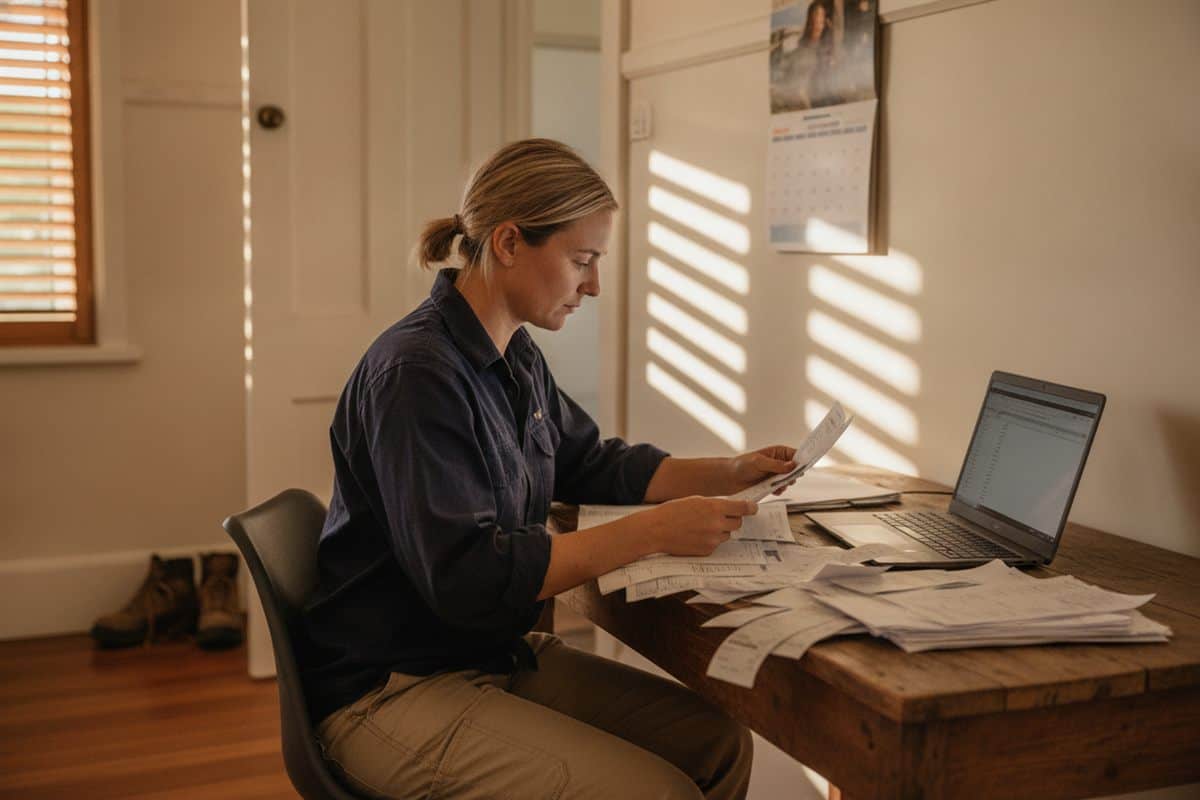
The ATO’s figure is based on last year. If this year is going to be clearly lower, you can vary your instalments on the activity statement. Perhaps you lost a builder who gave you most of your work, or you are taking three months off. You do it on or before the due date, and before you lodge that year’s return. The varied amounts should add up, quarter by quarter, to 25%, 50%, 75% and then 100% of the tax you now expect for the year. You also give a reason code.
Here is the catch. In the ATO’s words: “If your varied instalments are less than 85% of your total tax payable, you may have to pay a general interest charge on the difference … there may also be penalties.” An illustration, not a real case:
That interest is the general interest charge, at 11.51% a year for October to December 2026. And since 1 July 2025, GIC is no longer tax-deductible, so a wrong guess now costs the full rate. The ATO’s own advice is blunt: “If you’re not sure, it is best to not vary.” A variation works best when you have a clear reason and a realistic view of the rest of the year. It is not a way to hold on to cash in a busy one.
Decide which of the three positions you are in. If this year looks much like last, pay the ATO’s amount and put the same sum aside each quarter, so the instalment is a transfer rather than a shock. If your work comes in bursts, switch to the instalment rate on your first activity statement, so quiet quarters cost less. And where this year is clearly lower and you can say why, vary. But set the figure from real numbers, not hope: tracking a few figures each month, such as revenue and margin, gives you an estimate you can stand behind. Your registered tax agent can make the call with you, and may be able to lodge later than the dates above.
ON THE INSTALMENT RATE
Know what the quarter earned before the ATO asks.
The instalment rate and any variation both start from what you invoiced in the quarter. SendWork keeps your quotes, jobs and invoices together on your phone, so that figure is there when you or your tax agent need it, rather than rebuilt from the glovebox the week it is due.
See how Australian tradies keep jobs and invoices in one place →