Go to SendWork
— Free for 7 Days
Full access
Full access

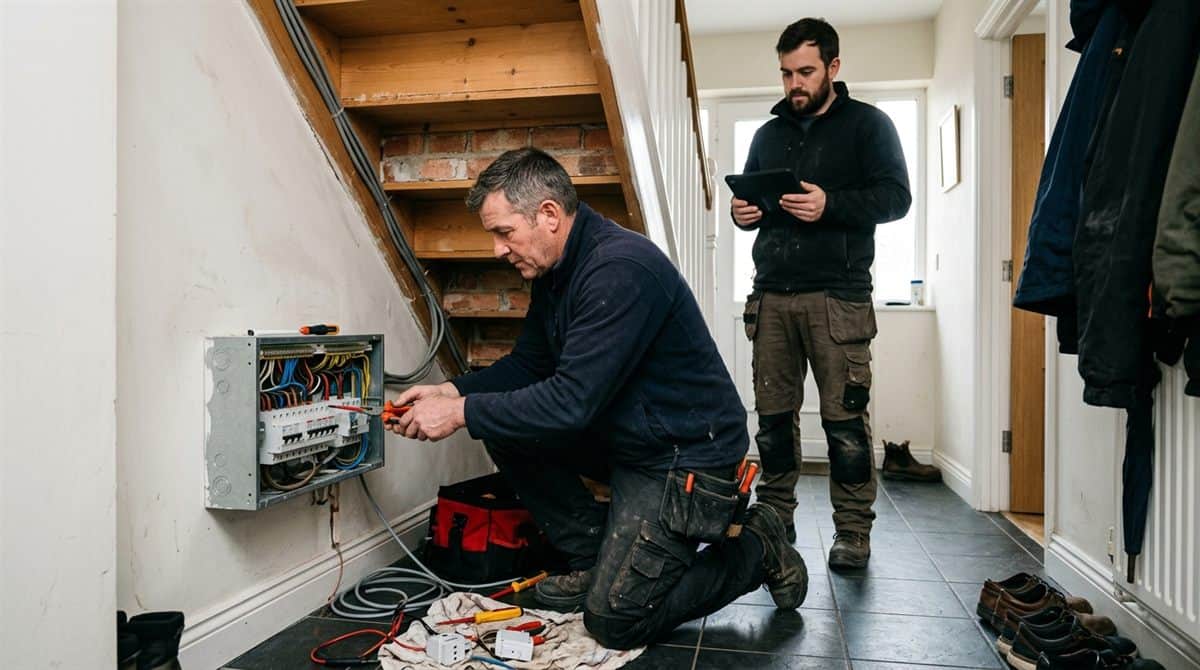
Your heat pump quote for a semi in Naas, County Kildare, needs a new supply circuit and a new board, because the old one is full. Both are restricted electrical works: only a registered electrical contractor may do them, and the homeowner gets a certificate.
Taking out the oil boiler and fitting the unit, cylinder and pipework in a 1990s house is your trade, and your own fitter is well able to run a cable. The law draws the line at the board. In a home, the dedicated circuit is restricted electrical works under regulation 4(2)(c), and replacing the full board is restricted under 4(2)(b). Both belong to a registered electrical contractor (REC), who certifies the work when it is finished. Your crew keeps the hydraulic side.
The supply may need more than a circuit. The ESB Networks rewiring service page lists a new heat pump as a typical reason to upgrade the meter tails. In that case the REC submits a completion certificate to Safe Electric, and the homeowner applies through their ESB Networks online account. The fee shown on that page is €212.99 including VAT. The Sustainable Energy Authority of Ireland (SEAI) runs the heat pump grant, an optional payment to homeowners. It now includes a €2,000 boiler scrappage add-on, covered in our Budget 2027 briefing.
Restricted electrical works is the legal name for the domestic electrical jobs that only an REC may do. The list is set by the Electricity Regulation Act 1999 (Restricted Electrical Works) Regulations 2013, S.I. No. 264 of 2013. They have applied since 1 October 2013. The Commission for Regulation of Utilities (CRU), then called the Commission for Energy Regulation, made them under section 9E of the Electricity Regulation Act 1999. The Energy (Miscellaneous Provisions) Act 2006 added that section. Using an REC for this work is a legal requirement, not a voluntary quality mark.
Regulation 4 lists four kinds of work in a domestic property:
“Domestic property” is wider than the house itself. Regulation 3 includes a home office, surgery or consulting room of up to 50 m² in total, outbuildings used for non-commercial purposes and the home’s connection to the network. Regulation 4(3) then excludes minor works: replacing an accessory such as a light switch, replacing or moving a light fitting while keeping the existing circuit, and adding a socket to an existing radial circuit.
The register itself sits in the Safe Electric scheme. This is the statutory regulatory scheme for electrical contractors, run day to day by Safe Energy Ireland on behalf of the CRU. Safe Energy Ireland holds the appointment for 2023 to 2028. Registration is compulsory for anyone carrying out restricted works, and membership is what makes a business an REC.
Whether a job counts as restricted electrical works turns on what it does to circuits and the board, not on how long it takes.
An EV charger fed from a new circuit at the board is restricted under regulation 4(2)(c), protective device included. ESB Networks also names a new EV charger as a typical reason for its meter tails upgrade, and the REC submits a completion certificate for that work too.
A consumer-unit change is restricted in its own right under regulation 4(2)(b), with nothing else changed. The wording runs to the customer tails on both sides of the main protective device. A board swap on a rental before new tenants arrive is REC work, however tidy the old cabling looks.
One more socket can fall outside the rule, because adding a socket to an existing radial circuit is minor work. Two conditions travel with that. The socket has to go on a circuit already there, with no new circuit and no new protective device at the board. The room matters as well, because the regulation lists work in a Part 7 special location separately as restricted. An REC who does minor work must still certify it if the customer asks.
A kitchen rewire replaces circuits, so it is restricted under regulation 4(2)(c). If the new circuits need a bigger board, regulation 4(2)(b) applies too. Price the electrical part as an REC’s package, with its certificate, rather than as a line inside the joinery.
Regulation 4(3) takes several settings out of restricted works. They include commercial premises, construction sites, farms and horticultural installations, exhibitions and public lighting. In a shop or office, most of the same jobs fall under controlled electrical works instead. Safe Electric says these need certification when an REC does them, and the CRU recommends using one, but the law does not reserve them for RECs.
The construction-site exclusion does not let a new house skip the REC, though. ESB Networks says a validated completion certificate must reach it from the electrical contractor’s regulatory body before any connection work can begin. Building a new dwelling is the first case on its list. On the site itself, the usual site rules apply, starting with the Safe Pass card check on each worker’s first day.
The completion certificate is the REC’s statement that the work meets the National Rules for Electrical Installations. Section 9D of the 1999 Act requires an REC to issue one for specified works, on a form the CRU sets. The CRU’s guidance for householders puts it simply: an REC working in your home “must give you a Completion Certificate”.
Safe Electric’s completion certificates page sets out what that document looks like in practice:
Sometimes the REC finds a hazard that neither they nor the customer can put right on this job. Then they issue a Notice of Potential Hazard with the certificate.

Safe Electric’s certificate timelines page gives normal processing as 3 to 5 working days. It asks people to allow up to 10 working days for validation before chasing. Its top five reasons for a failed certificate include expired insurance, wrong Qualified Certifier numbers, incomplete addresses and wrong or illegible MPRNs. The MPRN, the Meter Point Reference Number, is on the homeowner’s electricity bill. Get it from them before the REC fills in the form.
Reconnection matters on renovations. ESB Networks lists reconnecting a home that has been disconnected for more than six months as a typical case needing a certificate. If you are renovating a vacant house, build the REC’s test, the certificate and its validation time into your programme before you promise a move-in date. If the installing electrician becomes unavailable before certifying a new installation, Safe Electric runs a change-of-contractor process. Its FAQ gives a minimum charge of €280 plus VAT for the inspection.
A landlord, buyer or lender may ask for a report on a house’s wiring. In a home, inspecting, testing or reporting on an existing installation is restricted under regulation 4(2)(d), so an REC has to produce it. Safe Electric’s periodic inspection reports page says a report is “not a Completion Certificate”. It records the condition of the installation, good or bad. The REC must give the customer the report with its Test Record Sheet and explain the next steps. Remedial work it recommends is a separate job. If that work is restricted, it needs its own completion certificate.
Before an electrician goes on your quote, check the business on the Find a Registered Electrical Contractor search on the Safe Electric website, by county or keyword. Not every REC appears there, because joining the public listing is optional. If the contractor you plan to use doesn’t show up, Safe Electric asks you to email or phone it to confirm their registration. Match the registered name to the name on their quote and invoice.
Safe Electric says any REC on its register has appropriate insurance cover in place. That cover is theirs, though. What your own business carries is a separate question, and our guide to contractor insurance in Ireland walks through it.
Paying the REC as your subcontractor can bring in Revenue too. Relevant Contracts Tax is Revenue’s compulsory withholding system for payments from a principal contractor to a subcontractor, set out in Chapter 2 of Part 18 of the Taxes Consolidation Act 1997. Installing a power supply system in a building is a construction operation under section 530. So if you are the principal, notify the contract on ROS before you make the first payment.
Under section 9E(4), anyone who carries out restricted works without being an REC commits an offence. On summary conviction, the maximum is a €5,000 fine, six months in prison or both. On indictment, it rises to €15,000, three years or both. Section 9D(25) makes it a separate offence to describe yourself in a way that suggests you are an REC when you are not. On indictment, that one carries a fine of up to €50,000. The CRU investigates unregistered domestic work, and anyone can report it through Safe Electric.
The commercial cost arrives sooner. A homeowner whose REC won’t issue a certificate can complain to Safe Electric, and a house with no validated certificate waits for its ESB Networks connection.
MPRN AND ADDRESS FIRST
A certificate that fails validation holds up the connection.
Wrong MPRNs and incomplete addresses are among the top reasons Safe Electric rejects certificates. With SendWork, you can keep the homeowner’s MPRN and Eircode, the REC you subcontracted and the job notes on one job record. The electrician then fills in the certificate from the right numbers.