Go to SendWork
— Free for 14 Days
Full access
Full access

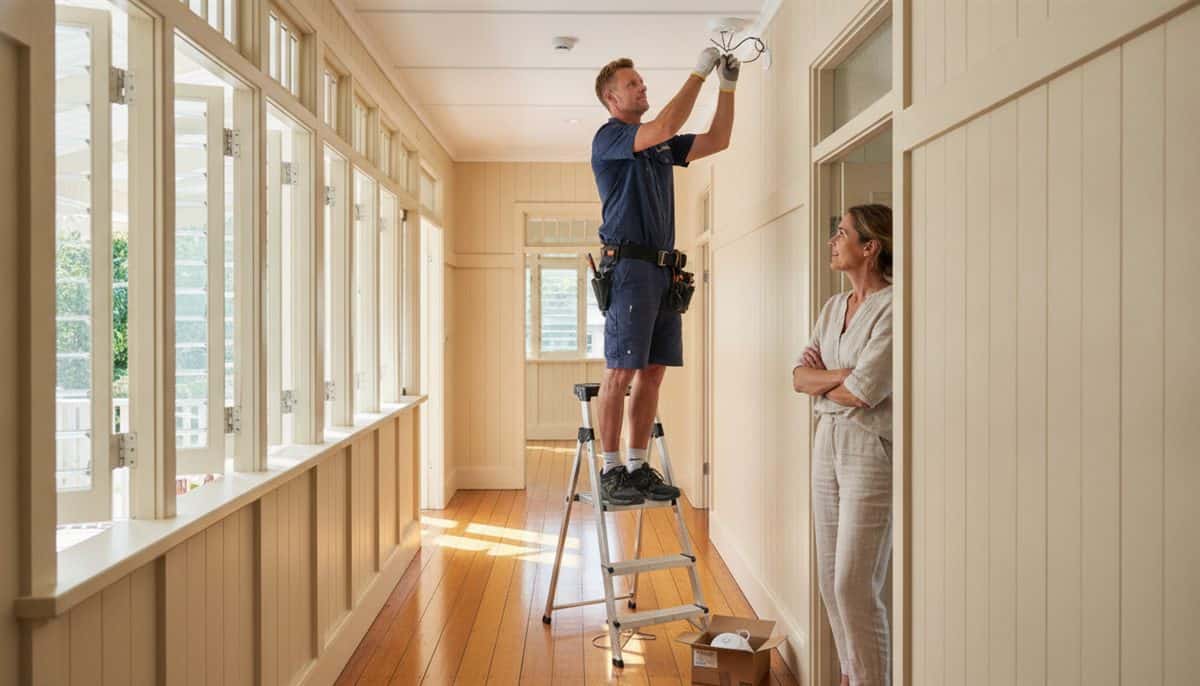
From 1 January 2027 every owner-occupied home in Queensland needs interconnected photoelectric smoke alarms in every bedroom, the hallway outside them and on every storey. What a compliant installation needs, where each alarm goes, what the owner may fit themselves, and the certificate the electrician issues.
Take a homeowner in Toowoomba who rings in October (an illustration, not a real job). Her house has two old smoke alarms in the hallway, one wired in and one on a 9-volt battery. She has heard the Queensland smoke alarm rules are changing. She wants to know whether she needs to do anything, and what it will cost. The answer is yes, before 1 January 2027, and the price depends on how many bedrooms and storeys the house has.
That date is the last phase of the Queensland smoke alarm law. From 1 January 2027 it reaches every owner-occupied home, not just rentals, sales and new builds. If you are the Queensland electrician taking that call, you need four things straight before you quote: what a compliant installation needs, where each alarm has to go, what you may leave to the owner, and the certificate your part of the job produces.
Queensland phased the rules in. The Queensland Fire Department’s reform page lists three dates: from 1 January 2017 for new homes and substantial renovations, from 1 January 2022 when a home is sold or leased, and from 1 January 2027 “to all remaining domestic dwellings”.
Legally, the switch is in the Fire Services Act 1990. The section that kept older homes on the old rules, section 147Y, “expires on 31 December 2026”. From the next day the current requirements in section 147Z apply to every domestic dwelling. In the Act that means a house (a class 1a building) or a unit in a class 2 apartment building. For the owner on the phone, that comes down to one sentence: from New Year’s Day, the rules that already applied to rentals, sales and new builds apply to their home too.
| Requirement | What the law says | Where it sits |
|---|---|---|
| Type | Complies with AS 3786–2014, has a photoelectric sensor and no ionisation sensor | Building Fire Safety Regulation 2008, s 55E |
| Age and testing | Manufactured less than 10 years before installation, and operates when tested | Fire Services Act, s 147Z(5) |
| Interconnection | Interconnected with every other required alarm in the home | Fire Services Act, s 147Z(5) |
| Power | Hardwired to the mains, or a built-in battery that cannot be removed and lasts at least 10 years | Building Fire Safety Regulation, s 55D |
| Replacement | Replaced within 10 years of manufacture, or immediately if it fails a test; a hardwired alarm is replaced with a hardwired one | Fire Services Act, s 148A |
Each row is something to check on the existing alarms at the quote visit: the type, the manufacture date, whether they are linked and how they are powered. The detail comes from Part 5A of the Building Fire Safety Regulation 2008, published on the Queensland legislation site. Interconnection is a result, not a method. The Act asks that each alarm sounds when another is activated. The fire department’s FAQ says the link can be “physically wiring together by a licenced electrician or using wireless technology (or a combination of both)”.
Walk the house with this list at the quote visit: the bedrooms and hallways set the count, and the clearances further down decide where you drill. Section 55C of the regulation sets the locations. There must be an alarm in every bedroom. On a storey with bedrooms, one goes in the hallway that connects them to the rest of the home. With no hallway, it goes between the bedrooms and the rest of that storey. On a storey without bedrooms, one goes on the most likely path of travel to an exit.
The same section fixes the placement:
Where the required spot is impracticable, section 148 of the Act allows another location that still gives a warning. Note the reason on the job, so anyone checking the install later can see why the alarm sits where it does.
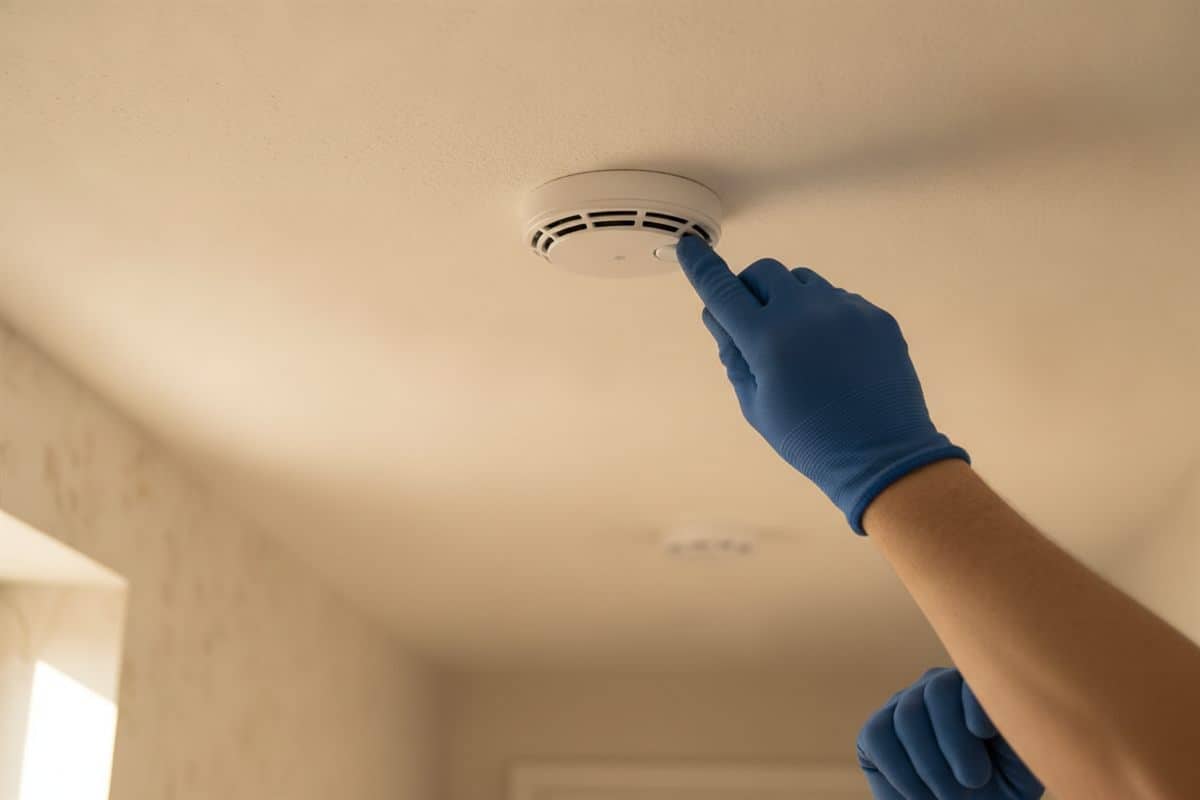
Hardwired alarms are licensed work. The FAQ is direct: “240-volt smoke alarms connect to the electricity supply and must be connected by a licenced electrician.” It also says “non-removable battery powered smoke alarms do not need to be installed by an electrician”. So some owners may fit their own battery units. Your job is the part only you may do, and the quote should say which part that is, so the owner knows which alarms your certificate covers.
Existing hardwired alarms set the floor. Under section 148A(3), a hardwired alarm being replaced must be replaced with a hardwired one. So the hallway alarm in the Toowoomba house stays on the mains. The bedrooms can take wired alarms or 10-year battery alarms, linked by wire or wirelessly, as long as the whole house ends up interconnected.
One paperwork change to know before you write the certificate: Queensland’s electrical safety rules were remade in September, when the Electrical Safety Regulation 2026 commenced on 1 September 2026 and replaced the 2013 regulation. WorkSafe says it adds no new obligations. The certificate of testing and compliance now sits in section 229 of the 2026 regulation, although some guidance still cites section 227 of the old one.
After connecting the installation, you must give your customer a certificate. It states that the work has been tested, is electrically safe and complies with the wiring rules. The maximum penalty for not doing so is 40 penalty units. You must keep a copy for at least five years. For a smoke alarm upgrade, that certificate may be the only paperwork the owner holds, and it matters again when they sell: they declare smoke alarm compliance on the transfer form, which the fire department calls a “Form 24”.
An illustration with round numbers, not a price guide. A two-storey, four-bedroom house with two hardwired hallway alarms from 2012, one upstairs and one down:
For the owner, the risk is small in money but real, and it is worth putting plainly when they ask whether this can wait. Failing to install compliant alarms carries a maximum of 5 penalty units. At the 2026–27 value of $172.70 a unit, that is $863.50. Some owners may qualify for help. Home Assist Secure clients “may qualify for a $250 subsidy”, although the Queensland Government says funding has run out in some areas.
Expect the calls to bunch up in November and December. A same-day quote with the count and the method written down can carry more weight than a cheaper one a week later. That is the case the article on why slow estimates lose jobs makes.
ON THE SMOKE ALARM CALLS BEFORE CHRISTMAS
Six alarms, two storeys and a certificate: the quote has to hold all of it.
A smoke alarm upgrade is a count, a method and a certificate, and the calls will bunch up before 1 January. SendWork keeps the quote, the job and the invoice on one record, so the alarm count you quoted is the one the crew installs and the one you bill.
See how Queensland electricians keep quotes and jobs together →