Go to SendWork
— Free for 7 Days
Full access
Full access

Your techs can deduct customer tips under the no tax on tips law, but only if you set up the tip screen, pay tips over and report them right. One $40 card tip traced from the screen to the 2026 W-2, and which trades qualify.
Should you put a tip option on your invoices and card reader, now that your techs can deduct their tips? You can, and an HVAC tech, plumber, electrician or house cleaner can claim the no tax on tips deduction on what customers give them. But the deduction belongs to the tech, and whether they can use it depends on how you set up the tip screen, pass the money on and report it. Get the screen wrong and the tip doesn’t qualify. Skip the reporting and it never reaches their 2026 W-2, which is due February 1, 2027.
The deduction comes from section 224 of the tax code, added by P.L. 119-21, the federal tax law of July 2025 known as the One Big Beautiful Bill Act. It lets a worker deduct up to $25,000 of qualified tips a year from federal taxable income, for 2025 through 2028, whether or not they itemize. It shrinks by $100 for every $1,000 of income above $150,000, or $300,000 on a joint return. The worker claims it on their own return, and needs a Social Security number valid for work.
“No tax” is a stretch. Social security and Medicare still apply to every tip, for the tech and for you, and many states tax tips as usual. Your job as the employer is narrower than the tech’s: offer tips in a way that qualifies, hand them over in full, and report them correctly.
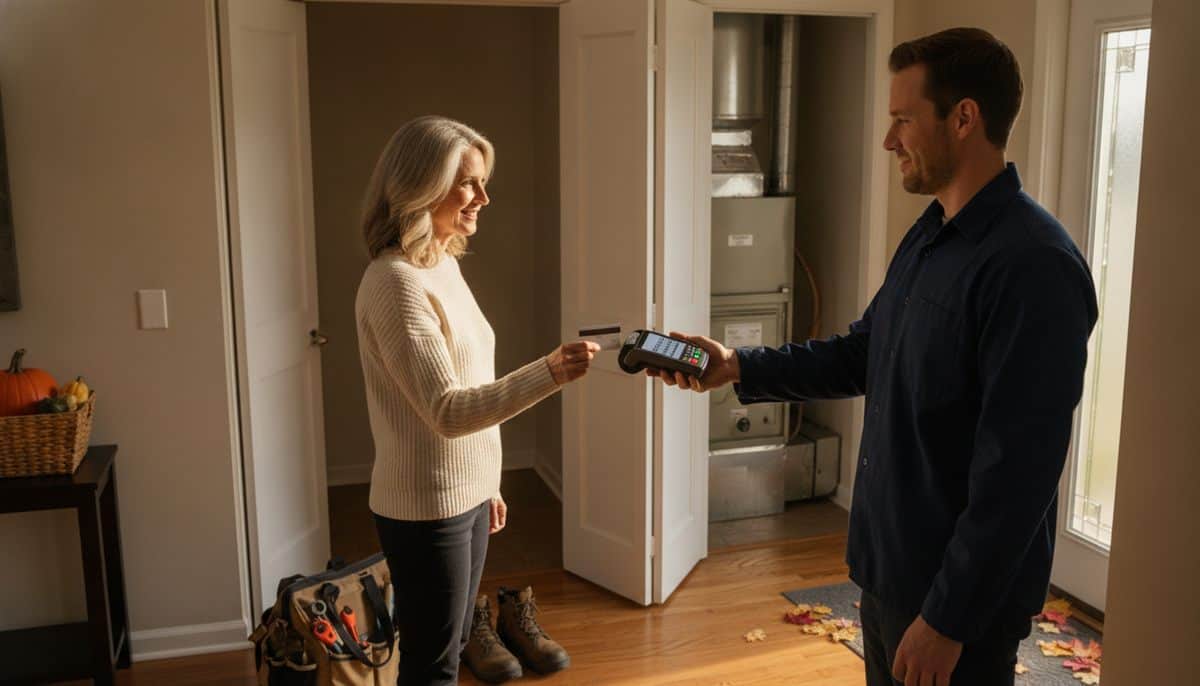
Here is an illustrative example. An HVAC tech finishes a $385 furnace repair and hands the customer your card reader.
The screen offers $20, $40, $60, a custom amount and “No tip”. The customer taps $40, and the card is charged $425. That $40 is a qualified tip, because the customer chose it freely and could have chosen nothing. The final Treasury regulations are specific about the screen. If there is no “No tip” option, the forced minimum doesn’t qualify; only the amount above it does. A service charge printed on the invoice is not a tip at all, even if you pass it to the tech. Neither is part of the job price relabeled as a tip.
Under the Fair Labor Standards Act, you may not keep any part of an employee’s tips, whether or not you pay the minimum wage. Managers and supervisors may not share in them either. On a card tip, the Department of Labor lets you deduct only the card company’s transaction fee on the tip itself. At an assumed 2.9% fee, that is $1.16, so the tech gets $38.84. Passing on the full $40 is simpler. Either way, pay it with the regular wages.
Card tips you pay over are still tips the employee reports to you. Any month their tips reach $20, the tech reports them by the 10th of the following month, so November tips are due by December 10. The report can go through an electronic system you set up, or on a statement the tech signs and dates. IRS Publication 531 calls the old Form 4070 historical, so don’t hand it out.
Reported tips go through payroll as wages. On the $40, the tech pays 6.2% social security and 1.45% Medicare, $3.06 in all, and you match it with another $3.06. Income tax is withheld too, under the same supplemental-wage rules as a bonus. A tech who expects the deduction can file a new Form W-4 to reduce it. Unlike restaurants, a home-service business cannot claim the FICA tip credit on its techs’ tips: since the 2025 law, that credit covers only food and drink service and four beauty services.

The 2026 Form W-2 instructions add two entries. Box 12, code TP, shows the total cash tips the employee reported to you. It is not “qualified tips”: the tech works that out. New box 14b, “Treasury Tipped Occupation Code(s)”, takes up to two three-digit codes for the jobs the tips came from. If any tips came from a job not on the list, one of the codes must be “000”. Say our tech reported $1,240 of tips in 2026. Their W-2 shows $1,240 with code TP and in box 7, includes it in boxes 1 and 5, and shows 405 in box 14b. The penalty relief the IRS gave for 2025 W-2s does not extend to 2026.
On their return, the tech deducts the $1,240 if it all qualifies. In the 12% federal bracket, that is worth about $148.80; the $40 tip alone, about $4.80. The overtime deduction works the same way through a different box, covered in our guide to reporting overtime on the W-2.
Only tips earned in an occupation on Treasury’s list count. The IRS list has a home services group, codes 401 to 409:
Pest control is not on the list. Apprentices and helpers count in the occupation they work in. The regulations do not say how tips on purely commercial jobs fit the “home” codes, so ask your payroll provider or tax adviser before you code them.
Owner-operators in a listed trade can claim on tips they receive themselves, with extra conditions, so check with your tax preparer. Subcontractors on a 1099 report their own tips; our guide to 1099 versus W-2 workers explains the difference. And anything you pay your own tech, even a holiday “tip”, is wages under the regulations, not a tip.
State income tax is separate. Michigan follows the federal deduction from 2026, for example, but states differ, so check yours before telling techs what they’ll save.
If you are still setting up payroll, start with our guide to hiring your first employee. To keep tips apart from job revenue in your books, see our bookkeeping basics, and our 2027 overview lists the other payroll changes.
WHEN THE CUSTOMER TIPS
A tip is easier to pass on when you know which job and which tech it came from.
In SendWork each job shows the technician assigned to it alongside the invoice for that visit, so you can see whose work a customer’s payment belongs to.