Go to SendWork
— Free for 14 Days
Full access
Full access


The first pay you run in January 2027 takes CPP contributions at 5.75% instead of 5.95%, and your matching share as the employer drops by the same amount. On an apprentice earning $42,000 that is $77 less for each of you over the year, but on anyone earning over $87,400 the cut is worth only $9.45 each, because the earnings that CPP is charged on went up for 2027 as well.
The first pay you run in January 2027 takes CPP contributions at 5.75% instead of 5.95%, and your matching share as the employer drops by the same amount. On an apprentice earning $42,000 that is $77 less for each of you over the year, but on anyone earning over $87,400 the cut is worth only $9.45 each, because the earnings that CPP is charged on went up for 2027 as well.
The cut is settled law, not a proposal. Parliament lowered the base Canada Pension Plan rate from 4.95% to 4.75% each for employees and employers, and from 9.9% to 9.5% for the self-employed, starting with the 2027 year. The extra contributions that have been added on top since 2019 stay exactly where they are, and the Canada Revenue Agency has already posted its figures for CPP contributions in 2027, so you can set up January’s payroll and next year’s labour rates on real numbers now.
The Canada Pension Plan is the federal pension that pays retirement, disability and survivor benefits, and almost everyone who works in Canada outside Quebec pays into it from age 18 to 70 once they earn more than $3,500 a year. You take the employee’s half off each paycheque, add the same amount again as the employer, and send both to the CRA with your other source deductions. If a pay goes out without the right deduction, the CRA assesses you for both halves, whether or not you can get the money back from the worker, and can add a penalty of 10% of what you didn’t deduct. None of this applies to work in Quebec, where employers deduct Quebec Pension Plan contributions instead and Revenu Québec sets the rates, so if your crew works there, use Revenu Québec’s figures rather than the ones below.
The rates are written into the Canada Pension Plan itself, the federal Act that sets up the plan, so changing them takes an Act of Parliament. That came in Division 5 of Part 3 of the Spring Economic Update 2026 Implementation Act, which received Royal Assent on June 18, 2026. It adds a line to Schedule 1 of the Canada Pension Plan setting the base rate at 4.75% for employees, 4.75% for employers and 9.5% for the self-employed for 2027 and every year after, and it updates the plan’s fallback rate formula to match the new 4.75%.
A contribution rate change can’t take effect on Parliament’s say-so alone. Under section 114 of the Canada Pension Plan, the provinces are joint stewards of the plan, and at least two-thirds of them, with at least two-thirds of the population, have to consent before the federal cabinet can bring the change into force. Ontario gave its consent on August 13, 2026, and once enough provinces had done the same, the cabinet’s Order in Council P.C. 2026-1055, made on October 30, brought the rate cut into force the next day. The CRA had added the 2027 rows to its CPP contribution rates page and its second additional CPP page by November 9.
Only the base part moves. The first additional contribution, the 1% each that phased in from 2019 to pay for the bigger pension, stays at 1%, so the total rate on ordinary pensionable earnings goes from 5.95% to 5.75% for each side. The second additional contribution, which the CRA calls CPP2, stays at 4% each on the slice of pay between the first earnings ceiling and the second. Both ceilings went up for 2027, as they do most years: the year’s maximum pensionable earnings rises to $76,700 from $74,600, and the second ceiling to $87,400 from $85,000, on the CRA’s published limits. The Department of Finance puts the saving at about $133 a year for an employee on $70,000, with the same saving for the employer, and the arithmetic bears that out: 0.2% of the $66,500 of earnings above the $3,500 exemption is $133.
| What it is | 2026 | 2027 |
|---|---|---|
| Rate for the employee, and again for the employer | 5.95% | 5.75% |
| Rate for a self-employed person paying both halves | 11.9% | 11.5% |
| Earnings exempt from CPP each year | $3,500 | $3,500 |
| Year’s maximum pensionable earnings (the first ceiling) | $74,600 | $76,700 |
| Most an employee pays in CPP, and the employer matches | $4,230.45 | $4,209.00 |
| Most a self-employed person pays in CPP | $8,460.90 | $8,418.00 |
| CPP2 rate on pay between the two ceilings, each side | 4% | 4% |
| Second ceiling, where CPP2 stops | $85,000 | $87,400 |
| Most an employee pays in CPP2, and the employer matches | $416 | $428 |
| Most a self-employed person pays in CPP2 | $832 | $856 |
The maximum is the line to look at twice. The rate fell by two-tenths of a point, but the earnings it applies to grew by $2,100, so the most anyone pays in regular CPP drops by only $21.45, and CPP2 at the top rises by $12. That is why the cut is worth real money to the people in the middle of your payroll and close to nothing to your best-paid people.
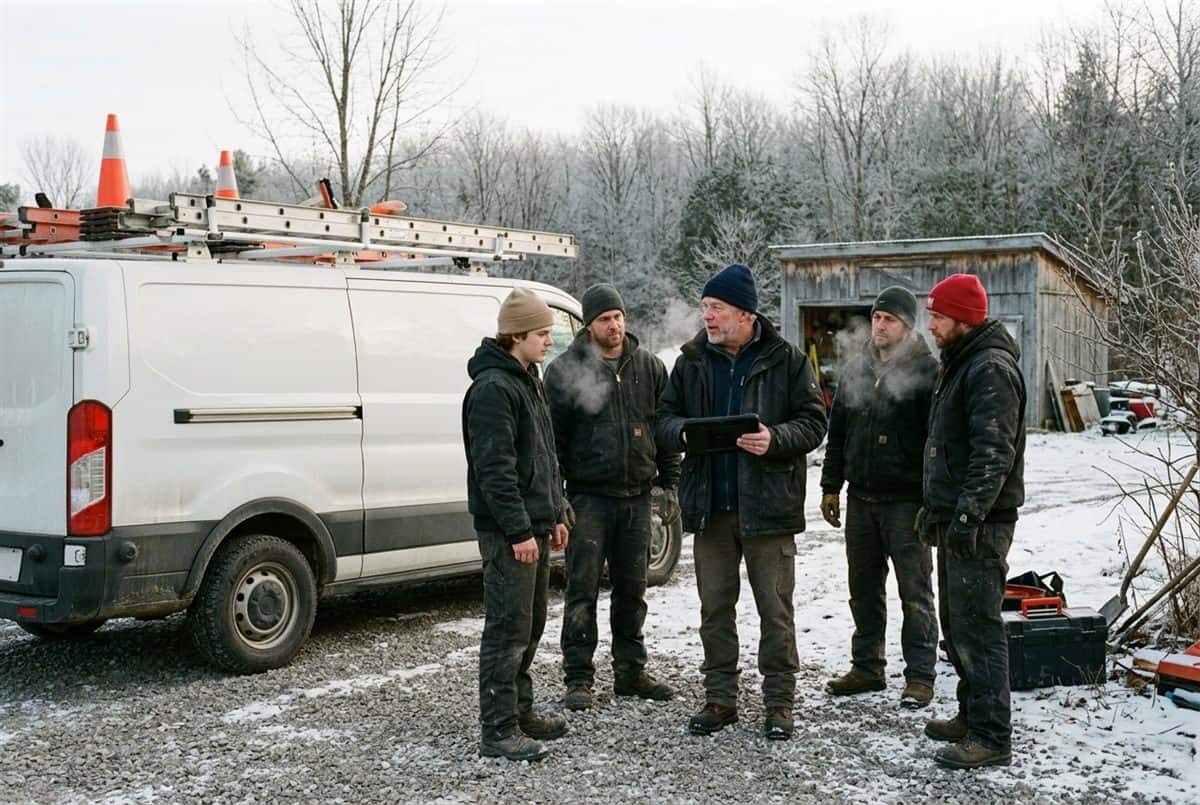
Say you run a renovation crew in Barrie, Ontario, and three of the people on it earn $42,000, $80,000 and $95,000 a year, paid every two weeks. To keep the comparison clean, the wages stay the same in both years, and each figure below is the employee’s deduction for the year, which you match as the employer.
The apprentice on $42,000 never comes near either ceiling, so the whole of his pay above the $3,500 exemption, $38,500, attracts CPP at the full rate. In 2026 that is $2,290.75, and in 2027 it is $2,213.75, which is $77 less for him and $77 less for you. Spread over 26 pays, his pay stub shows about $3 less CPP each time, starting with the first pay in January.
The lead hand on $80,000 sits between the two ceilings, so he pays regular CPP up to the maximum and CPP2 on the rest. In 2026 that is $4,230.45 plus $216 of CPP2 on the $5,400 between $74,600 and $80,000, or $4,446.45. In 2027 his regular CPP stops at the new $4,209 maximum, and because CPP2 now starts at $76,700, only $3,300 of his pay attracts it, which is $132. His total is $4,341, a saving of $105.45 on each side, larger than the apprentice’s because the higher first ceiling shrinks the slice of pay that CPP2 reaches.
The foreman on $95,000 pays both maximums in both years. That comes to $4,646.45 in 2026 and $4,637 in 2027, so the cut is worth $9.45 to him and $9.45 to you. If he has heard about a rate cut and expects to see it on his pay, it’s worth a word before January, because on his stub it is close to invisible.
The CRA’s rule for payroll deductions is that you use the rates in force on the date you make the payment, not the dates the work was done. So a cheque or deposit dated in January 2027 for the last week of December takes CPP at 5.75% and counts toward the 2027 maximum, and anything you pay on or before December 31, 2026 stays on the old rate and the old ceiling. If your payroll software or payroll provider handles the yearly update, check the first January pay run all the same: the employee rate should read 5.75%, the employer share should match it, and the maximum should be $4,209 rather than this year’s $4,230.45.
Each employer works out CPP on its own pay, too. If someone joins you in March after maxing out with another contractor, you still deduct and match from their first pay with you, and the CRA refunds any overpayment to the worker when they file, not to you. That matters when you take on someone from another contractor’s crew partway through 2027, because your share of the CPP on what you pay them is a full cost to you, however much they had already paid that year.
For pricing, the cut is small per hour but it is real. A carpenter on $31 an hour who works 2,000 paid hours earns $62,000, and your employer CPP on that is $3,480.75 for 2026 and $3,363.75 for 2027, or about $1.74 an hour falling to $1.68. Six cents an hour won’t change a quote on its own, but it belongs in the burden you add to the wage, along with vacation pay, statutory holidays and your workers’ compensation premium, which in Ontario construction is the WSIB premium. Our guide to turning a wage into a charge-out rate works through the rest of that load.
Employment Insurance is the other federal line on the same payroll, and for 2027 it moved the other way, with both the premium rate and the earnings ceiling going up. Our breakdown of EI premiums for 2027 has those figures, and the two together are the 2027 payroll cost per person that your labour rate needs to cover. Set side by side, the CPP saving is bigger than the EI increase for everyone on the Barrie crew except the foreman, because above the second CPP ceiling a $9.45 saving on CPP is smaller than the rise in the most you pay in EI as the employer.
As a sole proprietor you pay the employee’s share and the employer’s share on your own net business income, so the self-employed rate falls from 11.9% to 11.5%. You don’t pay it through payroll. It is worked out on Schedule 8 of your 2027 income tax return and paid with the tax you owe for the year, which means the balance is due at the end of April 2028, although self-employed people have until June 15, 2028 to file. If you’re incorporated and pay yourself a salary, the company deducts and matches your CPP like anyone else’s, and dividends carry no CPP at all, which is one of the trade-offs our comparison of a sole proprietorship and a corporation for contractors sets out.
Put the Barrie business together and the whole cut comes into view. Say it’s a sole proprietorship, with the apprentice on $42,000, two carpenters on $62,000 each, the lead hand on $80,000 and the foreman on $95,000 on the payroll, and you net $70,000 yourself. Your employer share of CPP and CPP2 for the five of them comes to $18,345.15 for 2026 and $17,919.25 for 2027, which is $425.90 less. Your own contributions on $70,000 of self-employed income fall from $7,913.50 to $7,647.50, which is $266 less, and none of it is CPP2 because $70,000 is under the first ceiling. That makes $691.90 a year for the business and its owner together. The $425.90 comes off your remittances one pay at a time from January, so it can go straight into your 2027 labour rate. The $266 arrives later, as a smaller bill when you file your 2027 return in the spring of 2028, so the money you put aside through the year for that bill can come down by the same amount.
PRICING NEXT YEAR’S LABOUR
Your 2027 labour cost only helps you if it’s the number in front of you when you write the quote.
SendWork handles quoting, scheduling and invoicing from your phone, with your jobs and crew assignments in one place, so the labour rate you work out this winter is the one you price from when the first 2027 job comes in.
See how Canadian contractors quote and schedule with SendWork →