Go to SendWork
— Free for 7 Days
Full access
Full access

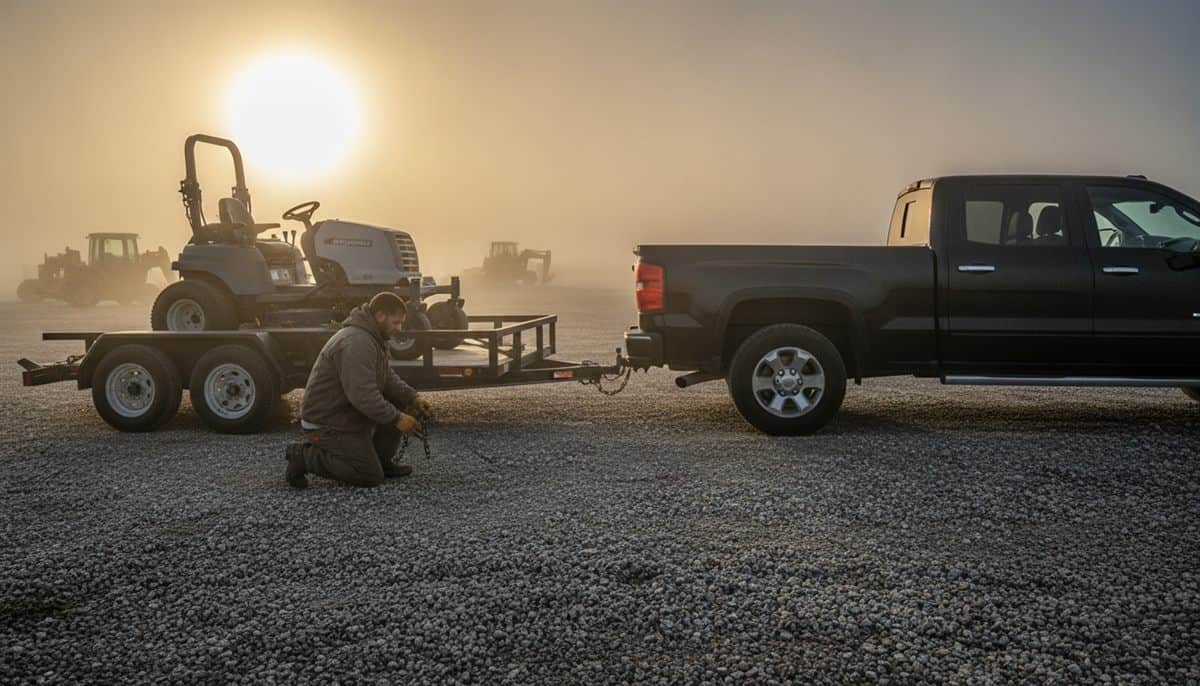
Most contractor pickups towing a working trailer cross the 10,001-pound line on their ratings alone. Once a trip crosses a state line, that means a USDOT number, marking, a medical card, an annual inspection and driver records. What the line measures, when state rules apply, and when a Class A CDL is needed.
Two landscapers leave the same yard on the same morning, towing identical trailers with the same half-empty load. One works a job ten miles away in the same state. The other crosses a state line to reach a client twenty miles off. Under federal motor carrier rules, the second rig is a commercial motor vehicle. It needs a USDOT number, and its driver needs a medical card. The first one probably does not, depending on the state. Neither answer depends on what the scale would have said that morning.
A USDOT number is the identification number the Federal Motor Carrier Safety Administration (FMCSA) issues to a motor carrier. For the second rig it is not optional. 49 CFR 390.19T requires every motor carrier operating in interstate commerce to register before it starts operating. 49 CFR 390.5T defines both that term and the commercial motor vehicle. The medical card is the certificate a driver gets from an examiner on FMCSA’s National Registry.
If you tow for work, whether that is a mower trailer behind a landscaper’s pickup, a skid steer on a builder’s gooseneck or a plumber’s equipment trailer, your answer turns on the same three questions: what the 10,001-pound line actually measures, whether a trip brings the federal rules into play, and what each threshold switches on, up to the point where a driver needs a commercial driver’s license (CDL).
Start with the labels, not the scale. The rule counts the rating or the actual weight, whichever is greater, so the figures on the truck’s certification label and the trailer’s VIN plate can put a rig over the line before anything is loaded. The federal definition sits in 49 CFR 390.5T. A commercial motor vehicle is a vehicle “used on a highway in interstate commerce to transport passengers or property” when it “has a gross vehicle weight rating or gross combination weight rating, or gross vehicle weight or gross combination weight, of 4,536 kg (10,001 pounds) or more, whichever is greater.”
The words “whichever is greater” do the work. A rating is the maximum the manufacturer says a vehicle can carry, not what it weighs today. For a truck and trailer, the combination rating is the greater of two figures:
So a pickup rated at 7,000 pounds towing a trailer rated at 5,000 is a 12,000-pound combination, even with nothing on the trailer. There is one relief. The truck’s combination rating is not used when the truck “is not towing another vehicle.” A three-quarter-ton pickup with a gross vehicle weight rating under 10,001 pounds is under the line on its own. Hitch up almost any working trailer and it is over.
The federal definition applies to interstate commerce. Section 390.5T defines that as transport between a place in one state and a place outside it. It also covers a trip between two places in one state that passes through another. So does one that is part of trade starting or ending outside the state. A New Jersey contractor who runs to a job in Pennsylvania is in interstate commerce. So is one who cuts through a corner of another state to reach a job at home. For each job, then, the question is not how far away it is but whether the route crosses a state line or the goods are moving between states. That is the whole difference between the two landscapers at the top.
A rig that never leaves the state is not off the hook automatically. FMCSA’s registration guidance says “some states require their intrastate commercial motor vehicle registrants to obtain a USDOT Number.” It lists more than thirty states that do. Their thresholds and rules vary. Texas, for example, requires its own TxDMV number for vehicles or combinations over 26,000 pounds. For intrastate work, check with your state’s motor carrier agency before assuming the answer.
The rules are not only for trucking companies. Section 390.5T defines a private motor carrier as “a person who provides transportation of property or passengers, by commercial motor vehicle, and is not a for-hire motor carrier.” Hauling your own tools, materials and equipment to your own jobs in a commercial motor vehicle fits that definition. You do not need operating authority, the MC number for-hire carriers use. You do need the registration and safety rules below.
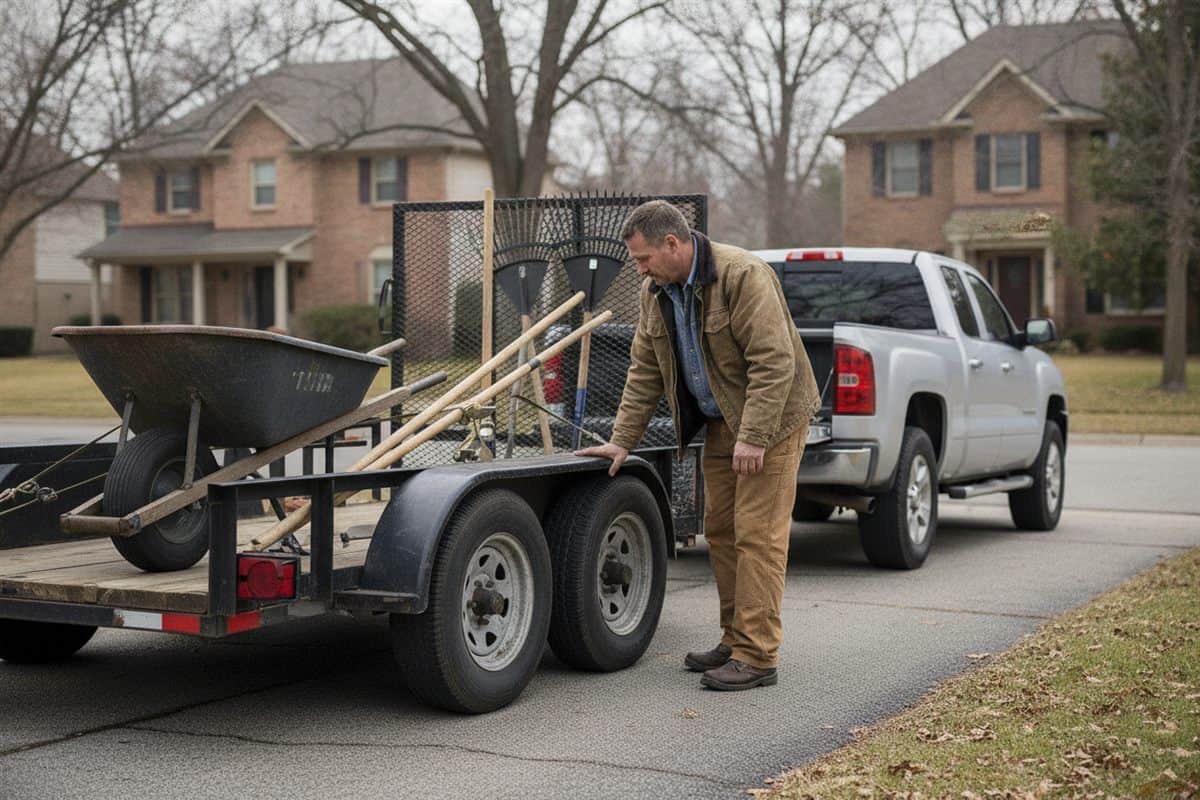
Some of this you set up once per truck or per driver: the number, the marking and the qualification file. The rest comes round on a clock: the biennial update, the medical card, the annual inspection and the daily hours.
| Requirement | What it means for a contractor | Rule |
|---|---|---|
| USDOT number | File the Motor Carrier Identification Report, Form MCS-150, before operating, and update it every 24 months. FMCSA charges nothing for the number. | 49 CFR 390.19T |
| Marking | Company name and USDOT number on both sides of the truck, legible from 50 feet in daylight. | 49 CFR 390.21T |
| Medical certificate | The driver must be medically certified by an examiner on FMCSA’s National Registry, and carry the certificate. It lasts up to 24 months. | 49 CFR 391.41, 391.45 |
| Driver qualification file | An application, driving records, road test and medical certificate for each driver, kept for three years after they leave. | 49 CFR 391.51 |
| Annual inspection | Every vehicle in the combination, trailer included, inspected at least once in the past 12 months, with the record on the vehicle. | 49 CFR 396.17 |
| Hours of service | Up to 11 hours driving in a 14-hour window after 10 hours off. Local work within 150 air miles, back at base within 14 hours, is exempt from logs if you keep time records for six months. | 49 CFR 395.3, 395.1(e) |
Registration itself has moved. FMCSA’s new system, Motus, replaces the old Unified Registration System for new USDOT number applications, as its April 2026 Federal Register notice explains. Motus launched on 19 May 2026, so register there rather than through older links. During the move, FMCSA has temporarily suspended enforcement of the biennial update. Registrants whose update was due on or after 1 June 2026 get extra time and will not have their number inactivated for missing it. Treat that as a pause, not a waiver, and check the page before you rely on it. If your number is already active, keep the update on your calendar anyway, so the pause does not turn into a forgotten filing.
For a local trade crew, the 150 air-mile exception is the one to know. Picture a crew that leaves the yard, works local jobs and is back and released within 14 hours. It does not need logbooks or an electronic logging device. It still needs everything else in the table.
A commercial driver’s license is a separate, higher threshold, and it applies whether or not you cross a state line. Section 383.5 puts a combination in Group A, the Class A license, when it has “a gross combination weight rating or gross combination weight of 11,794 kilograms or more (26,001 pounds or more), whichever is greater, inclusive of a towed unit(s) with a gross vehicle weight rating or gross vehicle weight of more than 4,536 kilograms (10,000 pounds)”. A single vehicle rated at 26,001 pounds or more is Group B.
Both conditions have to be met for Class A. The trailer must be rated over 10,000 pounds, and the combination must reach 26,001. On an equipment trailer, check both figures, not just the combination total. A CDL also brings drug and alcohol testing. Those rules apply to drivers who need a CDL, not to every driver of a commercial motor vehicle.
These are illustrations with typical ratings. Your own figures are on the truck’s door-jamb label and the trailer’s VIN plate.
Put the same trailer on a different truck and the answer can change. That is why the labels matter more than the load. Insurance is a separate question: the commercial auto policy has to fit how the rig is used.
Add the truck’s and the trailer’s ratings, and compare them with the truck’s own combination rating; use the greater. At 10,001 pounds or more, ask whether any trip crosses a state line or carries goods moving between states. If one does, register for a USDOT number, mark the truck, certify the drivers and keep the records. If none does, check your state’s own rules. Then check the trailer’s rating. A trailer over 10,000 pounds in a combination of 26,001 or more means a Class A CDL, on every road.
ON THE RECORDS A ROADSIDE INSPECTION ASKS FOR
The short-haul exception only works if the day’s hours are on record.
Local crews skip the logbook by staying within 150 air miles and keeping time records for six months. SendWork keeps jobs, schedules and crew assignments in one place, so where the crew worked each day, and when the day ended, is already written down.
See how US contractors keep crews and schedules on one record →