Go to SendWork
— Free for 7 Days
Full access
Full access

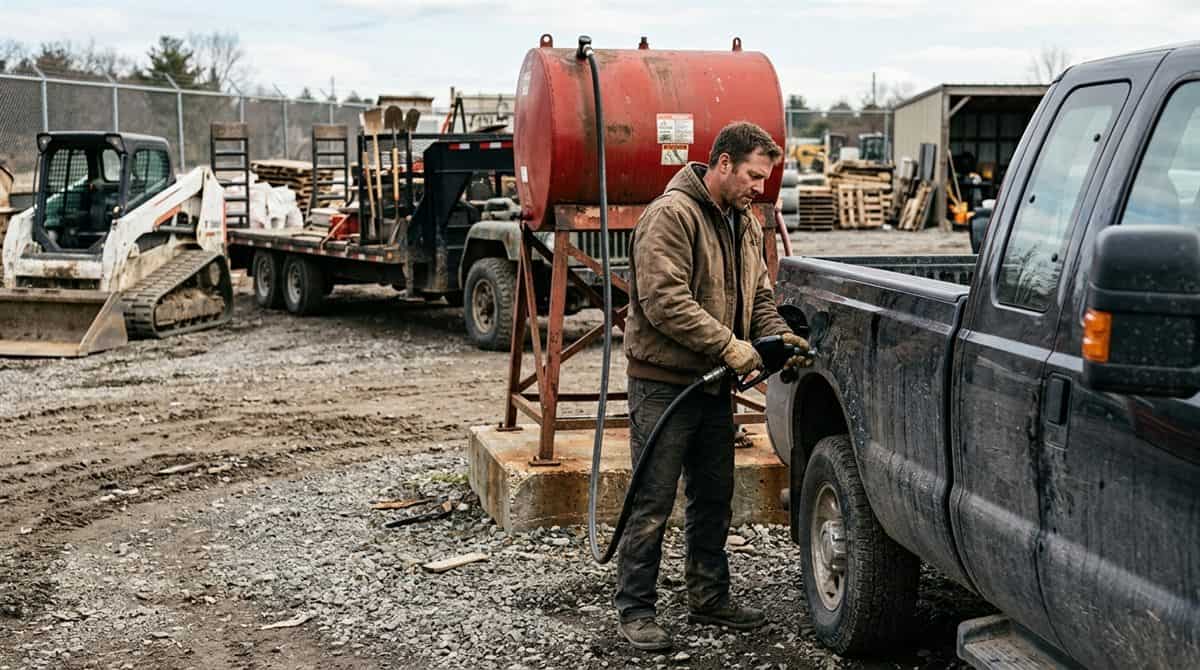
An inspector finds dyed diesel in your pickup's tank, and in normal times that's at least $1,000 in federal penalty. Until December 31, 2026, the IRS won't impose it, but your state may still enforce its own rules.
The federal relief runs from October 1 and covers any business, not just farms. Take a landscaping crew that fills its pickup with 25 gallons of dyed diesel from the yard tank every Thursday. By December 31 that’s 14 fills, or 350 gallons. The IRS won’t inspect the truck or ask for a report on any of them. What it hasn’t done is forgive the tax on those gallons. It has only put it on hold.
Dyed diesel is diesel sold without the federal fuel tax because it’s meant for off-road use: an excavator, a skid steer, a stump grinder or a generator. The exemption is in section 4082 of the Internal Revenue Code. The red dye lets an inspector see untaxed fuel in a road vehicle’s tank.
Put it in a truck registered for the road, and normally two things follow. First, the vehicle’s operator owes a “back-up” tax under section 4041, generally 24.4 cents a gallon, according to IRS Publication 510. Second, section 6715 adds a penalty of $1,000 or $10 a gallon, whichever is greater, for each act. The $1,000 then rises with every repeat penalty. For the landscaping crew, one Thursday fill in normal times means $6.10 of tax and at least $1,000 in penalty.
On October 5, 2026, the President signed Executive Order 14435, “Emergency Tax Relief on Diesel Fuel.” It told the Treasury to defer the tax on dyed diesel used on the highway and to waive the penalties. The IRS then announced two pieces of temporary administrative relief. They don’t change the tax code; they change how the IRS enforces it until the end of the year.
The first, IR-2026-122 of October 14, says the IRS “will not impose a penalty when dyed diesel fuel is sold for use or used on highways nationwide.” It runs from October 1 to December 31, 2026, and it is open to “any person.” The IRS has reassigned its fuel compliance officers, so there are no federal roadside inspections of dyed fuel during the period.
The second, IR-2026-125 of October 21, deals with paperwork. You don’t have to file Form 720 just to report this tax, or keep records just to prove it. The IRS also won’t ask you to rebuild records after December 31. If you file Form 720 for other excise taxes, you still report those as normal.
The tax itself still exists in law. The executive order asks the Treasury to defer payment and to “explore avenues, including legislation” to cancel the amounts deferred. As of late October, no payment date and no forgiveness had been announced.
The IRS says plainly that its relief “has no effect on state fuel taxes and penalties.” State police and revenue departments enforce their own dyed-fuel rules, and they’ve gone different ways. We read these states’ positions at their own official sites:
| State | Who can run dyed diesel on the road without state penalty | Until | State tax |
|---|---|---|---|
| Missouri | All vehicles, for any purpose (governor’s order) | Dec 31, 2026 | Not stated |
| Colorado | All: no state enforcement (governor’s order) | Dec 31, 2026 | Not stated |
| Nevada | All: enforcement suspended (governor’s order) | Federal period, extended for residual dye | Not stated |
| Texas | Restrictions suspended under the disaster declaration | No end date given | The 20 cents a gallon is still owed |
| Illinois | Farming and agricultural use only | Dec 31, 2026 | Normal enforcement from Jan 1 |
| North Carolina | Farming and agricultural use only | Dec 31, 2026 | Sales and use tax continues |
| Nebraska | Vehicles hauling Nebraska farm products only | Dec 23, 2026 | Refund route for those users |
| Iowa | Vehicles hauling listed farm products only | Feb 2, 2027 | Not stated |
| South Dakota | No roadside checks, but the revenue department says only farm producers should use it on the road | End of 2026 | Non-farm users owe sales and municipal tax |
| Minnesota | No relief | — | Normal tax and penalties |
Georgia waived its penalties for all on-road use, but only until 11:59 p.m. on November 5. We found no statement from California, New York, Pennsylvania or Ohio. In those states, assume the normal rules apply until you hear otherwise.
Most farm-only orders give a landscaper, excavator or tree crew no cover. A landscaping pickup isn’t hauling corn. In Illinois, North Carolina, Nebraska, Iowa and South Dakota, the state rules apply to that truck as normal.
If a truck runs under the International Fuel Tax Agreement, the federal relief changes nothing on your IFTA return. IFTA, Inc., the nonprofit that administers the agreement, told carriers on October 8 that most state orders don’t exempt dyed diesel from fuel use tax. You report all miles and gallons, can’t count dyed fuel as tax-paid, and pay state fuel tax through the return. A truck fueled legally in one state can also be cited when it crosses into another. Federal safety and registration rules are unchanged too, as the order itself says; our guide to the USDOT number covers what still applies.
At 24.4 cents a gallon, the crew’s 350 gallons carry about $85.40 of federal tax. Three things are still open:
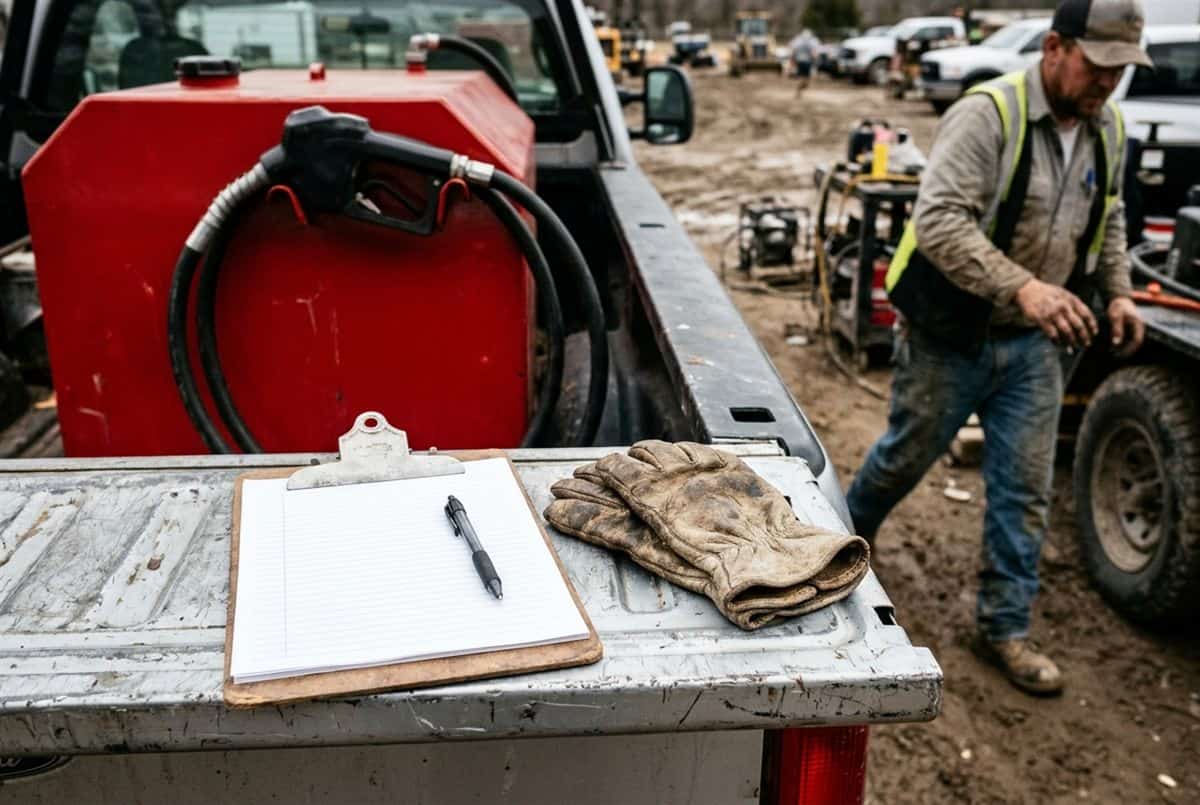
The IRS doesn’t want records for this relief. Your state might. Illinois, for instance, expects farm users to keep plate numbers, gallons, fill-up dates and the date of the last dyed fill, for four years. South Dakota encourages anyone using dyed fuel on the road to keep “accurate fuel use records.” And IR-2026-125 says it doesn’t change record rules that apply to other taxes or to refund claims.
A simple log covers all of that. Note the date, the truck, the gallons and the odometer at each fill. On December 31, write down the odometer and the date of the last dyed fill, then keep your clear-diesel receipts from January. If the IRS or your state sets a grace period for red dye left in the tank, that record shows when you stopped. It also keeps your fuel costs straight for the vehicle expenses you deduct and for any take-home truck you value for an employee.
BEFORE THE RELIEF RUNS OUT
When January’s guidance lands, the record of which truck ran where is the one you’ll want.
In SendWork every job shows who was assigned and when it was done, so the dates behind your fuel log are easy to find.