Go to SendWork
— Free for 7 Days
Full access
Full access

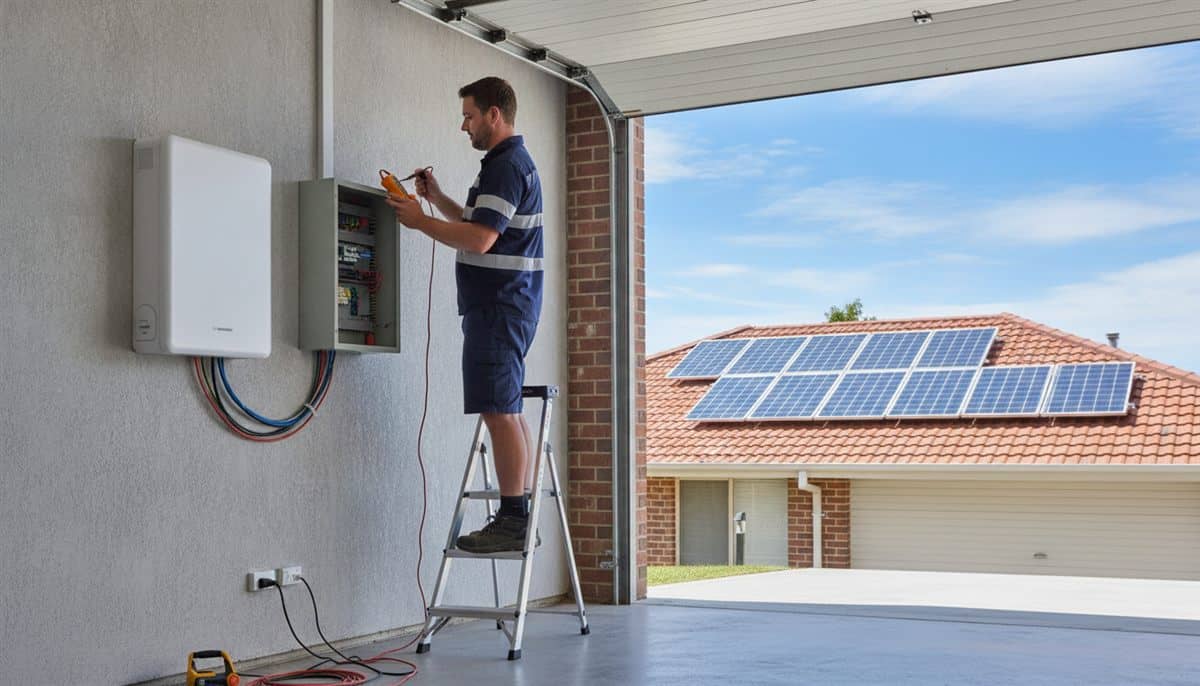
A home battery certified on 31 December earns more certificates than the same battery certified on 4 January: $600 more on a 13.5 kWh system. How the count works, what the drop from 6.8 to 5.7 costs on three common sizes, and what to put on a November or December quote.
Put a 13.5 kWh home battery in and have it certified on Thursday 31 December, and it earns 91 certificates under the federal battery rebate. Certify the same battery on Monday 4 January and it earns 76. At the $40 Clearing House price, that’s $600 less off the customer’s price. The date that decides it is the one on the electrical compliance certificate, not the day the customer signed your quote.
For every battery quote going out in November and December, that leaves three things to get right: which date the discount is priced on, what the quote says if that date slips, and how you explain it to the customer. The numbers come first.
The “battery rebate” is the Cheaper Home Batteries Program, an Australian Government discount on small-scale batteries installed with new or existing solar. The Department of Climate Change, Energy, the Environment and Water sets the policy and funds the discount. The Clean Energy Regulator (CER) runs it. It works through small-scale technology certificates (STCs) under the Small-scale Renewable Energy Scheme, set up by the Renewable Energy (Electricity) Act 2000. The battery rules are in the Renewable Energy (Electricity) Regulations 2001, as amended by the Renewable Energy Legislation Amendment (2026 Measures No. 1) Regulations 2026, which set the current figures from 1 May 2026.
It’s optional on both sides. Nobody has to offer the discount or take it. In practice the owner assigns the certificates to a registered agent, usually the retailer or installer, in exchange for an upfront discount on the price. To qualify, the CER’s battery page says the system must be 5 to 100 kWh nominal capacity, on the Clean Energy Council’s approved battery list and installed to AS/NZS 5139:2019. It must also be capable of joining a virtual power plant if grid-connected. The installer needs Solar Accreditation Australia accreditation with a battery endorsement. Only one battery system per premises qualifies.
The number of certificates depends on the battery’s usable capacity, not its nominal size, multiplied by the STC factor for the period it’s certified in. Bigger batteries earn less per kilowatt-hour above 14 kWh:
The bands are added together and the total is rounded down once to a whole certificate. The factor is 6.8 for batteries certified from 1 May to 31 December 2026. It drops to 5.7 from 1 January 2027 and to 5.2 from 1 July 2027, then keeps falling every six months until it reaches 2.1 in the second half of 2030.
Here is the same arithmetic for three usable capacities. The dollar figures use the price at the STC Clearing House, the CER-run facility where certificates can be sold. That price is fixed by law at $40, excluding GST. They show the gross certificate value, before any fee an agent takes.
| Usable capacity | Certified by 31 Dec 2026 (6.8) | Certified 1 Jan–30 Jun 2027 (5.7) | Drop at $40 | Certified 1 Jul–31 Dec 2027 (5.2) |
|---|---|---|---|---|
| 10 kWh | 68 STCs, $2,720 | 57 STCs, $2,280 | $440 | 52 STCs, $2,080 |
| 13.5 kWh | 91 STCs, $3,640 | 76 STCs, $3,040 | $600 | 70 STCs, $2,800 |
| 20 kWh | 119 STCs, $4,760 | 100 STCs, $4,000 | $760 | 91 STCs, $3,640 |
The 20 kWh line shows the taper at work: 14 kWh at 6.8 is 95.2, and the other 6 kWh at 60% of 6.8 is 24.48. The total is 119.68, rounded down to 119.
Open-market prices sit just under the cap at the moment. Broker data showed trades at $39.65 and $39.90 on 21 October, and the Clearing House has a surplus, so sellers there wait in a queue. What your customer actually sees depends on the price your agent pays and the fees it takes. The gap between December and January stays roughly the same either way.
The Regulations tie the factor to the date the battery is “certified for compliance”. The department’s eligibility guidance says a battery counts as installed from the date its certificate of electrical compliance, or your state’s equivalent, is issued. So a job you finish on 31 December but certify on 4 January is a January battery at 5.7.
That puts December’s diary under pressure. Stock, network approval and the Christmas shutdown all eat into it. New Year’s Day falls on a Friday and is a public holiday. Earlier this year, before the 1 May change, the CER also told retailers that installers can claim no more than two installations a day. If a December slot is tight, say so when you quote, rather than discovering it on 30 December.
Once the certificate is issued, the certificates can be created within the following 12 months. That window doesn’t move the factor: it’s fixed by the certificate date.
The department expects the upfront discount to be “clearly displayed against the price of the system”. For a quote that straddles 1 January, that means showing three things: the number of certificates, the discount in dollars, and the certification date the figure depends on. Then say what happens if the job is certified later.

Before the May change, the CER’s message to retailers was blunt. In March it said rebates “are determined by the installation date, not when a contract is signed”, and that retailers are responsible for “fulfilling the contracts they sign”. In April it warned that a retailer who agrees an installation before the change “but can’t deliver” may be liable to pay the difference. The CER hasn’t issued a release about 1 January 2027, but the same Regulations apply.
So the choice is yours to make before you send the quote. Either you commit to a December certification date and carry the risk, or the quote says plainly that the discount falls if certification moves into January. A price-change term has to be fair and clear to stand up, which is where our guide to unfair contract terms in trade quotes helps. Example wording, to adapt with your own figures:
Upfront discount: $3,640 (91 STCs at the 6.8 factor), based on installation and certification by 31 December 2026. If certification happens on or after 1 January 2027, the discount becomes $3,040 (76 STCs at 5.7) and the price rises by $600.
Say the same thing out loud when you hand the quote over. A customer who heard in November that the date matters has no reason to feel short-changed in January.
Some states add their own incentive. Western Australia’s scheme, for example, offered Synergy customers up to $1,300 and Horizon Power customers up to $3,800, according to a WA Government announcement in May 2026. State rules and whether they stack with the federal discount vary, so check your state’s current scheme before you put a figure on a quote.
For that battery, the whole decision comes down to one line on the quote and one conversation. Certified by 31 December, the battery rebate on it is $3,640. Certified in January, it’s $3,040, and the customer needs to have heard that before they sign. The same exercise comes round again for June jobs, when the factor drops to 5.2 on 1 July.
Battery work shares December with other dated jobs. Queensland electricians also face the 1 January 2027 smoke alarm deadline. Your crew’s leave needs settling too, which our article on Christmas shutdown notice under the awards covers. And for the labour side of the quote, see what goes into electrician rates.
A QUOTE WITH A DATE IN IT
Get the battery quote to the customer while December is still on offer.
A discount that depends on the certification date rewards the quote that goes out quickly and gets revised the moment the install date moves. With SendWork you build and send the quote from your phone after the site visit, and update it the same day if the schedule changes.