Go to SendWork
— Free for 14 Days
Full access
Full access

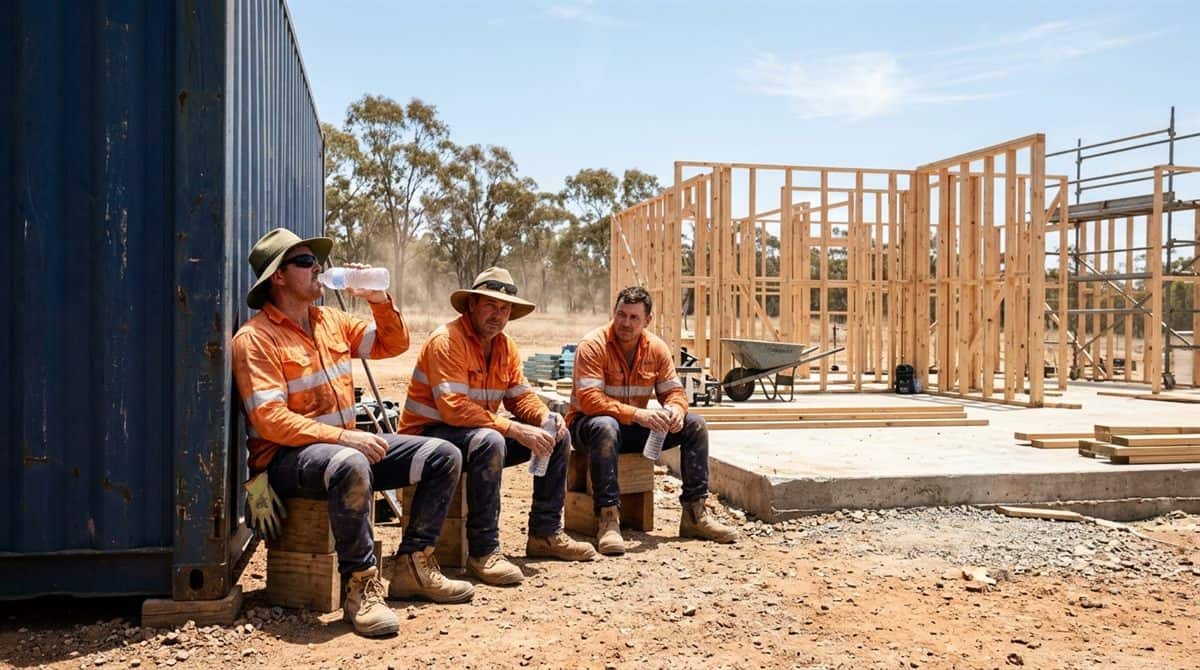
The storm rolls over the slab at 1.30 pm, the crew downs tools, and every hour they lose comes out of the 32 hours of inclement weather pay the building and plumbing awards allow in every four weeks. The electrical award pays for as long as the weather lasts instead, and under all three awards the times you note when work stops and starts again decide what you owe.
So the call you make at 10 am in a downpour, or at 1 pm on a 41-degree afternoon, is a pay decision as well as a safety one. You can stop the work, move the crew to somewhere the weather isn’t stopping it, or keep going on the narrow jobs the awards allow in bad weather, and the award your people are on changes what each of those choices costs. All three are modern awards, the legal instruments the Fair Work Commission makes under the Fair Work Act 2009 to set the minimum pay and conditions for the employers and employees they cover. If your crew is on one of them, paying less than its weather clause gives them is an underpayment the Fair Work Ombudsman can recover. Building crews on site come under clause 24 of the Building and Construction General On-site Award 2020, plumbers under clause 21.11 of the Plumbing and Fire Sprinklers Award 2020, and electricians under clause 15 of the Electrical, Electronic and Communications Contracting Award 2020. If your business has an enterprise agreement, its weather clause applies instead, so read that first.
The building and plumbing awards use the same definition: rain or abnormal climatic conditions, whether hail, extreme cold, high wind, severe dust storm or extreme high temperature, where it isn’t reasonable or it’s unsafe for the crew to keep working. The electrical award says “abnormal and extreme climatic conditions” and doesn’t list them. None of the three puts a number on extreme heat, so the question on a hot afternoon is the same one you’d ask in the rain: is it still reasonable and safe to keep working where they are? Whether the heat itself is safe to work in is a separate duty under your state’s work health and safety laws, and Safe Work Australia’s guide for managing the risks of working in heat sets out what an employer is expected to do about it. The awards decide what the stopped hours cost you.
One coverage point comes first for builders. Clause 24 of the building award applies only to general building and construction and to civil construction, which leaves metal and engineering construction out. House building sits inside it, because the award describes its residential building industry as the general building activities done on a single or dual occupancy home that isn’t multistorey (clause 22.2). Plumbers and electricians working for their own contractors on that same house site are on their own awards, so one storm can stop three trades under three different sets of rules.
| What the clause decides | Building award, clause 24 | Plumbing award, clause 21.11 | Electrical award, clause 15 |
|---|---|---|---|
| Pay for ordinary hours lost to the weather | Paid at the ordinary hourly rate, up to 32 hours in any four-week period | Paid for up to 32 hours in every four-week period, with the payment made weekly | Paid for the ordinary time lost for as long as the conditions last, with no limit in the clause |
| When the four-week periods start | Every four weeks from Monday 4 January 2010, which puts the current ones at 16 November to 13 December 2026 and 14 December 2026 to 10 January 2027, unless you were using another calendar before 15 July 2013 | From the first Monday on or after 1 January each year, which in 2027 is Monday 4 January, and unused hours don’t carry over | There’s no bank, so there are no periods |
| Someone who starts partway through a period | 32 hours if they start in the first week, 24 in the second, 16 in the third and 8 in the fourth | 8 hours for each week or part of a week they’re employed in that period | Paid like everyone else |
| Part-timers | Their 32 hours are scaled down: 32 times their agreed hours in the period, divided by 152 | The clause doesn’t scale it | The clause doesn’t scale it |
| Casuals | Not left out of the clause, and the minimum of 4 hours’ pay for each engagement still applies | Not left out of the clause, and the minimum of 3 hours’ pay still applies | Not left out of the clause, and the minimum of 2 hours’ pay still applies |
| Weather during overtime | Doesn’t count, and stoppages outside ordinary hours aren’t paid | The clause pays ordinary time lost, not overtime | The clause pays ordinary time lost, not overtime |
| Meeting to decide whether the weather counts | Within a reasonable time, never more than 60 minutes, after the crew asks | The same, and an employee who leaves before it’s held loses the pay | The same, and pay depends on the clause being followed |
| Recording when work stops and restarts | The employer records both times | Your representative on site and the crew’s representative agree both times and note them | Not spelt out in the clause |
| Work that can go on in bad weather | Emergency work, and finishing a concrete pour already started, with the pour paid at 200% of the ordinary rate, rounded up to the next hour | Only what’s essential to deal with an emergency, restore a service or make the site safe, paid at 200% | The clause sets no special rate |
| Moving the crew | To another area of the same site where it’s reasonable and safe to work, or to another site with transport where needed, if there’s work in their classification | To another part of the site or another site, with fares reimbursed unless you provide transport | To another part of the site or another site, with transport where necessary |
Casuals are where the awards leave a real question open. None of the three clauses takes them out, but none says whether the 25% casual loading goes on top of rained-off time, so settle that with the Fair Work Ombudsman before you set it up in payroll.
When the crew or their representative asks, you or whoever runs the site for you have to meet them within 60 minutes to decide whether the weather counts. Under the plumbing award, an employee who heads home before that meeting happens isn’t entitled to the pay, so the meeting matters to them as much as it does to you. Once it’s agreed, the stop time goes down, and when the weather has clearly passed and work starts again, that time goes down too. Those two times are what the payroll is worked out from, so keep them with the job, not on a scrap of paper in the ute.
Moving people is the first thing to try, because a plumber fitting off inside a house with its roof on isn’t losing any time. The building award goes further and says that anyone working on a part of the site the weather isn’t affecting keeps working, even if the rest of the crew has stopped. The plumbing award adds a rule for the aftermath: if the weather leaves a plumber’s own task unsafe, you can move them to other work in their trade on the site until it’s fixed, and if there’s none, they stay on site and are paid for that time without it coming out of their 32 hours.
Rain also limits how long you can keep a crew waiting in the sheds. Under both the building and plumbing awards you can’t require them to stay on site once the rain has stopped work for more than four hours of ordinary time in a day, for more than half the afternoon after the lunch break, or for more than an hour in the last two hours of the day. If they agree to stay longer, the extra wet time is paid and doesn’t come off their hours. If the forecast tells you the night before that tomorrow is a washout, the building award’s right to disconnect clause makes clear you can still contact your crew after hours to tell them about an emergency roster change under its inclement weather clause, which our piece on calling your crew after hours under the right to disconnect explains.
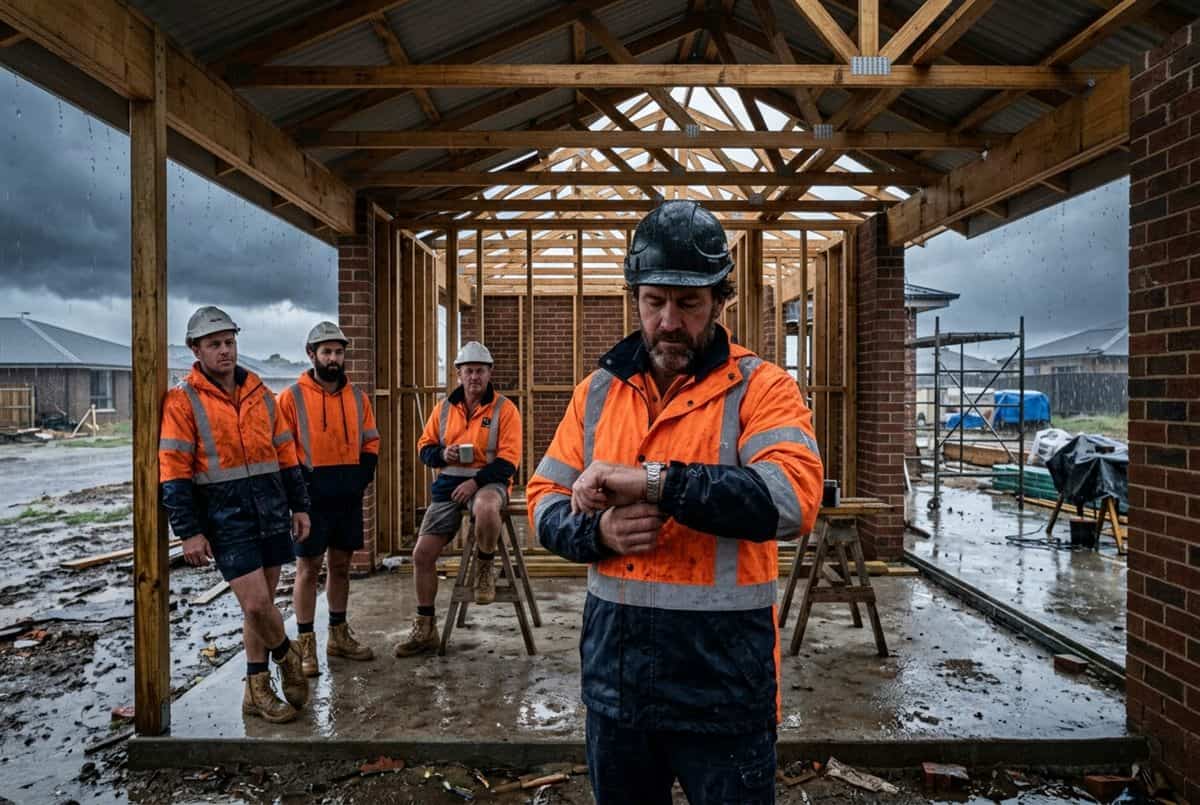
Say you run a plumbing business at North Lakes, north of Brisbane, with four on the tools across a run of new houses: two plumbers on the roofs, and a leading hand and an apprentice putting in the stormwater. They work eight ordinary hours a day, 7 am to 3.30 pm with half an hour for lunch, and take a rostered day off every four weeks. Your current plumbing period runs from Monday 7 December 2026 to Sunday 3 January 2027, so everyone starts it with 32 hours.
On Monday 7 December a storm comes through at 9.30 am. The leading hand asks to meet, you agree by 10 am that nobody can work in it, and the stop is noted at 9.30. It clears and work restarts at 11, so each of the four loses an hour and a half and has 30.5 hours left. On Wednesday it’s raining at starting time and the roofs and trenches are both under water. Just after 11 am the rain has stopped work for more than four hours of ordinary time, so you can’t keep them there any longer, and you send them home. That’s a full eight-hour day lost for all four, and each of them has 22.5 hours left.
Thursday is the heat. By 12.30 pm the roof sheets are too hot to work on, so you move the two roof plumbers into a house that’s already roofed to fit off the bathrooms, and they lose nothing. The leading hand and the apprentice are in an open trench in full sun with no shaded work to move to, so at 1 pm you agree it isn’t safe for them to carry on, note the time and send them home. They lose two and a half hours and have 20 left.
On Monday 14 December a storm hits at 1.30 pm. One of the roof plumbers spends half an hour strapping down a stack of roof sheets that would otherwise go through a neighbour’s window, which is work to make the site safe, so that half hour is paid at 200%. He had a dry shirt in the ute; without one, the award would have let him stop for the day once the job was done without losing pay. Just after 2.30 pm the rain has stopped work for more than an hour in the last two hours of the day, so everyone goes home. The plumber who secured the sheets loses an hour and a half, and everyone else loses two hours.
A new plumber you hired starts on Wednesday 16 December, in the second week of the period. He’s employed for part of week two and all of weeks three and four, so he’s credited with 24 hours. On Thursday 17 December it rains all morning and the crew goes home just after 11 am again, so all five lose a full eight hours.
At the end of the fortnight, the roof plumber who secured the sheets has 13 hours left, the other roof plumber has 12.5, the leading hand and the apprentice have 10 each, and the new starter has 16. The hours lost in each week are paid at their ordinary rate on that week’s pay. If storms take more than those balances before Sunday 3 January, the extra time lost isn’t paid under the clause. Whatever is left when the period ends is gone too, because plumbing hours don’t carry over, and everyone, the new starter included, starts the period beginning Monday 4 January 2027 with a fresh 32. If you close over Christmas, the shutdown takes part of that last stretch anyway, and the notice for directing leave over the break under the same three awards is covered in our article on the two months’ notice for a Christmas shutdown.
Run the same fortnight past an electrical contractor and every one of those lost ordinary hours is paid, with no bank to run down. Run it past a builder and the Monday 14 December storm falls in a new four-week period, so it comes out of a fresh 32 hours rather than the balance left from the week before.
When the weather turns, check first whether there’s safe work in the same trade somewhere else on the site, or on another site you can get the crew to, because a crew that’s been moved isn’t losing hours. If there’s nothing to move them to, meet within the hour when they ask, agree that the weather counts, and note the time work stopped. Keep anyone working only on what the award allows in the weather, which is emergency work and, under the building award, finishing a concrete pour already under way, and pay the 200% the plumbing award sets for that work and the building award sets for the pour. Then note the time work restarts, take the lost ordinary hours off each person’s bank under the building or plumbing award, or pay them in full under the electrical award, and put them through that week’s pay at the ordinary rate.
When the weather stops a site
The time work stopped and the time it started again are what your crew’s weather pay is worked out from.
SendWork keeps your jobs, schedules and crew assignments in one place, so when a storm shuts one site you can move the crew to another job, reschedule the rest of the day’s work and add a note to the job with the times they stopped and started again.
See how Australian tradies schedule their crews in one place →