Go to SendWork
— Free for 7 Days
Full access
Full access

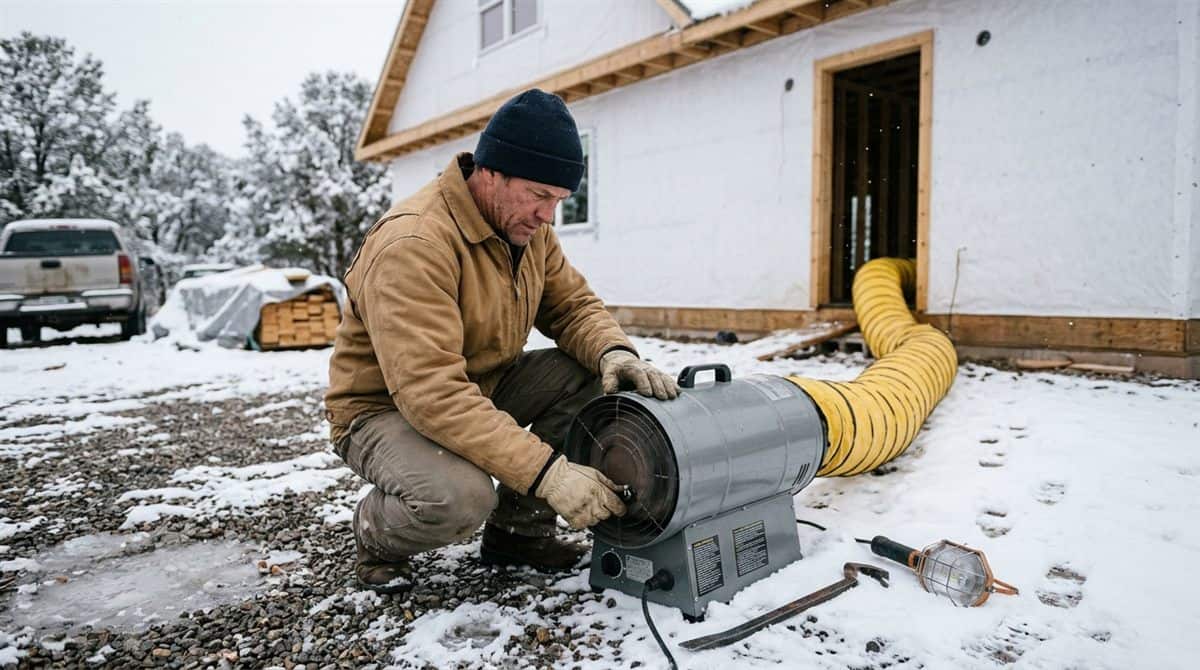
You light a propane heater in a closed-in house to dry the mud, and its exhaust stays with your crew. In the US, OSHA allows temporary heaters indoors on its conditions, and a six-step morning routine meets them.
The conditions are short. OSHA lets you run temporary heaters inside a house or building on a construction job as long as the crew gets fresh air, nothing that burns sits too close, propane cylinders stay outside wherever that’s practical, and none are stored inside overnight. The routine is the same whether you’re drying drywall mud, curing paint or keeping a framing crew working through January.
OSHA is the federal agency that sets and enforces workplace safety standards under the Occupational Safety and Health Act of 1970. Its construction standards are in 29 CFR Part 1926, Subpart F, “Fire Protection and Prevention”, and they bind any employer with employees on the site. Section 1926.154 covers temporary heating devices, and section 1926.153 covers liquefied petroleum gas, which on a jobsite mostly means propane. In a state with its own OSHA-approved State Plan, a state agency enforces rules that must be at least as protective.
If someone has bypassed a heater’s flame-failure shutoff, or it doesn’t work, take it out of service. For equipment that doesn’t comply, the rule is to tag it as unsafe, lock out its controls or take it off the site (1926.20(b)(3)).
Put one named person in charge of the temporary heaters. OSHA requires “frequent and regular inspections of the job sites, materials, and equipment” by competent people you designate (1926.20(b)(2)). You also have to train each employee who handles fuel or gas on the hazards and on the Subpart F rules (1926.21(b)(5)). If the morning check belongs to whoever arrives first, it tends to belong to no one.
Table F-4 in 1926.154 sets the minimum gap between the heater and combustible material such as framing, stacked lumber, cardboard or drop cloths. A heater listed for smaller clearances may use them, so read the rating plate. The table has no figure for the front, where the heat comes out, so take that from the manufacturer’s manual.
| Heater type | Sides | Rear | Chimney connector |
|---|---|---|---|
| Room heater, circulating type | 12 in | 12 in | 18 in |
| Room heater, radiant type | 36 in | 36 in | 18 in |
Set the heater level unless its markings say otherwise. If the manufacturer doesn’t rate a heater for wood floors, it can’t sit straight on the subfloor. It needs insulating material or at least an inch of concrete under it, reaching 2 feet beyond the heater on every side. Keep it at least 10 feet from tarps or canvas, and tie those coverings down so wind can’t drag them into the heater or knock it over (1926.154(b)–(c)).
Propane containers may come inside a building only when keeping them outside “is impracticable” (1926.153(h)(1)). So the first choice is a cylinder outside, with the hose run through a wall opening. When a cylinder does have to come in, these conditions apply:
The first line of the heating standard is about air, not heat: “Fresh air shall be supplied in sufficient quantities to maintain the health and safety of workmen.” Where open windows and doors aren’t enough, you have to add mechanical ventilation. In a confined space you take “special care” to keep enough air for combustion and for the crew (1926.154(a)). A direct-fired propane or kerosene heater puts all of its exhaust into the room you’re heating. In a closed-in house, that usually means a cracked window on the far side of the room or a fan pulling air through.
OSHA’s own carbon monoxide QuickCard tells workers to never use space heaters “in enclosed spaces or indoors”. That is cautionary advice to workers. The binding standard allows indoor temporary heat with enough ventilation, and this step is how you provide it.
The carbon monoxide from direct-fired temporary heaters has no smell or color, and OSHA’s fact sheet warns that large amounts “can overcome you in minutes without warning”. The legal limit for construction is 50 parts per million as an 8-hour average. Table 1 of 29 CFR 1926.55, the standard on airborne contaminants, sets that figure. The same standard requires ventilation and other controls before anyone relies on protective equipment.
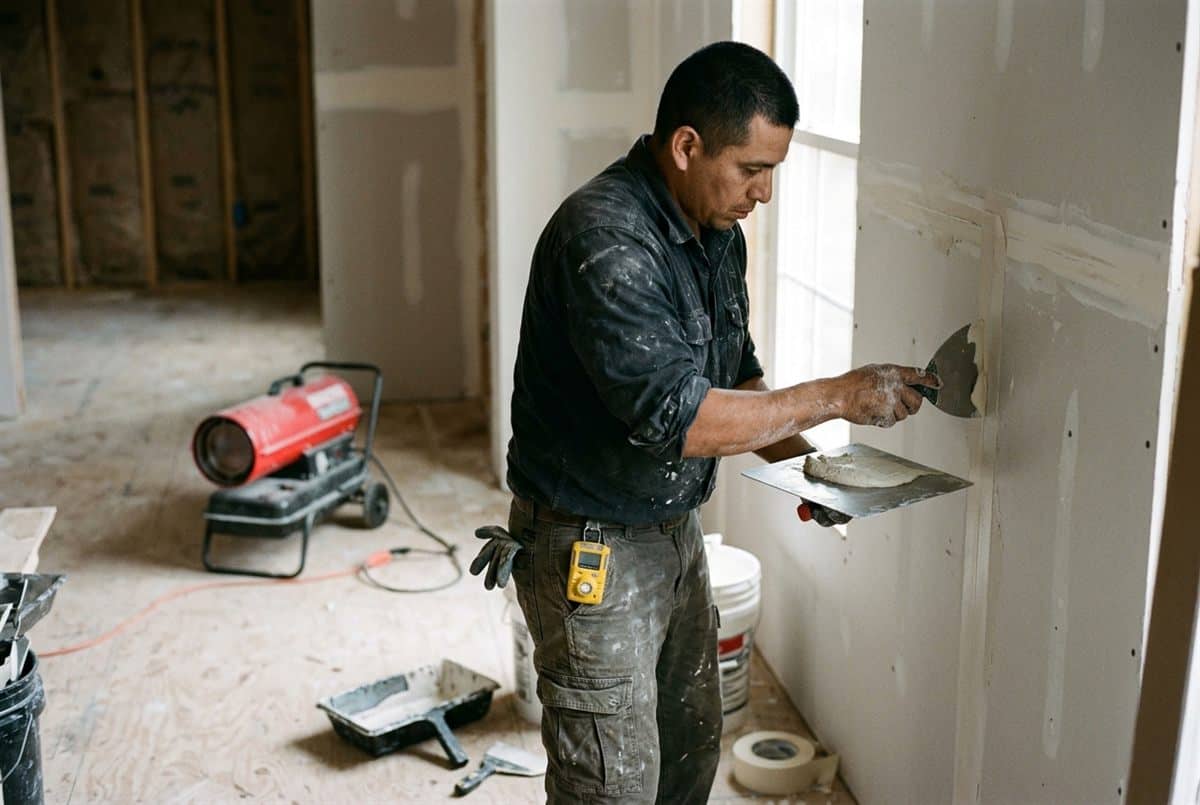
The standard doesn’t say how often to test, and OSHA’s guidance fills that gap. Its carbon monoxide fact sheet tells employers to test the air regularly and to provide personal CO monitors with audible alarms where exposure is possible. A 1988 OSHA interpretation describes the voluntary industry standard for jobsite heaters, ANSI A10.10, as it stood then. It called for a CO test within an hour of the start of each shift and at least every four hours after. Above 50 ppm at breathing height, you shut the heater off unless more ventilation brings the level down. OSHA said it could use those provisions to cite an employer under the general duty clause.
You can set a monitor’s alarm lower than the legal limit. The National Institute for Occupational Safety and Health, a federal research agency, recommends 35 ppm over a shift and never above 200 ppm. That figure is advice, not law. Headache, dizziness, drowsiness or nausea on a heated job is a warning sign. Get the person into fresh air straight away, and call 911 if symptoms are serious.
Once more than 5 gallons of liquid fuel or 5 pounds of propane are in use, you need a fire extinguisher rated at least 10B within 50 feet (1926.150(c)(1)(vi)). A single connected 20-pound cylinder holds more than that. Keep extinguishers where they won’t freeze.
Painters and floor finishers need one more check, because direct-fired temporary heaters are open flames. Crews can use the most volatile flammable liquids only where there’s no open flame or other ignition source within 50 feet (1926.152(f)(3)). Whether a lacquer, stain or solvent falls in that group depends on its flashpoint, which you’ll find on the safety data sheet. Our piece on the 2024 hazard communication changes covers what those sheets now have to show. If the flashpoint puts it in range, switch to indirect or electric heat on finishing days.
The LP-gas standard settles this in six words: “Storage of LPG within buildings is prohibited” (1926.153(j)). A cylinder counts as “in use” only while it’s hooked up, so anything you unhook at the end of the day goes outside. Up to 500 pounds of stored propane can sit right next to the building (Table F-3). Store it in a ventilated enclosure or somewhere otherwise protected against tampering, with an extinguisher rated at least 20-B:C at the storage spot.
Kerosene and diesel usually count as flammable liquids under Subpart F, depending on the flashpoint on their safety data sheets. Use approved safety cans for 5 gallons or less, keep the cans closed, and keep no more than 25 gallons in a room outside an approved storage cabinet. Never put fuel in an exit, a stairway or anywhere people normally walk through (1926.152(a)–(b)). Shut the cylinder valve, let the heater cool, and refuel outside the next morning before you bring it back in.
On a remodel where the family is still living in the house, OSHA’s rules protect your crew, not the homeowner. The family’s safety is still your problem in every practical sense. Tell them which rooms you’re heating, and keep doors to the living area closed.
General liability insurance exists to answer a claim like a heater fire that damages their property. If a heater injures one of your own people, workers’ comp is the cover that applies. A citation costs up to $16,550 for each serious violation in 2026, and up to $165,514 for a willful or repeated one. Our overview of the OSHA rules that draw the most citations covers the wider picture.
BEFORE THE FIRST CO READING
The heater check happens when it has someone’s name on it.
SendWork assigns each day’s jobs to a named person on the crew, with the site notes attached, so whoever opens up knows the heater check is theirs.