Go to SendWork
— Free for 14 Days
Full access
Full access

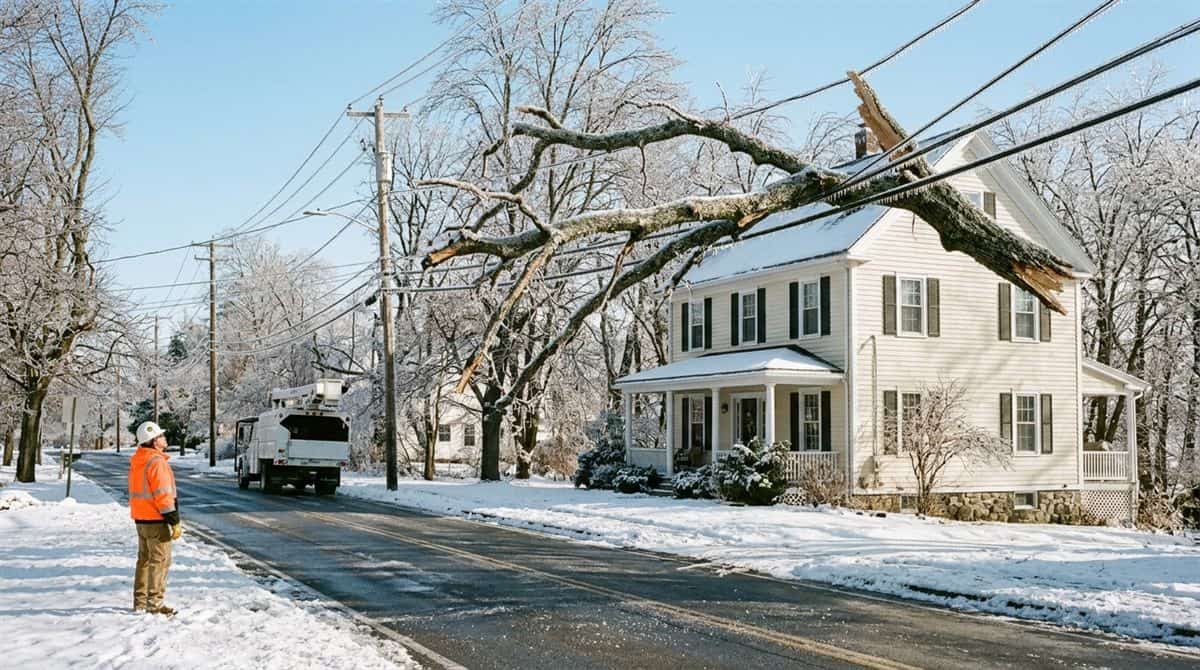
An ice-heavy limb lies on the wire to your customer's house, and a second hangs in the line between the poles. Unless someone on the job has OSHA's electrical training, your crew and every tool stay 10 feet from both until the utility shuts them off, so tree work near power lines starts with a phone call.
The homeowner wants both limbs gone today, and you can still do real work this morning. Any tree work that stays more than 10 feet from both power lines is ordinary storm cleanup. Measure that to the end of the longest saw, pole or rope your crew might touch. The limb on the house wire waits until the utility disconnects that wire. The one in the main line waits until the utility has dealt with that line. So clear the yard, make the call and put the split in writing before anyone climbs.
The answer turns on who is paying you. 29 CFR 1910.269 is OSHA’s standard for electric power generation, transmission and distribution. It binds utility crews and the line-clearance tree trimmers who work for them. Tree work falls under it only when the trimming clears space around the power lines on behalf of the organization that operates or controls them. The note to its definition of line-clearance tree trimming is blunt. Trimming done for “a homeowner or commercial entity” other than such an organization “is outside the scope of this section.”
A call from a homeowner therefore puts you under a different part of the rulebook. OSHA’s electrical safety-related work practices, 29 CFR 1910.331 through 1910.335, cover anyone working on or near electrical installations. Section 1910.331(b)(1) applies them to untrained workers near utility lines, not only to the wiring on a property. They are legal requirements for every employer OSHA covers. For a crew without electrical training, they come down to one number: 10 feet.
You won’t find a rule written for tree care itself. The Department of Labor’s regulatory agenda appeared in the Federal Register on August 14, 2026. It says there is no OSHA standard for tree care operations, only “a patchwork of standards.” It projected a proposed Tree Care Standard (RIN 1218-AD04) for October 2026. No proposal had appeared when we checked on November 9. The industry’s own rulebook is ANSI Z133-2026, Safety and Health Requirements for Arboricultural Operations. The International Society of Arboriculture released it on May 27, 2026, after ANSI approval. It is a voluntary consensus standard, not a regulation, and the digital copy is free for individual use.
Section 1910.333(c)(3) starts with a choice. Before work begins, the overhead lines are either de-energized and grounded, or guarded, isolated or insulated. You arrange a shut-off with whoever “operates or controls” the circuit, which on a residential street means the utility. Until then, your crew works by distance, and the distance applies three ways.
A climber at work in the tree has to stay where neither they nor “the longest conductive object he or she may contact” can come within 10 feet of energized power lines. That figure covers lines up to 50 kV to ground. Above 50 kV, add 4 inches for every 10 kV. Measure from the tip of the pole saw or the end of the rope, not from the climber’s hands.
A worker on the ground may not bring any conductive object closer than those same distances. OSHA’s note to the rule settles the tool question. Anything without “an insulating rating for the voltage involved” counts as conductive. An aluminum ladder, a pole pruner without a rating and an ordinary lowering rope all count.
Bucket trucks, cranes and grapple trucks keep 10 feet too, plus the same 4 inches per 10 kV above 50 kV. A truck in transit with its boom lowered may come within 4 feet. Rated insulating barriers that are not attached to the truck allow less. An insulated aerial lift run by a qualified person may work at the closer distances in OSHA’s Table S-5. Your ground crew may not touch the truck unless they wear gear rated for the voltage. The one other way is to park it where no uninsulated part can reach inside the clearance.
For a crew without electrical training, it doesn’t. OSHA’s electrical definitions describe the service drop as the overhead conductors “from the last pole or other aerial support” to the building. It is an overhead line like any other, and 1910.333 makes no exception for it. The limb on the house wire is as far out of bounds as the one in the main line.
Electrical training changes the numbers. Under 29 CFR 1910.332(b)(3), a qualified person knows how to tell live parts from the rest. They can also determine the voltage and know the clearance distances for it. The training can happen in a classroom or on the job. For a qualified person, Table S-5 sets distances by voltage. For lines of 300 volts and less, it says only “Avoid contact.” OSHA’s definition adds that a worker can be qualified for some equipment and not for the rest. Unless the person on the saw has that training for this kind of line, your crew is unqualified and the 10 feet stands.
Utilities treat the two wires differently, and each sets its own policy. SWEPCO, for example, trims only lines “that run from power pole to power pole.” It leaves trees threatening the service drop to the property owner. Call at least two business days ahead and it will send a crew to disconnect that wire. Avista offers a no-cost service drop on three business days’ notice. Both describe planned disconnects, not storm response. After a storm, SWEPCO asks customers to report branches on power lines right away.
Twenty-two OSHA-approved State Plans, Puerto Rico’s among them, cover private employers. Each must be “at least as effective as OSHA,” and some write their own tree rules. California is the clearest case for this job. Cal/OSHA, the state’s Division of Occupational Safety and Health, enforces tree work safety orders under Title 8 of the California Code of Regulations. Section 3423 bars tree trimming within 10 feet of high-voltage lines unless the worker meets its further requirements. A trained “qualified tree worker” may work within 10 feet of energized lines of 600 volts or less, but no closer than 1 foot. In Washington, Michigan, Oregon, the Carolinas or another State Plan state, check the state’s tree work rules first.
Make the call before anyone climbs. Report the limb in the main line as a hazard and ask the utility to disconnect the house wire. Note the time, the name of the person you spoke to and any reference number. OSHA’s storm guidance for tree trimming tells crews to “assume that electrical lines are energized until proven otherwise.” It also warns that lines “may become re-energized without warning” while utilities restore power after a disaster. A dark house is not a dead line. Treat both wires as live until the utility confirms otherwise, and keep everyone away from any wire that is down.
Utility crews doing tree work around power lines have a weather rule of their own. Under 1910.269(r)(1)(vi), line-clearance tree trimming may not go ahead when adverse weather makes it hazardous. The note names “snow storms, and ice storms” among the conditions presumed too dangerous. Anyone trimming in a storm’s aftermath needs training in its special hazards. The limb in the main line may sit there until the weather breaks and a restoration crew reaches the street. That is the wait you are about to explain to the customer.
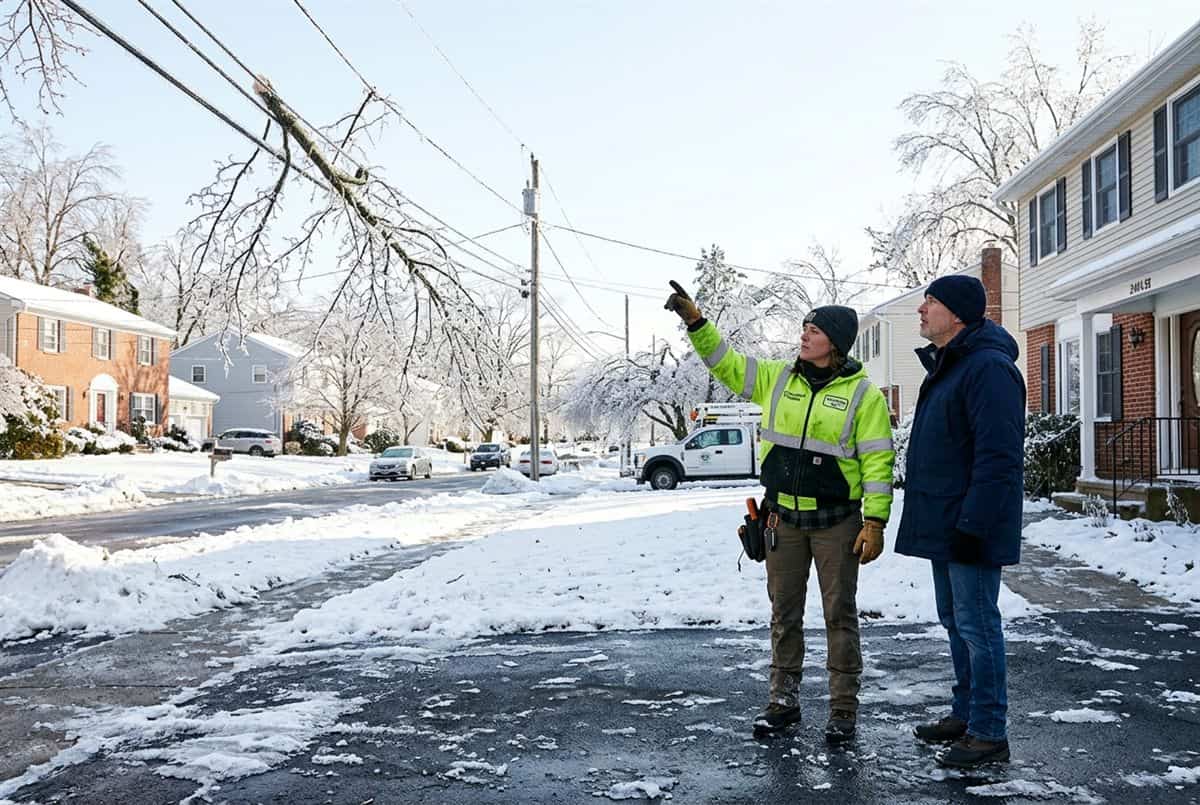
Now the conversation turns to the customer, who wants a straight answer, not a citation. Tell them what you will do today, what has to wait and who they are waiting for. Wording like this works on the phone and again on the estimate:
“We can clear the yard and the driveway today. The two limbs on the wires stay where they are until the power company has dealt with them. Safety rules keep our crew 10 feet from a live line. We’ve reported both limbs, and we’ll come back for the one on your house wire once the utility disconnects it.”
Write the estimate the same way. Split it into the work you can do now and a second visit for the limbs on the wires. Price that visit separately and mark it as depending on the utility. Add the utility’s reference number and the date you reported it to the job, with photos of both limbs from the ground. If the utility clears the main line itself, that item comes off the estimate before the invoice goes out.
Price the return visit as real work. Our guide to landscaping rates builds a crew-hour cost you can use for it. In most storm-prone states, a declared emergency also brings both visits under a price gouging law. Our storm repair pricing guide sets those laws out for seven storm states. And if a limb your crew drops takes the house wire down, that is damage to someone else’s property. Our general liability guide explains what that policy pays and what it leaves to you. For inspections, penalties and the rest of what OSHA expects of an employer, see our OSHA compliance guide for contractors.
Run every storm call for tree work near power lines through the same test. Say the customer is a homeowner and nobody on the crew has the training of a qualified person. Then nothing you hold, climb or drive goes within 10 feet of a live line. Inside that distance, the utility goes first. It disconnects the house wire and deals with the main line, and then your crew comes back to finish the job you quoted.
TWO VISITS, ONE QUOTE
A storm call near the wires is two jobs, and the quote should say so.
With SendWork, you can quote today’s ground work and the after-the-utility visit as separate line items. The utility’s reference number and your photos stay on the job, and the crew goes back on the schedule once the wire is clear.